
- HOME
- OPINION
- ON GROUND
- INTERVIEW
- Neta Profile
- Editor's Pick
- INDIA
- NewsGram USA
- WORLD
- न्यूजग्राम
- POLITICS
- ENTERTAINMENT
- CULTURE
- LIFESTYLE
- ECONOMY
- SPORTS
- Jobs / Internships
- Misc.
- NewsGram Exclusive
This story by Justine Muboka originally appeared on Global Voices on February 3, 2026.
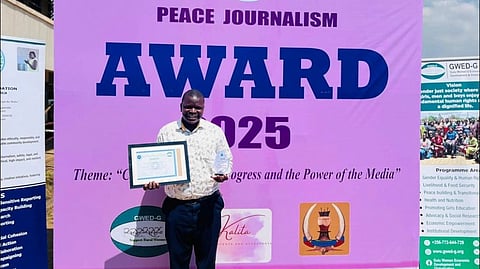
On December 19, 2025, the air in Gulu City, Uganda, carried more than the warmth of the dry season; It carried the weight of history. At the premises of Gulu Women’s Economic Development and Globalization (GWED-G), the Peace Journalism Foundation (PJF) Uganda–East Africa launched the first edition of the Peace Journalism Awards. This initiative is designed to recognize journalism that contributes to peace, social cohesion, and development.
Held under the theme “Celebrating Peace, Progress, and the Power of the Media,” the awards marked a shift in how journalistic excellence is honored. Rather than relying on self-submitted applications, the PJF introduced a bottom-up, community-led nomination model. This approach is grounded in the belief that the grassroots communities — those most affected by journalism — are best placed to assess its value and impact.
In traditional journalism awards, recognition is often driven by applications and the submission of selected stories. By contrast, the Peace Journalism Awards rely on community validators and partner organizations, including GWED-G, to identify journalists whose work has made a demonstrable difference in post-conflict contexts such as Northern Uganda. The model is expected to expand to other regions, including Karamoja, Bunyoro, and the Rwenzori sub-region.
This approach elevates what might otherwise remain invisible. It recognizes reporters in remote villages who use conflict-sensitive language to defuse tensions over land disputes. It also highlights broadcasters who create space for dialogue where violence might otherwise erupt. Under this model, excellence is measured not by prominence but by verifiable community impact — reduced tensions, informed dialogue, and steps toward reconciliation.
One of the most resonant moments of the ceremony was the Peace Radio Award presentation to Mega FM 102.2. The award’s significance is rooted in history. During the height of the Lord’s Resistance Army (LRA) conflict in Northern Uganda, radio played a critical role as a communication bridge. Radio Freedom, established with the involvement of the Uganda People’s Defence Force (UPDF), provided information to displaced communities. It aired messages urging combatants to take advantage of the presidential amnesty. According to publicly acknowledged accounts, these broadcasts contributed to the voluntary return of thousands of former combatants.
Radio Freedom later evolved into Mega FM. Today, under the management of Irene Atek, Mega FM is widely regarded as a platform for dialogue, information sharing, and community engagement in Northern Uganda — illustrating how media can contribute to stabilization and recovery when used responsibly.
Closely linked to this history is the Excellence in Peace Reporting Award, established in honor of Gloria Laker Adiiki Aciro, a 2025 Luxembourg Peace Prize laureate. Laker’s career spans frontline reporting during the LRA conflict to regional mentorship and training, reflecting a transition from conflict coverage to peace-oriented journalism.
The inaugural recipient of this award was Rosemary Anena of Vision Group (Radio Rupiny), who came from the same station where Laker began her career. Her achievement symbolized an intergenerational and “woman-to-woman” transfer of responsibility. In a region where women’s voices were once marginalized, Anena’s work highlights constructive reporting, community resilience, and inclusive narratives.
The awards also recognized the evolving role of talk show hosts in fragile contexts. Otim Steven Acire, popularly known as “Palaring” of Radio Pacis, was named Talk Show Host of the Year for Northern Uganda. His nomination, submitted by GWED-G, highlighted the importance of mediation skills in live broadcasting.
While conventional journalism emphasizes detachment, the Peace Journalism Foundation underscored that, in high-stakes talk shows, responsible moderation can help prevent escalation. Palaring is recognized for managing tense discussions and ensuring respectful engagement among guests with opposing views. Reflecting on a recent broadcast involving multiple political candidates, he noted that deliberate use of mediation techniques helped maintain calm and constructive dialogue throughout the program.
Following the January 2026 elections, such conflict-sensitive approaches are increasingly relevant. The PJF’s framework seeks to move the media beyond sensationalism toward peace- and development-oriented reporting, emphasizing early identification of conflict triggers and promoting nonviolent responses.
Another defining moment of the evening was the recognition of the Youth Peace Activist of the Year. Historically, young people in periods of political tension have often been portrayed as vulnerable to manipulation. The PJF’s decision to center youth in peacebuilding reframed this narrative.
Uganda has one of the world’s youngest populations, with over 75 percent of the country being under 35 years old. When Senior Mercy Florence received the award, she emphasized the significance of being recognized in a country where young people constitute the majority of the population. Her acknowledgment sent a message that young people can be agents of social cohesion and constructive engagement. By spotlighting such initiatives, the PJF aims to encourage peaceful participation during the 2026 election cycle and beyond.
Several speakers used the occasion to reflect on the broader role of media in society. Pamela Angwech, executive director of GWED-G, emphasized that media should be treated as an essential public good rather than a luxury. She noted:
Angwech also highlighted the importance of fair labor practices within media houses and the need to appreciate journalists whose work supports the industry. She stressed that protecting journalists and upholding freedom of expression — within the bounds of the law — is fundamental to an informed society.
Gloria Laker Adiiki Aciro, speaking in her capacity as Director of the Peace Journalism Foundation, urged journalists to prioritize development-focused reporting and to learn from regional history.
“It is us who can create a society, so let us promote peaceful development,” she said, referencing the importance of avoiding post-election violence experienced elsewhere in the region.
Speaking on behalf of the security sector, Captain David Kamya, the Fourth Division Uganda People’s Defence Force (UPDF) public information officer, reflected on the human cost of conflict and called for reporting that emphasizes unity and shared responsibility.
“Let us report unity over division, humanity over hatred,” he said, noting that irresponsible reporting can have consequences for entire communities.
Local government also weighed in. Peter Banya, the Gulu City resident city commissioner for Laroo–Pece Division, encouraged journalists to highlight positive developments in the region to balance narratives and support recovery.
Building on the success of the first edition, the PJF announced plans to expand the awards in 2026 to include Digital and Individual Peacebuilders, such as bloggers and online content creators. As information increasingly circulates across digital platforms, these categories aim to recognize efforts that counter misinformation and promote responsible online discourse.
The 2025 Peace Journalism Awards positioned ethical, impact-driven journalism as a cornerstone of sustainable peace. As Gloria Laker noted, supporting peace journalism is an investment in the infrastructure of peace — one that benefits communities, democratic processes, and regional stability. The 2025 laureates included Benson Ongom (Journalist of the Year), Dennis Ojwee (Lifetime Achievement Award), and Otim Steven Acire (Talk Show Host of the Year). They represent a media landscape that prioritizes responsibility over sensationalism. Their recognition affirms a growing consensus: When journalism chooses peace, society as a whole is strengthened.
(SY)
Suggested Reading:
Subscribe to our channels on YouTube and WhatsApp
Download our app on Play Store

