
- HOME
- OPINION
- ON GROUND
- INTERVIEW
- Neta Profile
- Editor's Pick
- INDIA
- NewsGram USA
- WORLD
- न्यूजग्राम
- POLITICS
- ENTERTAINMENT
- CULTURE
- LIFESTYLE
- ECONOMY
- SPORTS
- Jobs / Internships
- Misc.
- NewsGram Exclusive
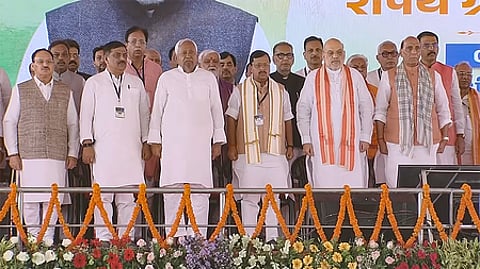
Patna, May 7 (IANS) The cabinet of Samrat Chaudhary was expanded on Thursday in a major political event held at Gandhi Maidan, where 32 leaders from the ruling NDA alliance took the oath of office as ministers.
The grand swearing-in ceremony was attended by Prime Minister Narendra Modi, Union Home Minister Amit Shah, Defence Minister Rajnath Singh, former Chief Minister Nitish Kumar, and several senior NDA leaders.
Thousands of supporters gathered at the venue, turning the event into a major political show of strength.
One of the most notable aspects of the expansion was the inclusion of several fresh faces.
The JD(U) inducted three new leaders into the cabinet, including Nishant Kumar, Bulo Mandal, and Shweta Gupta.
The induction of Shweta Gupta is being viewed as a move aimed at strengthening women’s representation in the government.
Meanwhile, the BJP also introduced four first-time ministers named Mithilesh Tiwari, Ramchandra Paswan, Nand Kishore Ram, and Engineer Shailendra.
Through these appointments, the BJP has attempted to broaden its outreach across various social groups.
The cabinet reflects a balanced distribution among NDA allies: 15 ministers from the BJP quota, 13 from JD(U), two from Lok Janshakti Party (Ram Vilas), one from Hindustani Awam Morcha (Secular), and one from Rashtriya Lok Morcha led by Upendra Kushwaha.
The allocation underscores the NDA’s effort to maintain alliance unity while preparing for future electoral contests.
The cabinet composition reveals a carefully crafted caste and social balance, including 10 ministers from the Extremely Backward Classes (EBC), six from Other Backward Classes (OBC), seven from Dalit communities, nine from Savarna (upper caste) groups, and one Muslim minister.
First, Governor Syed Ata Hasnain administered the oath of office to Shravan Kumar, Vijay Kumar Sinha, Dilip Jaiswal, Nishant Kumar, and Leshi Singh.
Subsequently, Ram Kripal Yadav (BJP), Nitish Mishra (BJP), JD(U)'s Damodar Rawat, Sanjay Singh 'Tiger' (BJP), and Ashok Chaudhary (JD-U) took their oaths as ministers.
Following them, the Governor administered the oath of office to Bhagwan Singh Kushwaha (JD-U), Arun Shankar Prasad (BJP), Madan Sahani (JD-U), Santosh Kumar Suman (Hindustani Awam Morcha), and Rama Nishad (BJP).
After that, Ratnesh Sada (JD-U), Kumar Shailendra (BJP), Sheela Kumari (JD-U), Kedar Prasad Gupta (BJP), and Lakhendra Kumar Roshan (BJP) took their oaths as ministers.
In addition to these, Sunil Kumar (JD-U), Shreyasi Singh (BJP), Jama Khan (JD-U), Nandkishore Ram (BJP), Shailesh Kumar alias Bulo Mandal (JD(U)), Pramod Kumar (BJP), Shweta Gupta (JD-U), Mithilesh Tiwari (BJP), Ramchandra Prasad (BJP), Sanjay Kumar Singh (LJP-Ram Vilas), Sanjay Kumar (LJP-Ram Vilas), and Deepak Prakash (RLM) have taken the oath as ministers in the Samrat Cabinet.
The inclusion of leaders from nearly every influential social bloc reflects the NDA’s broader electoral strategy in Bihar, where caste dynamics continue to play a central role in politics.
The new cabinet includes five women ministers, with the JD(U) contributing the highest number -- three.
Political observers believe this is an attempt to project the government as supportive of greater female participation in governance and politics.
While the cabinet expansion has largely been interpreted as a politically calibrated exercise ahead of future elections, the newly expanded government now faces the challenge of translating political messaging into governance outcomes.
The NDA leadership has attempted to strike a careful balance between alliance management, caste representation, and electoral strategy.
With the cabinet now in place, attention will shift toward the implementation of development schemes and maintaining political cohesion within Bihar’s complex social landscape.
--IANS
ajk/dpb
Subscribe to our channels on YouTube and WhatsApp
Download our app on Play Store

