
- HOME
- OPINION
- ON GROUND
- INTERVIEW
- IPL 2026
- INDIA
- NewsGram USA
- WORLD
- न्यूजग्राम
- POLITICS
- ENTERTAINMENT
- CULTURE
- LIFESTYLE
- ECONOMY
- SPORTS
- Jobs / Internships
- Misc.
- NewsGram Exclusive
BY- JAYA CHOUDHARY
The name 'Ayutthaya' is recognizable to Indian ears since it is derived from Ayodhya, the Indian city where Lord Rama was born in the Ramayana. Ayutthaya, like the epic's Ayodhya, gleamed with a splendid luster. The historical city is around 70 kilometers from Bangkok and is known for its wonderful food, laid-back city feel, and, most significantly, the ancient ruins that can be seen throughout. Ayutthaya grew to become Thailand's capital in the 15th century. Many Ram temples have been constructed in this area. This city was later destroyed by a Burmese army attack along with all the temples. It is noteworthy that the city was added to UNESCO's World Heritage List in the year 1991.
History of Ayutthaya Kingdom
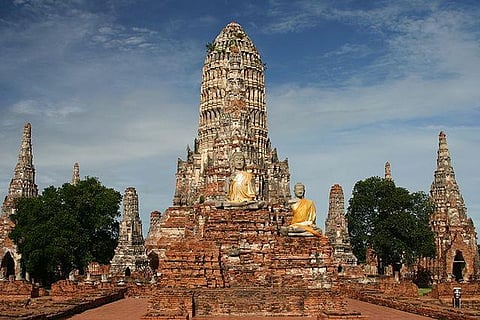
King Ramathibodi I, commonly known as U-Thong, created the Ayutthaya Kingdom in 1351. It was the second Thai empire after Sukhothia. With over a million residents at its peak, Ayutthaya was one of the world's largest and wealthiest cities. The city was established on an island bordered by three rivers: the Chao Phraya, Pa Sak, and Lopburi, which acted as a natural barrier against invading armies. The Chao Phraya river connected Ayutthaya to the Gulf of Siam around 100 kilometers south. Many palaces and magnificent temples were constructed. Sukhothai and Angkor, as well as China, Japan, and numerous European nations, had an effect on architecture and art. The enormous Angkor style prangs, such as those at Wat Ratchaburana and Wat Chaiwatthanaram, are one of the clearest instances of foreign influence.

After Sukhothai, it was the second Thai empireWikimedia commons
War history
Many battles were fought with competing Kingdoms like Sukhothai, Burma, and Angkor over the nearly four centuries of its existence. The invasion of Angkor by Ayutthaya in 1431 brought an end to the Khmer empire, which had ruled much of Southeast Asia for millennia. Sukhothai, the first independent Thai kingdom, had deteriorated by the middle of the 15th century and was united with Ayutthaya.
Several conflicts with Burma were fought in the second part of the sixteenth century. Burmese attacked Ayutthaya in 1569, capturing the Royal Family and transporting them to Pegu (modern-day Bago) in Burma. The Burmese were pushed out a few decades later during King Naresuan's reign, and Ayutthaya recovered its freedom.
At last, when the Burmese invaded and destroyed the city in 1767, the Ayutthaya Kingdom came to an end. The city was not rebuilt; instead, the Thais relocated their capital to Thonburi, farther south. The Thai Fine Arts Department did not begin restoration work in Ayutthaya until the end of the 1960s. Several temples have been renovated in recent years, giving a fair image of the Kingdom's riches. The Chao Sam Phraya National Museum, Chandra Kasem National Museum, and the Ayutthaya Historical Study Center are among the museums on the island that give insight into the Ayutthaya empire's history.
The Ram Janmabhumi Nirman Nyas declared their plans to build a Ram temple in Thailand in 2018Wikimedia commons
Association with India
The Ram Janmabhumi Nirman Nyas declared their plans to build a Ram temple in Thailand in 2018. It's no surprise that Thailand appeals to many Indians, whether it's because of the name "Rama" given to all Thai monarchs from the Chakri dynasty to the current day, or because of the importance of the Thai Ramayana, known as the "Ramakien."
Phendin-Klang Rama II was a great poet who translated the Hindu Ramayana into Thai. Not only for Siam, but for Southeast Asia as a whole, India's epic and Puranic literature served as a major source of inspiration. It created theme-based classical theatre, shadow theatre, and marionette presentations. Siamese dance, theatre, and music all have a strong indigenous influence. Many of Siam's many dance-dramas are based on Indian tales, such as the narrative of Savitri and Satyavan. Many Thai musical instruments are quite similar to Indian ones. Though Buddhism was the Kingdom of Ayutthaya's primary religion, Hindu texts had a significant impact on its society.
ALSO READ: ayodhya-world-tallest-lord-rama-statue
Ravana's sacrifice of family, country and life itself for the love of a lady moves the Thais. The Thai characters, unlike Valmiki's, are a flawed, human blend of good and evil. One is saddened by Ravana's demise here. It is not a time for unmistakable joy like it is in Valmiki." Thais, like Hindus, worship Vishnu or Narayana, Mahadeva or Siva, and despise asuras as the devas' adversaries. Famous Indian dramas like the Ramayana and Mahabharata, as well as the Shakuntala, have served as inspiration for some of Siam's best writing. In Siam, the Ramayana is referred to as the Ramakien "Ram – Akhyan," where Akhya is a Sanskrit term that means "narrative rendering of."
While efforts are being made to confine the Ramayana to a few square kilometers in Northern India, with one of its many versions enforced as the one and only genuine version, the global epic has rejected these constraints and extended its wings abroad. No one ever reads the Ramayana and the Mahabharatha for the first time in India or Southeast Asia, as Ramanujan would say. "Always already," the stories are there. It's just that, with each step one makes, the narrative alters a bit.
Subscribe to our channels on YouTube and WhatsApp
Download our app on Play Store
