
- HOME
- OPINION
- ON GROUND
- INTERVIEW
- Neta Profile
- Editor's Pick
- INDIA
- NewsGram USA
- WORLD
- न्यूजग्राम
- POLITICS
- ENTERTAINMENT
- CULTURE
- LIFESTYLE
- ECONOMY
- SPORTS
- Jobs / Internships
- Misc.
- NewsGram Exclusive
By Prakhar Patidar
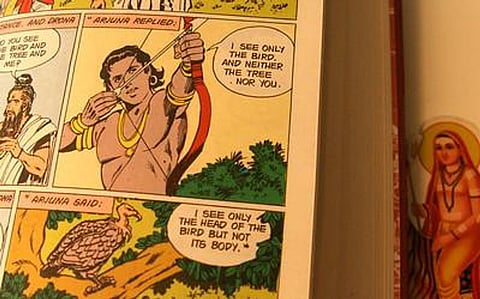
In 1967, Anant Pai: an educationist, laid the foundation of the Indian world of comics that brought to our homes Indian mythology, history, folktales and legends through colourful pictures and enjoyable narratives. What motivated Pai to embark on this journey was the ignorance he saw amongst Indian children about their cultural heritage. What good does knowing the world do when one is unaware of his/her own home?
Through children-friendly reiterations of religious stories, the great epics: Mahabharata and Ramayana, legends of the great Indian, stories of our freedom struggle and myths of local deities, these stories have successfully contributed towards a Hindu consciousness for its readers. This legacy has continued to impact the childhood of several Indian children introducing them to the Hindu culture and traditions through stories.
Stories about religion and mythology have always been for educational purposes rather than for leisure. When modelled as eye-catching graphics with griping narratives it meets the purpose envisioned by Pai. It has successfully served the purpose and created an interesting medium to get acquainted and stay in touch with one's culture.

Cover page of Amar Chitra Katha on Bundela King Chattrasal.wikimedia commons
While Amar Chitra Katha has received immense appreciation for being the pioneer of comic storytelling in India, it hasn't escaped criticism. Critics have recognised the potential Amar Chitra Katha has achieved, but have been critical of its construction of a certain kind of nationalism that isn't inclusive of various ways one can be a nationalist. Along with that, it has also been questioned for its anti-communist elements and poor portrayal of minorities. A medium as influential as this and targeted towards children should serve inclusivity and diversity more than anything else.
The happy conclusion is that the beloved comic of our childhood is making efforts to respond to the criticism by bringing a positive change in their narratives. Amar Chitra Katha has taken to work on the representation in their stories, do away with colourist, classist and casteist tropes and expand their horizon to cover a wider range of historic themes.
The trajectory Amar Chitra Katha has taken highlights the role of narratives in passing on cultural heritage. More than that, it highlights the influence narratives have in representation and the construction of identities. They may seem like simple stories for children, but it's not as simple.
Subscribe to our channels on YouTube and WhatsApp
Download our app on Play Store
