
- HOME
- OPINION
- ON GROUND
- INTERVIEW
- IPL 2026
- INDIA
- NewsGram USA
- WORLD
- न्यूजग्राम
- POLITICS
- ENTERTAINMENT
- CULTURE
- LIFESTYLE
- ECONOMY
- SPORTS
- Jobs / Internships
- Misc.
- NewsGram Exclusive
By Renata Nathania
Living in villages set deep within the Western Ghats, the Siddi community of Karnataka, is one of India's colonial heritages. A unique tribe descended directly from the Ethiopian (Old name: Abyssinia) Bantu community, the Siddis were brought to India by the Portuguese slave traders. They were either set free here, or escaped, and built homes for themselves in the forests of Western India. In Karnataka, they live in the northern region, namely in the villages of Tavargatta, Yellapura, and other surrounding regions.
Reluctant to leave the country and return to Africa after India's independence, the Siddi community decided to stay back and assimilate the local culture. They speak the regional languages, Kannada and Konkani, as fluently as a native would. They have even adopted the dressing style. Women wear saris, and men wear either the veshti, or pants, depending on their occupation. Most Siddi men are employed as daily wagers, or seasonal migrant workers. Within their community, they have other roles, which involve tending to their produce, building homes, and so on.

The Siddis have grown to rely on nature for their sustenance. They have systems in place to produce their own natural gum, honey, and lumber.ians
Living in the forests began as a choice, to remain excluded from other Indian communities, to avoid discrimination, and to avoid being punished for running away. But today, it is a way of life. The Siddis have grown to rely on nature for their sustenance. They have systems in place to produce their own natural gum, honey, and lumber. They use the food that they grow to prepare their meals, and use vegetables to wash their clothes. They have a diet that consists of dal, rice, and pickles. They are able to buy rice only if they work outside the community, and sometimes do not make enough to be able to afford it. Their delicacy is red-ant chutney, semiya appalam, and jackfruit. They sing about 'Chicken Saadam' (chicken rice) being a luxury. The men go hunting for the chicken, and even if they are successful in bringing enough home, there is the uncertainty of having rice to go with it.
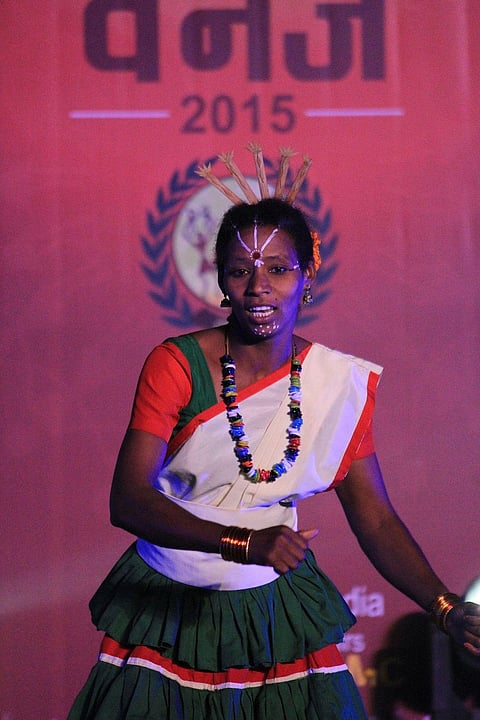
The Siddis have retained some African traditions, like their rhythmic music and dance. They celebrate 'Siddi Habba' (Siddi festival) where they take these dance forms to the urban areas. This is their way of trying to become more involved in the local communities. They perform their traditional dance, Dhamal, where they move to music played on a percussion instrument that resembles the mridangam. It is a clay pot covered with a piece of leather, tapped to create a hollowed-out sound. The men wear a belt of shells, occasionally adorned with peacock feathers and leaves. They paint white patterns on their bodies, much like their African ancestors. They break coconuts over their heads, and dance on embers.
The men wear a belt of shells, occasionally adorned with peacock feathers and leaves. They paint white patterns on their bodies, much like their African ancestors. wikimedia
Direct descendants of the Portuguese slaves practice Christianity or Catholicism as taught by their masters. Others, who had been sold to Arabs, adopted Islam, while some of them converted to Hinduism. Each Siddi village is separate from the other, divided on the basis of their religion. They do not intermarry, although in recent times, in this has been allowed. Mixed into their respective religious practices, all Siddi communities observe Hiriyaru, or ancestoral worship. They believe that their ancestors look after them, and must be appeased. This is one of the traditions carried over from their homeland. Another custom that has not changed, is the practice of the bridegroom paying a bride-price for his wife. African communities are women-centric and in the area of marriage, the woman is paid for by the groom.
After the government recognised the community as a Scheduled Tribe, the Siddis have begun to slowly enter into the surrounding cities and towns. They are still not openly accepted, but they are beginning to be acknowledged. The benefits that they now receive from the government, is opening up their world to education and full-time jobs.
Subscribe to our channels on YouTube and WhatsApp
Download our app on Play Store
