
- HOME
- OPINION
- ON GROUND
- INTERVIEW
- IPL 2026
- INDIA
- NewsGram USA
- WORLD
- न्यूजग्राम
- POLITICS
- ENTERTAINMENT
- CULTURE
- LIFESTYLE
- ECONOMY
- SPORTS
- Jobs / Internships
- Misc.
- NewsGram Exclusive
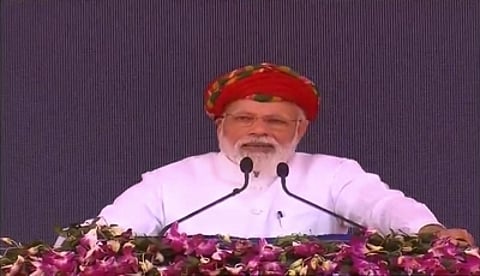
Gandhinagar, March 25 (IANS) Prime Minister Narendra Modi will visit Gujarat on March 31 to inaugurate and lay foundation stones for a range of urban development projects, as the state highlights two decades of rapid urbanisation and infrastructure expansion.
The visit comes as Gujarat marks 20 years since 2005, when Narendra Modi, then Chief Minister, had declared the year as “Urban Year” with a focus on strengthening urban infrastructure.
The state government said the urban development journey was completed in two decades by 2025, during which Gujarat witnessed significant growth in planned city development and civic infrastructure.
Officials said cities across the state have seen the expansion of roads, street lighting, drinking water pipelines, sewerage systems and urban green spaces.
Housing has also been provided to economically and socially weaker sections in urban areas, alongside the implementation of multiple town planning schemes aimed at accelerating urbanisation and improving ease of living.
To sustain this trajectory, the government under Chief Minister Bhupendra Patel had announced 2025 as “Urban Development Year” in the previous state budget.
Gujarat’s transport infrastructure has expanded through road, rail and air connectivity projects.
Overbridges and underbridges are being constructed in major cities, including Ahmedabad, Rajkot, Vadodara and Surat to manage rising traffic.
The Sudarshan Setu bridge connecting Dwarka and Bet Dwarka has been opened, along with approach roads and parking facilities, easing access between the two locations.
Several highway and expressway projects are under development, including the Jamnagar-Bhatinda Highway, Vadodara-Mumbai Expressway and Porbandar-Dwarka National Highway.
The state has also announced two greenfield corridors -- the 430-km Namo Shakti Expressway from Deesa to Pipavav and the 680-km Somnath-Dwarka Expressway -- to strengthen regional connectivity.
Urban transport has seen expansion with metro rail projects. Phase 2 of the Ahmedabad Metro has recently been completed, improving connectivity between Ahmedabad and Gandhinagar, while 24 trainsets have been ordered for the Surat Metro.
The Mumbai-Ahmedabad bullet train project is also progressing through Gujarat. Since September 2022, when the first Vande Bharat train was flagged off in the state, five such trains are now operational.
Under the 'Amrit Bharat Station' scheme, 89 railway stations in Gujarat are being redeveloped, of which 18 have been inaugurated.
Airport infrastructure has also been upgraded. The Hirasar Greenfield Airport in Rajkot has been developed for Rs 1,405 crore, while Surat International Airport has been established with an investment of Rs 3,400 crore.
Regional connectivity under the UDAN scheme has expanded services at Bhavnagar, Jamnagar, Kandla, Keshod, Mundra and Porbandar airports.
In urban utilities, projects under the Atal Mission for Rejuvenation and Urban Transformation (AMRUT) 2.0 have been implemented to improve water supply and sewerage systems.
During 2025, water supply projects worth Rs 630.39 crore were executed, covering 82,328 households, while sewerage projects worth Rs 575.58 crore covered 24,206 households.
The works included the creation of 67 MLD of additional sewage treatment capacity and the laying of 113.31 km of sewer lines.
Under the Smart City Mission, six cities -- Ahmedabad, Surat, Vadodara, Rajkot, Gandhinagar and Dahod -- have undertaken 359 projects worth over Rs 11,507 crore, of which 357 projects valued at Rs 11,277 crore have been completed, with the remaining nearing completion.
Housing initiatives under the Pradhan Mantri Awas Yojana (Urban) have led to the construction of 9,19,204 houses in Gujarat for economically weaker and lower middle-income groups.
In Rajkot, 1,144 houses have been built under the Lighthouse Project using monolithic concrete construction technology.
Following this, more than one lakh additional houses have been approved under PMAY (Urban) 2.0, announced in 2025.
The state has also upgraded nine municipalities -- Nadiad, Surendranagar, Gandhidham, Morbi, Navsari, Mehsana, Anand, Vapi and Porbandar -- to municipal corporations, increasing the total number to 17 and extending urban governance and services to newly integrated areas.
In the 2026-27 state budget, Rs 33,504 crore has been allocated to the Urban Development and Urban Housing Department.
The 'Swarnim Jayanti Mukhyamantri Urban Development' scheme allocation has been increased by around 17 per cent to Rs 16,116 crore.
This year's budget also provides Rs 1,278 crore to develop Olympic-ready urban infrastructure, including sports complexes and public transport systems, in preparation for the Commonwealth Games 2030.
Additional provisions have been made for water supply, drainage, lake development, metro expansion in Ahmedabad and Surat, the Gujarat Metro Rail Project and the Swachh Bharat Mission (Urban).
Officials noted that in 2023, Ahmedabad hosted Urban-20 meetings under India’s G20 presidency, bringing together representatives from cities of member countries to discuss urbanisation and city planning.
The government said Gujarat’s urban growth has been driven by economic expansion, industrial development and infrastructure investment, transforming several areas into urban centres and attracting investment and migration.
--IANS
mys/dpb
Subscribe to our channels on YouTube and WhatsApp
Download our app on Play Store

