
- HOME
- OPINION
- ON GROUND
- INTERVIEW
- Neta Profile
- Editor's Pick
- INDIA
- NewsGram USA
- WORLD
- न्यूजग्राम
- POLITICS
- ENTERTAINMENT
- CULTURE
- LIFESTYLE
- ECONOMY
- SPORTS
- Jobs / Internships
- Misc.
- NewsGram Exclusive

Key Points
Pakistani classical dancer Sheema Kermani faced backlash after remarks linking Kathak and Odissi to the Indus Valley Civilization resurfaced online following the Lahore Kathak Festival 2026.
Critics accused Pakistani platforms and commentators of attempting to appropriate Indian classical dance heritage by describing Kathak as part of “Pakistan’s classical arts.”
Historians and dance scholars maintain that Kathak and Odissi originated in specific regions of India, though they acknowledge the broader shared cultural heritage of the Indian subcontinent.
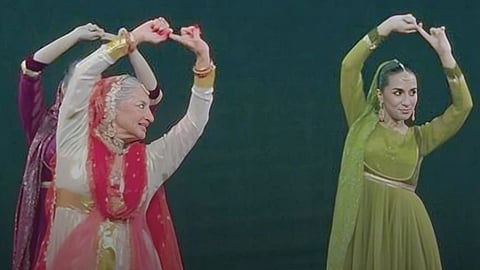
Controversy has erupted online following recent performances and statements by renowned Pakistani classical dancer and activist Sheema Kermani, particularly around the first-ever Lahore Kathak Festival held in early May 2026 held in Pakistan. Kermani, a veteran performer of Bharatanatyam, Kathak, and Odissi, has been accused by critics of claiming that these Indian classical dance forms originated in the Indus Valley Civilization (IVC), with some linking her remarks to broader India-Pakistan cultural and geopolitical tensions.
In addition, a Pakistani digital media platform, in a X post, posted a clip of Kermani's Kathak performance at the event and lauded it as a “milestone for Pakistani classical arts.” The internet has expressed its disapproval at Pakistan trying to misappropriate India’s culture and its ancient dance forms. Many users have taken to the platform to express their views on this matter.
A widely circulated social media post by user Annu Kaushik, a journalist for DD India, highlighted Kermani’s alleged statements, criticizing Pakistani state media for describing Kathak as “Pakistan’s classical arts” and accusing Kermani of falsely claiming that “Odissi originated in Indus Valley.” The post noted that Odissi is rooted in the ancient temple traditions of Odisha, in eastern India.
Similar criticisms have appeared on platforms like Facebook and Instagram, where users accused Kermani of cultural appropriation by linking Odissi to Sindh (Pakistan) and the broader Indus Valley heritage.
Kermani, who performed at the Lahore Kathak Festival alongside Nighat Chaudhry and received standing ovations, has long emphasized the deep historical roots of dance in the Indian subcontinent, often referencing the region’s ancient civilization dating back to the Indus Valley (c. 3300–1300 BCE). In a 2016 Dawn interview, she described her performances as “a celebration of the cultural history of this part of the world that dates back to the Indus Valley Civilization.”
In a previous podcast interview, Kermani claimed that the classical dance form “Odissi” traces its roots back to the Indus Valley Civilization, has also resurfaced. When asked about her dance artform, she mentioned the iconic “Tribhanga” pose of Odissi, which involves the dancer’s stance and posture curved to form an “S” shape, with hands placed on the hip and thigh.
“In India, they say that Odissi originated from the southern state of Odisha. But from my understanding, the specific stance and posture, and placement of hands on hip and thigh, is more closely related to Mohenjo-daro, one of the oldest civilizations of the world,” she remarked.
Kermani was, probably, equating that particular dance aspect of Odissi to the ancient artifact— “the dancing girl”—that was excavated from the Mohenjo-daro site of the Indus Valley Civilization. The artifact of a young woman is standing in a supposed “dance” form with her hand positioned in a similar manner as Kermani described.
The true origin of Kathak and Odissi
Historians and dance scholars largely reject direct links between modern classical forms like Kathak and Odissi and the Indus Valley Civilization.
Kathak originated in northern India, particularly in Uttar Pradesh with major gharanas in Varanasi, Lucknow, and Jaipur. It derives from kathakars, the storytellers who narrated Hindu epics like the Ramayana and Mahabharata. Its roots trace to the Natya Shastra from around 200 BCE–200 CE and developed further through the Bhakti movement and later Mughal court influences. No direct evidence connects it to the Indus Valley Civilization.
Odissi, one of India’s oldest classical dances, originated in the temples of Odisha. It is closely tied to Vaishnava traditions, mahari temple dancers, and sculptures at sites like the Konark Sun Temple. Its theoretical foundations appear in the Natya Shastra, with clear evidence from Odisha’s archaeological and temple records.
Carvings denoting the Odissi art form are found at Odisha’s largest buddhist complex, the Udayagiri Monastery, and denote that Odissi was patronised as early as 2nd Century BCE and the trend continued until about the 16th Century AD.
Indus Valley Civilization and Dance
While the IVC, with major sites like Mohenjo-daro in Sindh, Pakistan, provides evidence of dance in ancient South Asia— notably the famous “Dancing Girl” bronze figurine— its undeciphered script leaves scholars with limited knowledge of specific performing arts. Experts view broad claims of continuity to contemporary classical dances as speculative rather than based upon historically-accurate evidence.
See also: Kathak: Indo-Pak’s cultural bonhomie
About Sheema Kermani
Born in 1951 in Rawalpindi, Kermani trained in India under gurus like Leela Samson for Bharatanatyam. She is credited with preserving and promoting classical Indian dance forms in Pakistan despite facing conservative opposition. She gained international fame for her Bharatanatyam performance in the hit song ‘Pasoori’ and is a prominent women’s rights activist.
The Lahore Kathak Festival
The Lahore Kathak Festival, held on May 7-8, 2026, was promoted as a milestone for classical arts in Pakistan. Panels at the event discussed Kathak’s shared subcontinental heritage.
Online Criticism
Online critics have fun to say on this whole controversy. A viral post by user Prakhar Gupta argues that such claims serve to portray the Indus Valley Civilization as exclusively Pakistani heritage while downplaying its broader Indic cultural connections. This debate comes amid ongoing disputes between India and Pakistan related to the Indus Waters Treaty, which was suspended after the Pahalgam terror attack.
While some users have also tried to distance the Kathak art form from Pakistani culture, many have not taken so kindly to the remarks by the Pakistani media and Kermani’s statements.
Suggested reading:
Subscribe to our channels on YouTube and WhatsApp
Download our app on Play Store

