
Total sown area in ongoing summer season crosses 36.2 lakh hectares: Govt
New Delhi, March 17 (IANS) The total area covered under summer crops in India has reached 36.22 lakh hectares (as on March 13) this year, with the sowing season in full swing, data released by the Ministry of Agriculture and Farmers Welfare showed on Tuesday.
The normal summer area, calculated on the basis of average coverage from 2022-23 to 2024-25, is 75.37 lakh hectare. In comparison, the final summer area achieved in 2025 was significantly higher at 83.92 lakh hectare, suggesting that the current pace of sowing is aligned with previous expansion trends.
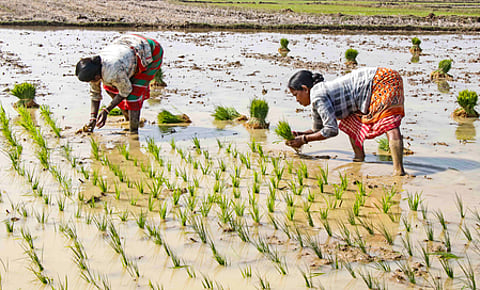
Rice remains the dominant summer crop, followed by pulses like moong and urad, oilseeds such as groundnut and coarse cereals like jowar bajra, ragi and maize.
The summer season in India spans from March to June, sandwiched between the rabi and kharif seasons, and plays a crucial role in boosting overall agricultural production
The area covered under rice has touched 26.75 lakh hectares, while pulses have been sown in in 2.25 lakh hectares. The area sown under coarse cereals is currently at 4.14 lakh hectares while that under oilseeds has crossed 3 lakh hectares so far.
The key cultivation areas for the summer crop include West Bengal, Tamil Nadu, Telangana, Odisha, Bihar, and Uttar Pradesh.
According to the Agriculture Ministry’s second advance estimates for the kharif and rabi season, released last week, kharif foodgrain production for 2025-26 is estimated at 1,741.44 lakh metric tonnes (LMT) and rabi foodgrain production at 1,745.13 LMT.
This is approximately 46 LMT (2.8 per cent) and 53 LMT (3.2 per cent) higher, respectively, compared to last year’s kharif foodgrain production of 1,694.60 LMT and rabi foodgrain production of 1,691.66 LMT.
Kharif rice production is estimated at 1,239.28 LMT as compared to 1,227.72 LMT in 2024-25, showing an increase of 11.56 LMT. Production of rabi rice is estimated at 167.20 LMT. Production of wheat is estimated at 1,202.10 LMT, which is higher by 22.65 LMT as compared to previous year production of 1,179.45 LMT.
While the Second Advance Estimates cover kharif and rabi seasons, the summer season will be incorporated in the Third Advance Estimates.
--IANS
sps/na
