
- HOME
- OPINION
- ON GROUND
- INTERVIEW
- Neta Profile
- Editor's Pick
- INDIA
- NewsGram USA
- WORLD
- न्यूजग्राम
- POLITICS
- ENTERTAINMENT
- CULTURE
- LIFESTYLE
- ECONOMY
- SPORTS
- Jobs / Internships
- Misc.
- NewsGram Exclusive

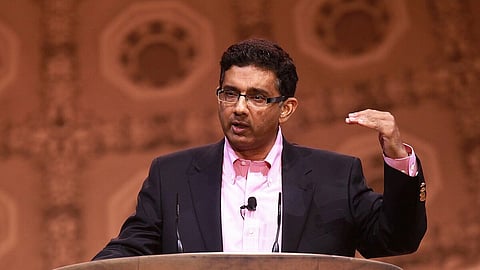
D’Souza is an Indian-American conservative commentator and filmmaker
D’Souza claimed that extremist ideologies enter academic and public discourse through softer narratives
He argued that after the Hamas attacks, global narratives “flipped,” portraying Israel as the aggressor
Dinesh Joseph D’Souza is an Indian-American right-wing political commentator, author, and filmmaker, and has long been a prominent conservative voice in the United States. He has written more than a dozen books—several of them New York Times bestsellers—and produced political documentaries such as Death of a Nation, 2016: Obama’s America, and 2000 Mules, all known for their strong ideological positions.
In an episode of East to West with Sarah Martinez Amir, Dinesh D’Souza discussed how Islamophobia is used in political discourse and how global narratives around extremism are shaped. He said that extremist groups cannot openly promote their ideology “You can't go and sell ISIS at Princeton. You can’t say, ‘Here’s a video of us beheading people’—that won’t work.”
However, he argued that organizations linked to Islamist ideology enter academic spaces through softer, more acceptable narratives. According to him, if a group frames its message under concerns like Islamophobia, people are more likely to support it. “If you come in with a Muslim Brotherhood garb and say, ‘We’re going to have a conference on the dangers of Islamophobia,’ everyone signs up.”
D’Souza claimed that this strategy shifts focus from acts of terrorism to society’s response to them. He explained that some try to make it seem as though the reaction to events like 9/11 is a bigger problem than the attacks themselves. “..The real problem is not 9/11, but Islamophobia—your reaction to the bombing is more dangerous than the attacks,” he said.
D’Souza argued that a similar narrative emerged globally after the October 7 Hamas attacks. According to him, “the story flipped,” portraying terrorists as victims and Israel as the aggressor.
“As if to say, the October 7 attacks were distressing, but the reaction to October 7 is far more dangerous… The real villain is Israel and the real victim is Hamas,” he said.
He described this shift as a “Left-wing moral inversion,” a tactic he believes deliberately reshapes truth and weaponizes sympathy. D’Souza argued that this inversion has spread across campuses, Western media, and activist spaces.
D’Souza concluded that this reversal of blame is part of what he calls the Left’s “ultimate project”—the inversion of moral hierarchy, where perpetrators are presented as oppressed and victims are portrayed as aggressors.
Born in Mumbai to a Catholic family, D’Souza moved to the United States as an exchange student and later graduated from Dartmouth College. He served as a policy adviser in President Ronald Reagan’s administration and was associated with conservative think tanks such as the American Enterprise Institute and the Hoover Institution.
[Rh]
Suggested Reading:
Subscribe to our channels on YouTube and WhatsApp
Download our app on Play Store

.jpg)
.svg)
