
- HOME
- OPINION
- ON GROUND
- INTERVIEW
- Neta Profile
- Editor's Pick
- INDIA
- NewsGram USA
- WORLD
- न्यूजग्राम
- POLITICS
- ENTERTAINMENT
- CULTURE
- LIFESTYLE
- ECONOMY
- SPORTS
- Jobs / Internships
- Misc.
- NewsGram Exclusive

A US Senate hearing on abortion drugs went viral after the question, “Can men get pregnant?” overshadowed policy discussions.
Senator Josh Hawley and Dr Nisha Verma clashed over biology, science, and political framing during the hearing.
The viral exchange shifted focus from women’s health and drug safety to a broader cultural debate online.
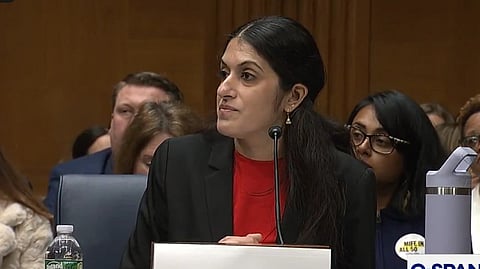
“Can men get pregnant?” A simple but deceptive question made a US Senate hearing go viral all over the internet on Wednesday, 14 January 2026. The topic of the hearing was “Protecting Women: Exposing the Dangers of Chemical Abortion Drugs.” The clip that went viral shows an awkward exchange over the question, which differed greatly from any policy arguments.
The Senate Health, Education, Labour and Pensions (HELP) Committee held the hearing at the Dirksen Senate Office Building. The discussion focused on the prescription drug mifepristone, which was approved by the US Food and Drug Administration (FDA) in 2019 and is widely used in medication abortions. It was led by Republican senators Josh Hawley of Missouri and Ashley Moody of Florida.
The debate, which should have remained focused on women’s health and drug safety, was instead turned into a heated discussion by the question, “Can men get pregnant?” Senator Hawley posed the question to Indian-American obstetrician-gynaecologist Dr Nisha Verma, who was present at the hearing as a Democratic witness and senior adviser to Physicians for Reproductive Health.
Dr Verma paused briefly after hearing the crisp yes-or-no question, after which she explained that she deals with patients from diverse gender identities. She said, “I do take care of people that don’t identify as women.” The answer, careful yet clinical, appeared to dodge the kind of response Hawley was aiming for.
This was followed by a tense exchange, as Hawley insisted on receiving a direct answer, saying he was trying to “establish a biological reality” and test Dr Verma’s credibility as a person of science. On the other hand, Verma stood her ground, refusing to reduce complex medical and social realities into a binary answer, which she described as a political exercise. She said, “Science and evidence should guide medicine.” She later added, “I also think yes or no questions like this are political tools.”
Hawley did not appear to accept Verma’s explanation and countered, “For the record, it’s the women who get pregnant and not men.” He further stated that refusing to acknowledge the basic biological distinction was “deeply corrosive to science, public trust, and constitutional protection for women.”
The discussion also touched upon abortion drug safety, with Senator Hawley citing studies that claimed adverse health events in 11 percent of cases. The figure itself has been debated by leading medical bodies, including the American College of Obstetricians and Gynaecologists (ACOG), which maintains that medication abortion is safe and effective when used as directed.
Dr Verma has previously stated that medication abortion has been extensively studied. She highlighted research reviewed in over 100 peer-reviewed studies, adding that more than 7.5 million people in the US have used abortion pills since their approval in 2000. She further warned that relying on political restrictions instead of medical evidence could cause real harm to patients.
Dr Nisha Verma comes from an Indian immigrant family and was born in North Carolina. She completed her medical education at the University of North Carolina and holds degrees in Biology, Anthropology, and Public Health. She is currently an Adjunct Assistant Professor at Emory University School of Medicine and provides clinical care in Georgia and Maryland. She is also a board-certified OB-GYN and complex family planning subspecialist.
She is leading research on the impact of Georgia’s six-week abortion ban on high-risk pregnancies and has testified multiple times before Congress on abortion access. She is also involved in training physicians nationwide on evidence-based communication around abortion, extending her work beyond the clinic. Additionally, she has worked closely with ACOG to support healthcare providers navigating restrictive laws.
In the end, the hearing was overshadowed by a seemingly simple biological question that carried cultural and political weight far beyond the committee room. The discussion around biological definitions and lived medical realities has since sparked widespread debate on social media. The Senate proceeding turned into a viral moment, with the question dominating headlines, memes, and online commentary.
Suggested Reading:
Subscribe to our channels on YouTube and WhatsApp
Download our app on Play Store
