
- HOME
- OPINION
- ON GROUND
- INTERVIEW
- Neta Profile
- Editor's Pick
- INDIA
- NewsGram USA
- WORLD
- न्यूजग्राम
- POLITICS
- ENTERTAINMENT
- CULTURE
- LIFESTYLE
- ECONOMY
- SPORTS
- Jobs / Internships
- Misc.
- NewsGram Exclusive

In the 1990s “Clear Craze,” Pepsi launched Crystal Pepsi as a transparent, caffeine-free cola, which became an early success.
Coca-Cola responded with Tab Clear, a deliberately bad-tasting drink placed next to Crystal Pepsi to confuse customers and damage Pepsi’s image
The strategy worked: both products failed within months, proving that perception and positioning can be more powerful than product quality.
Sometimes companies launch products just so they can fail. Confusing, right? But it’s true. Big companies sometimes introduce new products knowing that they will not succeed. This strategy is called the Kamikaze Strategy.
In marketing, a kamikaze strategy refers to deliberately launching a product that is designed to fail in order to damage a competitor. The goal is not to make profit, but to create confusion, weaken a rival’s momentum, and protect market dominance.
In the 1990s, a major wellness and transparency trend swept across the United States, where people favoured pure aesthetics. Consumers began associating clear products with purity, health, and safety because they believed such products contained fewer dyes, artificial additives, and preservatives. Transparent soaps, gels, and even beer became popular, as people considered them more natural. This 1980s–1990s marketing trend was known as the “Clear Craze.”
Riding this wave, PepsiCo decided to launch a colourless soft drink called Crystal Pepsi. After testing many flavours, Pepsi introduced it as a transparent, caffeine-free cola. It was marketed as a clear alternative to traditional colas and promoted through a massive advertising campaign. Its tagline was, “You’ve never seen a taste like this.” The product became an instant success and captured a significant market share.
Crystal Pepsi tasted similar to regular Pepsi, but without caramel colouring. However, Pepsi made a major mistake: it marketed the drink as a healthier option, even though its calorie and sugar content was almost the same as regular Pepsi.
At the same time, Coca-Cola was struggling to recover from the failure of “New Coke.” With declining market share, the company needed a strong response. Instead of directly competing with Crystal Pepsi, which was difficult at the time, Coca-Cola adopted a highly unusual strategy known as Kamikaze Marketing.
Coca-Cola launched Tab Clear, a transparent, sugar-free, calorie-free cola. Publicly, it was promoted as offering “real cola flavour.” In reality, it was a reformulated version of the original Tab diet drink from the 1960s and 1970s, sweetened with saccharin. It was deliberately designed to taste unpleasant. Sergio Zyman, former Head of US Marketing at Coca-Cola, later admitted that Tab Clear was never meant to succeed.
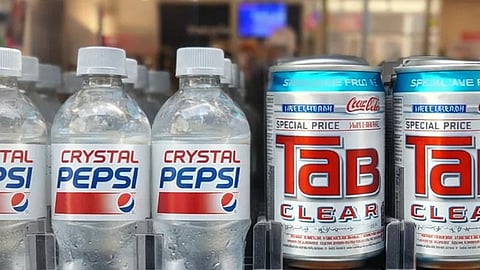
The real strategy was to confuse consumers. Coca-Cola placed Tab Clear bottles directly next to Crystal Pepsi on store shelves. Because both drinks were clear, customers began associating them with each other. Many assumed Crystal Pepsi was also a sugar-free, medicinal-style drink like Tab Clear. As a result, both products developed a negative image.
Consumers began to believe that clear colas were unhealthy, artificial, and unpleasant. Within six months of Tab Clear’s launch, sales of both drinks collapsed. Coca-Cola quietly withdrew Tab Clear, and Pepsi soon discontinued Crystal Pepsi. Coca-Cola had succeeded in destroying its competitor’s momentum by sacrificing its own product.
This tactic became known as the Kamikaze Strategy, a term inspired by World War II suicide missions. In marketing, it refers to launching a product designed to fail in order to damage a competitor. The focus is not on profit, but on confusion, disruption, and strategic defence.
From a consulting perspective, Crystal Pepsi did not fail entirely on its own. Pepsi failed to clearly differentiate its product from Tab Clear. Despite its early success, Crystal Pepsi suffered from weak long-term planning, poor competitor analysis, and misleading health claims.
This episode demonstrates that in marketing, perception is often more powerful than product quality. The placement of products, branding, and associations in consumers’ minds can determine success or failure.
The story of Crystal Pepsi shows that sometimes companies intentionally launch “suicide products” to weaken competitors. The case of Crystal Pepsi and Tab Clear remains one of the most famous examples of Kamikaze Marketing, showing how a failed product was used as a weapon to eliminate a competitor from the market.
Suggested Reading:
Subscribe to our channels on YouTube and WhatsApp
Download our app on Play Store
