--

The Odyssey (2026) Review: How Nolan Made the Homeric Epic a Spiritual Sequel to Oppenheimer

Nolan's adaptation is not just about the adventures of Odysseus. It is about him realizing how he has broken the law of the land. And maybe most importantly, it is about Ithaca forgetting and remembering the laws that are broken.
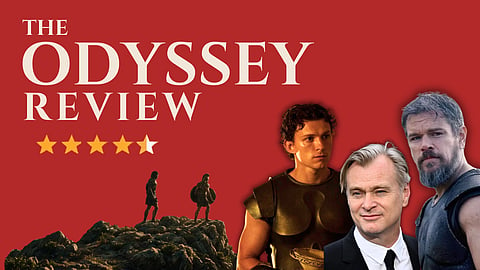
The Odyssey  2026 Review
This analysis will focus on Nolan as an auteur and how his style compliments Homer’s Odyssey. NG Creatives
Published on
When looking at the Nolan's oeuvre, The Odyssey (2026) acts as a unique anti-war film following Oscar-winning Oppenheimer.(4.5 / 5)

TO REIMAGINE an epic as extensive as Homer’s Odyssey, one would require more than mere three hours to deal with its vast  themes, plot, and all the nuances of the ancient mythology. Thus, one may call that Nolan’s vision of the tale was bound to fail from the onset, in a sense that it could never be true to the text; and maybe the Interstellar director knew that as well as his adaptation is not a mere retelling of Homer’s ancient epic. It is a version retold through the director’s lens, or what I would call an interpretation, rather than adaptation, of the epic.

To encounter Nolan’s vast vision, it’s just as impossible to evaluate and analyse all its themes, cinematic prowess, and literary analysis of the film. Thus, this analysis will focus on Nolan as an auteur and how his style compliments Homer’s Odyssey. Moreover, it will also delve deeper into how The Odyssey (2026) fits in his larger oeuvre, particularly focussing on its thematic similarities with Oppenheimer (2023).

How Nolan’s Signature Style Compliments The Odyssey

At this point, one cannot expect a straight-forward story telling from Christopher Nolan. Even while reimagining the ancient epic as vast as The Odyssey, the auteur lets its vision prevail through screen as the story is not told in a linear way. Moreover, you can witness elements of his past works in this 2026 epic. However, Nolan takes it one step further because the kind of story he wants to tell can’t be told chronologically, especially when he is telling the story of the return of a king simultaneously with the story of son learning about his father.

Unlike Homer, Nolan's tale is not just about the adventures of Odysseus (Matt Damon). It is about him realizing how he has broken the law of the land. It is about his son Telemachus (Tom Holland) maturing as his successor. And maybe most importantly, it is about Ithaca forgetting and remembering the laws that are broken. 

Christopher Nolan touching a head sculpture.
Unlike Homer, Nolan's tale is not just about the adventures of Odysseus. It is about him realizing how he has broken the law of the land. X

Nolan has had so much experience in practicing this non-linear narrative style that it is a masterfully interwoven in his latest film. Although, his signature style can sometimes become so convoluted and loud that it becomes just self-indulgent tale, overriding the plot of the film (looking at you, Tenet). However, in The Odyssey, Nolan strikes the perfect balance in telling different narratives simultaneously.

See Also: Spider-Man: Brand New Day Reminder: Things To Know About The New Spider-Man Movie Before Entering The Cinemas

The most crucial part of of The Odyssey is Odysseus’s return home, but he can only return home if he remembers his past. The same past he is trying to forget because at the core he is war veteran riddled with trauma. What Nolan’s Odysseus is witnessing are symptoms of Post-Traumatic Stress Disorder, leading him to eventually take solace in lotus flowers and calypso to literally forget his pains. 

On the other hand, his son Telemachus is on  a different journey into manhood. He is on the quest to find his father and learn more about him. All he has heard and known about Odysseus is from his mother, suitors, the Bard’s tales, the unreliable tales of beggars, and finally Menalaus, who served right by his father’s side. But now his position demands that merely learning about his father is not enough, he has to fulfill his responsibilities as well.

Another theme that is masterfully woven in the narrative is the fall of Ithaca, which, as Odysseus believes, was set forth from the fall of Troy. The former's fall is more metaphorical than Troy's as the Zeus's law is leaving the island without a ruler.

All these narratives— Ithaca forgetting his King and Gods, Telemachus learning about his father, and King Odysseus remembering his home, family and Gods— are running parallelly. It is interwoven into each other seamlessly, as evident from the transitions between the two narratives. As Telemachus learns a new detail about his father, we cut to his father, Odysseus stripped away of his glory and titles. And as the hero of the Trojan war remembers a new detail about his family, we cut away to his family remembering the lost King again.

However, Odysseus is not only remembering about his family. The Hero of the Trojan War is also riddled with the same vision. The same shot of him on a staircase at Troy is revisited again and again but he hasn’t remembered it fully, or rather he doesn’t want to remember it fully, because at the end of the day is a man riddled with trauma, trying to find solace in Calypso and eating Lotus flowers that makes him litterally forget about his pain. Him revisiting the vision on a staircase at Troy is evermore important in this regard.

The Question of Adaptation: Making the Great Odysseus’s Journey More Humane

Stills of Polyphemus and the beasts in Christopher Nolan's Odyssey.
Although, mythic creatures appear in Nolan's Odyssey, they act as the manifestation of Odysseus’s Trauma.X

How do you make an ancient epic with myths of witches, gods, beasts, and larger-than-life kings more humane for the modern audience? Christopher Nolan’s retelling of the three-thousand-year-old epic deals with this question in a creative way. He deviates from the original text quite a lot and changes crucial plot points as well to fit the narrative and themes he wants to explore. That’s why it also feels more like an interpretation of Homer’s epic rather than adaptation. 

This is is evident in his retelling of the great "trick" to end the war. The Trojan horse is often reimagined in all its glory. The trick that turned the tide for Greeks and ended the 10-year war. That’s how Odysseus start as the Bard (Travis Scott) narrates, “A face. A fleet. A war. A man. A thought. A trick. A trick to break the walls of Troy.”

See Also: Can We Map The Odyssey? How Ancient Geographers and Modern Researchers have Traced Odysseus’s Travels

However, it is immediately undercut by Queen Penelope (Anne Hathaway), because for her the “great trick” and stories are not enough to bring her love Odysseus back to Ithaca. That is the pain behind the great trick and that is the undercurrent which brings the larger than life “glory” of the Trojan hero Odysseus down to the ground. In Nolan’s reimagination, the trick is not as glorious as it is made out to be. It is the fall of Troy, which came as a high cost of human life and defiance of gods, setting of the events that will also lead to the desecration of Ithaca.

Another thing that makes Homer's epic larger than life are beasts and gods. Although, mythic creatures appear in Nolan's Odyssey, they act as the manifestation of Odysseus’s Trauma. Circe, the witch, tells Odysseus what he has already witnessed in Troy, that his man are pigs. Polyphemus, Poseidon’s son, curse his crew to remind him the cost of defying gods. The visions at underworld act as his regrets and guilt of not honoring his fallen mates. Whether these are real events in the story or they are imagined by man living with trauma, that can also be argued, but it plays an important role in Odysseus's journey back home, to the land of gods.

That is why Nolan, doesn't show any gods in The Odyssey either. The only god in the film, Athena (Zendaya), is again the manifestation of Odysseus's guilt as revealed near the climax, when Odysseus himself narrates the events of the Trojan war and how he broke everything that is sacred. In other words, he believes he has set a chain reaction that may one day end the world.

Breaking Zeus’s Law: The Odyssey as a Spiritual Sequel to Oppenheimer

Matt Damon as Odysseus and Cillian Murphy as Oppenheimer
Both the heroes of war, Oppenheimer and Odysseus, are riddled with their “masterful” tactic that ended the great conflict of their time. But they have a price to pay.X

In The Odyssey, the concept of Zeus’s Law is most important. It is the morality code that binds the society. It dictates its followers to treat every guest as sacred as it may be a God in disguise, placing hospitality as a core conduct of ancient Greeks. Breaking this hospitality code to win the Trojan war and defying gods was Odysseus’s biggest fall, as he confesses, “To burn the walls of Troy, was to burn the world entire.”

The same theme is seen in the Oscar-winning film Oppenheimer (2023). Just like the 20th century physicist, Odysseus great “trick” to end the war is seen as a deception that sets of the downfall of the society— a chain reaction— that not only upsets the gods but also put the fears of Oppenheimer at the end of Nolan's 2023 film in perspective.

In a way, Nolan's act of telling the ancient myth after a modern war story is itself a hopeful message. 3000 years ago, King Odysseus of Ithaca, who broke everything that is sacred, believed he has set forth the destruction of the world, yet we lived on. And in 20th century, J. Robert Oppenheimer feared he had begun the chain reaction that may end the world, and yet we live on.

After breaking Zeus’s law, Odysseus himself is also the victim of it. Whenever he visits a new island, his crewmates are the guest yet they are not give the hospitality as prescribed in the Greek society. He faces the same fate as Trojan, the consequences of the chain reaction that he had started.

Both the heroes of war, Oppenheimer and Odysseus, are riddled with their “masterful” tactic that ended the great conflict of their time. But they have a price to pay. That is why thematically it is a spiritual sequel to Oppenheimer. Some may say that Odysseus doesn’t tell or explore anything new that Oppenheimer hasn’t achieved. However, the scale, the conclusion and the hopeful message in the end is significantly different.

While both Oppenheimer and The Odyssey end with a harrowing vision — the vision of the entire world burning in former and the sight of burning horse in the latter—the 2026 film gives a message that civilization will rise again as noted by Queen Penelope. However, Odysseus sums it up in the end saying that the new dawn will break on the darkened world and their mistakes will be forgotten and repeated till eternity, just like Oppenheimer repeated it to end the World War II. 

In a way, Nolan's act of telling the ancient myth after a modern war story is itself a hopeful message. 3000 years ago, King Odysseus of Ithaca, who broke everything that is sacred, believed he has set forth the destruction of the world, yet we lived on. And in 20th century, J. Robert Oppenheimer feared he had begun the chain reaction that may end the world, and yet we live on.

Suggested Reading:

The Odyssey  2026 Review
Brand New Day Repeating No Way Home Tactic? Why Marvel-Sony Has Kept Sadie Sink's Spider-Man Role a Mystery

Subscribe to our channels on YouTube and WhatsApp

Download our app on Play Store

logo
NewsGram - Your Most Trusted Place for News with Substance
www.newsgram.com