
- HOME
- OPINION
- ON GROUND
- INTERVIEW
- Neta Profile
- Editor's Pick
- INDIA
- NewsGram USA
- WORLD
- न्यूजग्राम
- POLITICS
- ENTERTAINMENT
- CULTURE
- LIFESTYLE
- ECONOMY
- SPORTS
- Jobs / Internships
- Misc.
- NewsGram Exclusive

"(Indians) being black themselves, consider their own colour the best… the great majority of their idols are as black as black can be, and seem to be as dirty as they are ugly and horrible to look at."
These words were not written by a colonial-era soldier or trader. They were written by Francis Xavier— the man the Catholic Church made a saint, whose name today appears on schools, colleges, and hospitals all across India.
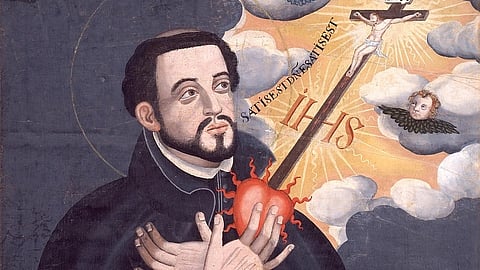
Known as a ‘relentless adventurer for Jesus Christ,’ St. Francis Xavier is quite a revered figure worldwide, lauded for his extensive propagation of Orthodox Christianity across Asia in the 16th century. Being a founding member of the Jesuit Society, Xavier played a significant role in education, charity, and humanitarian acts wherever he traveled.
Within Catholic tradition, he is celebrated as a tireless missionary whose efforts focused on preaching, teaching, and improving the social standing of local converts across Asia. However, local and historical accounts often gloss over the atrocities he committed in the name of religious propagation— most notably, the Goa Inquisition.
Born in 1506 in present-day Spain, Francis Xavier was one of the founding members of the Jesuits, a powerful Catholic religious order. He was appointed by Pope Paul III as the Church's official representative for missions across Asia, giving him enormous authority to spread Christianity in India, Malaysia, Indonesia, and Japan.
On May 6, 1542, Xavier arrived in Goa, which was then under Portuguese rule. He described the city with admiration, praising its churches, its convents, and the growing Christian presence. His work also included giving patronages for the building of churches.
Xavier established himself as an increasingly popular figure under the then Portuguese administration. His days in Goa were spent looking after the sick in the hospital where he resided, visiting prisoners in their cells and instilling them the knowledge of how to become servants of the God. Xavier's influence was seen over every strata of the society.
But beneath his religious enthusiasm was a deep contempt for the people he had come to convert, one that would result in a long and brutal chapter in Goa's history.
Xavier made no secret of how he viewed India's people and their beliefs. He called local Brahmins "the most perverse people in the world" and regularly described Hindus and Muslims as obstacles standing in the way of his mission of spreading Christianity.
His letters— sent to the Jesuit leadership in Rome and to the King of Portugal— were full of pride at the destruction of temples and idols. He saw this demolition as proof that his converts were truly committed to their new faith. His tactic was simple but devastating: push newly baptised Christians to physically destroy symbols of their old religion, making it nearly impossible for them to return to their roots.
As even his own biographer, Jesuit priest Fr. James Brodrick, admitted, Xavier had almost no real understanding of Hinduism or Indian culture. The Portuguese, Brodrick wrote, had been in India for over forty years and had made "not the slightest attempt to understand the venerable civilisation" they had forced their way into.
Xavier died in 1552, eight years before the infamous ‘Goa Inquisition’ officially began. But it was his letter to the King of Portugal in 1545 that set it in motion. In that letter, he wrote plainly: "The necessity for the Christians is that your majesty establish the Holy Inquisition, because there are many who live according to the Jewish law, and according to the Mahomedan sect, without any fear of God."
The Inquisition began in 1560 and ran for over 250 years, finally ending in 1812. Though it was originally intended to monitor Jewish converts to Christianity, it quickly became a tool used against Goa's Hindu and Muslim populations.
The Goa Inquisition (1560–1812) was a brutal judicial institution established by the Portuguese in Goa, India, to enforce Catholic orthodoxy, targeting "new Christians" (converts) suspected of practicing Hinduism, Islam, or Judaism. It was an extension of the Portuguese Inquisition meant to combat heresy through torture, imprisonment, and public executions (known as ‘autos-da-fé’).
The full scale of the Inquisition is hard to know, partly because Portugal destroyed most of its records in 1812. From what survives, historians estimate that over 16,000 cases were tried between 1560 and 1774. Thousands were imprisoned. Between 57 and 121 people were burnt alive at the stake.
But the violence went beyond executions. A 1559 law said that Hindu children who had lost their fathers must be handed over to Jesuits to be raised as Christians, even if their mothers or grandparents were still alive. By 1569, all Hindu temples in Portuguese-controlled Goa had been torn down. From the 1540s to the 1570s, over 760 temples were demolished across different parts of Goa. The money looted from these temples was used to build churches , Xavier himself mentioned this in his own writings.
A 1736 decree went even further, banning the Konkani language, traditional clothing like dhotis, and local festivals.
Portuguese researcher António José Saraiva found that over 74% of those prosecuted were Hindu converts charged with quietly continuing their old religious practices. Italian merchant Filippo Sassetti, who visited India in the late 1500s, wrote that the Church "destroyed Hindu temples, and so harassed and interfered with the people that they abandoned the city in large numbers."
The fear worked. Huge numbers of Hindus simply left Goa rather than face arrest, torture, or death for practising their own faith. They settled in places like Mangalore, Keralam, and the Canara coast. This mass displacement permanently changed the culture and population of India's western coast, and its effects can still be seen today.
Xavier's mission did not stop at India. He also travelled to Malaysia, Indonesia, and Japan. In Japan, where he worked from 1549 to 1551, he grew frustrated when conversions came slowly and began pushing Portugal to use political and economic pressure on local rulers. He wrote dismissively of Buddhist priests, calling them liars who misled the people. In the Spice Islands (modern-day Indonesia), he oversaw mass baptisms of thousands at a time, often with little to no explanation of the faith they were supposedly adopting.
See also: Kutle Khan: Folk music has always carried the history of longing
Historian Anant Kakba Priolkar described the Inquisition era as one of "callousness and cruelty, tyranny and injustice, espionage and blackmail, repression of thought and culture." He also noted that any Indian writer who tries to tell this story honestly is likely to be accused of being biased.
Francis Xavier's remains are still displayed in a church in Goa and visited by millions. Schools and colleges bearing his name operate across India. He is celebrated as a tireless, devoted missionary.
Even now, Saint Francis Xavier remains a revered figure in Goa and across the world. While he did not directly take part in the Goa Inquisition, he was the one who initiated the request that facilitated the establishment of it that became the source of terrible atrocities inflicted on people. For many Goans, St, Xavier remains not only a prominent religious historical figure, but is central to the state’s identity, faith, and memory. Yet, all those good deeds does not nullify the terrible pain that he inadvertently inflicted upon practitioners of non-christian religions.
Suggested reading:
Subscribe to our channels on YouTube and WhatsApp
Download our app on Play Store


