
- HOME
- OPINION
- ON GROUND
- INTERVIEW
- Neta Profile
- Editor's Pick
- INDIA
- NewsGram USA
- WORLD
- न्यूजग्राम
- POLITICS
- ENTERTAINMENT
- CULTURE
- LIFESTYLE
- ECONOMY
- SPORTS
- Jobs / Internships
- Misc.
- NewsGram Exclusive
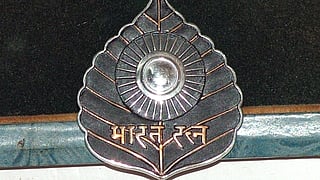

THERE ARE FOUR CIVILIAN HONOURS conferred by the Government of India—Padma Shri, Padma Bhushan, Padma Vibhushan, and Bharat Ratna. Among these four, the Bharat Ratna is the highest civilian award of the Republic of India. Instituted on January 2, 1954, it is given in recognition of exceptional service or performance of the highest order in any field of human endeavour.
The award is given irrespective of a person's caste, religion, gender, occupation, or social status. Recommendations for the Bharat Ratna are made by the Prime Minister to the President, and a maximum of three individuals can be awarded in a single year. The recipients receive a Sanad (certificate) signed by the President along with a peepal leaf-shaped medallion.
Many of India's most celebrated personalities have received the Bharat Ratna, including Indira Gandhi, Mother Teresa, Jawaharlal Nehru, Lata Mangeshkar, Sachin Tendulkar, Atal Bihari Vajpayee, and several others. Since the award was instituted, 53 individuals have been honoured with the Bharat Ratna. However, not everyone who was offered the country's highest civilian honour accepted it. A few eminent personalities chose to decline the award because of their personal principles and moral convictions.
Let us take a look at some of the personalities who declined to accept India's highest civilian honour because of their principles and values.
The first on the list is Maulana Abul Kalam Azad, who was popularly known as Maulana Azad. He was one of the foremost leaders of India's freedom movement. After India gained independence, Azad became India's first Education Minister, serving continuously from 1947 until his death in 1958. He was a member of Pandit Jawaharlal Nehru's Cabinet. During his tenure, he laid the foundation for India's modern education and scientific infrastructure.
He was nominated for the award but famously declined to accept the Bharat Ratna in 1954. Azad said that, according to him, people who were serving members of the Union Cabinet and had the authority to decide national honours should stay away from such temptations. Later, after he died of a heart attack on February 22, 1958, he was posthumously awarded India's highest civilian honour, the Bharat Ratna, in 1992.
Second on the list is H.N. Kunzru, a Kashmiri Pandit who was a member of the Constituent Assembly and a freedom fighter. He was a long-time parliamentarian, serving in several legislative bodies for nearly four decades. Kunzru is also known as the father of the National Cadet Corps (NCC) for his role in the establishment of the organisation. When Kunzru was nominated for the Bharat Ratna in 1968, he decided to decline the award.
Kunzru declined because of his objection to such honours in a republic. He had also raised this objection in the Constituent Assembly. According to him, in a republic, all citizens should be equal before the government, and the state should not confer honorary titles or civilian awards on individuals. Therefore, he chose not to accept the Bharat Ratna.
In January 1992, the Government of India announced that Netaji Subhas Chandra Bose would be posthumously awarded the Bharat Ratna. However, his family, including his daughter Anita Bose-Pfaff, declined to accept the honour on his behalf. They objected to the government describing it as a posthumous award because they believed that Netaji's death had never been conclusively established. They argued that conferring the honour posthumously required a documented date of death, which the government could not provide.
According to the official version, Subhas Chandra Bose died in a plane crash in Japanese-occupied Taiwan in August 1945. However, his death has remained one of India's biggest mysteries, with several theories claiming that he survived the crash and later lived elsewhere. The decision was later challenged in the Supreme Court, and the Bharat Ratna announced for Netaji in 1992 was subsequently withdrawn.
The next name on the list is Bhupen Hazarika, the legendary Assamese singer. He was posthumously awarded the Bharat Ratna in 2019, but the honour sparked a controversy. The award was rejected by his son, Tej Hazarika, who questioned its timing because of the Citizenship (Amendment) Bill, which had triggered massive protests across the Northeast. Tej Hazarika rejected the award in protest against the bill.
Bhupen Hazarika's brother, however, said that Tej had not consulted the family before rejecting the award. Tej Hazarika criticised the government for attempting to celebrate his father's legacy while simultaneously promoting legislation that he said stood in direct opposition to Bhupen Hazarika's core beliefs. He called it a "painfully unpopular bill regarding citizenship" that was in "direct opposition to what Bhupen Da believed in his heart of hearts," without naming any political party.
The last name on the list is Hanuman Prasad Poddar, who was popularly known as Bhaiji. He was the founding editor of the spiritual magazine Kalyan and played a key role in the growth of Gita Press. He was also a freedom fighter and was respected for his spiritual work and contribution to Hindu literature.
According to several accounts, then President Dr. Rajendra Prasad wanted Hanuman Prasad Poddar to be honoured with the Bharat Ratna and asked Union Home Minister Govind Ballabh Pant to seek his consent. However, Poddar politely declined the honour. He said that he wanted to stay away from worldly recognition and honours, believing that accepting such awards could draw him into unnecessary public and political attention.
Apart from these personalities, the Father of the Nation, Mahatma Gandhi, was also associated with a notable story related to the Bharat Ratna. There has been a long-standing debate over why Mahatma Gandhi was never awarded the Bharat Ratna. After his death, petitions were filed seeking to confer the honour on him posthumously. However, it has often been argued that Mahatma Gandhi's stature and contribution to the nation were so great that they transcended any civilian honour. As a result, he was never awarded the Bharat Ratna.
(Edited by Harsh Pandey)
Suggested Reading:
Subscribe to our channels on YouTube and WhatsApp
Download our app on Play Store


.jpg)
