
- HOME
- OPINION
- ON GROUND
- INTERVIEW
- Neta Profile
- Editor's Pick
- INDIA
- NewsGram USA
- WORLD
- न्यूजग्राम
- POLITICS
- ENTERTAINMENT
- CULTURE
- LIFESTYLE
- ECONOMY
- SPORTS
- Jobs / Internships
- Misc.
- NewsGram Exclusive

THE NATIONWIDE mandated rollout of E20 fuel — 20% ethanol-blended petrol— in April 2025, much ahead of its original 2030 deadline, was hailed as an achievement by the central government, but, at the same time, became a point of contention for the opposition and public. On July 5, 2026, a public protest was conducted in Jantar Mantar, Delhi, led by political analyst and entrepreneur Tehseen Poonawala. The government claims that the aim of the programme is to reduce crude oil imports, curb vehicular emissions, and increase farmers' income by boosting ethanol production, which uses crops such as sugarcane, maize and damaged food grains.
Protesters demanded that consumers should be given a choice of E0, E05, and E10 blended ethanol also instead of mandating 20% blended ethanol petrol for everyone as large numbers of vehicles are not E20 compliant in India. NewsGram Team visited the protest site and talked to the people to understand what's really going on:
Government's accelerated timeline has triggered growing concerns. One of the biggest criticisms is that consumers have not been given the option to choose between regular petrol and E20 fuel. Many people also believe that if the original 2030 timeline had been followed, there would have been a larger number of E20-compatible vehicles in the market.
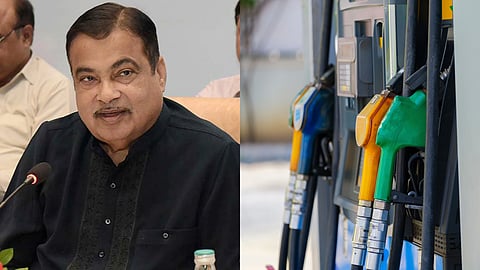
Critics also point out that several countries using ethanol-blended fuels continue to offer consumers a choice between different fuel blends at petrol pumps. Thus, India's nationwide rollout feels more like a mandatory shift, even for owners of vehicles that are not fully compatible with E20 fuel. However, these are not the only concerns of the public and the opposition as a bigger question about conflict of interest also looms over Union Minister of Road Transport and Highways, Nitin Gadkari.
Two companies have come under public scrutiny over allegations of unfair advantage due to connections with a Union Minister who has been actively pushing the ethanol-blended fuel in India. Cian Agro Industries & Infrastructure Ltd is promoted and managed by Nitin Gadkari’s son Nikhil Gadkari, while another company, Manas Agro, is linked to his other son Sarang Gadkari.
Opposition parties, particularly the Congress, have repeatedly raised concerns over an alleged conflict of interest. They claim that Cian's revenue jumped from ₹18 crore in June 2024 to ₹523 crore in June 2025, while its stock price surged nearly 2,184% within months after the implementation of the E20 policy. Congress has also alleged that the company reported a profit of around ₹10 lakh in the first quarter of FY24, which later rose to ₹52 crore in FY26.
Nitin Gadkari has denied these allegations. He has said that Cian was established before the ethanol blending policy was introduced and that its ethanol production accounts for less than 0.5% of India's total ethanol output. The Transport Minister has also stated that he has no role in awarding ethanol-related contracts, as those are handled by the Ministry of Petroleum and Natural Gas.
According to the company's disclosures, Cian says that a majority of its revenue comes from subsidiaries involved in sugar distilleries, power generation, infrastructure, healthcare and other businesses. However, independent market research platform Finshots has pointed out that the company's filings do not provide a specific breakup of ethanol production capacity or revenue contributions from individual subsidiaries. It has also highlighted inconsistencies in the company's cash flow statements and balance sheet that were signed off by its auditors.
Within one year, Cian's market capitalisation reportedly increased from around ₹100 crore in 2024 to nearly ₹2,000 crore in 2025. Following the sharp rise in its share price, the Bombay Stock Exchange (BSE) placed the company under Additional Surveillance Measure (ASM) Stage 4 — the exchange's highest surveillance category aimed at curbing abnormal price movements. Despite these developments, critics point out that no further inquiry into the company's conduct has been initiated by market regulator SEBI.
Apart from the political controversy, concerns have also emerged regarding the impact of E20 fuel on older petrol vehicles. According to a report by Dainik Bhaskar, many mechanics have claimed that the forced switch has affected their customers' vehicles, reporting increased repair costs, failures of fuel pumps, rusting of metal components and other fuel system issues. They also claim that vehicles that were left parked for long periods are facing additional problems because of ethanol's tendency to absorb moisture.
A nationwide survey conducted by LocalCircles, as reported by India Today, found that owners of petrol vehicles manufactured before 2023 reported several issues after using E20 fuel.
According to the survey, 66% of respondents said their fuel efficiency had fallen by more than 10% since early 2025. This was a significant increase from the previous survey, in which 45% had reported a similar drop in mileage. The survey collected responses from more than 44,000 owners of petrol vehicles manufactured before 2023 across 305 districts in India.
It also found that 55% of respondents experienced higher wear and tear or increased repair requirements, compared to 29% who reported similar issues in the May 2026 survey.
Another LocalCircles survey involving nearly 28,000 prospective vehicle buyers across 311 districts found that 43% of respondents had postponed buying a new vehicle by at least a year because of the government's ethanol push.
According to the survey, buyers are increasingly worried about E20 fuel compatibility as well as the possibility of future E30 blending. Concerns over fuel economy, long-term durability, maintenance costs and expensive repairs have reportedly led many consumers to delay their purchase decisions.
On July 5, 2026, a protest was organized by Tehseen Poonawala at Delhi’s Jantar Mantar against the government’s E20 fuel mandate. Delhi automobile owners joined the site and demanded that consumers should be given choices between E0, E5, E10 fuel options instead of mandating 20% ethanol-blended fuel as a large number of vehicles are not E20 compliant in India, specially the vehicles that were manufactured before 2023.
While addressing the media in the protest, Poonawala clarified that he is open for the government to move to E25, E30, E85, and E100, but there should first be a “360-degree infrastructure” in place that can support this rollout. “They have pre-poned the E20 program to 2023, so put the documents in public domain. You did it without 360-degree infrastructure in place,” he said.
He also questioned the government claims that farmers are getting benefit from Ethanol production, alleging that a sugarcane farmer only get ₹3.65 per kg for his crop. Poonawal demanded transparency to know where the rest of the money from ₹102 fuel is going. He targeted Nitin Gadkari’s family, claiming companies managed by his sons are taking away most of these profits. In an interview with NewsGram, Poonawala said that the government should make a website, put all compatible vehicles in public domain, and provide all documents regarding E20 too.
Rattan Dhilllon, the protest convenor, also spoke to NewsGram and clarified that the protestors are not against the idea of Ethanol blending to curb pollution. However, he gave examples of other countries like Brazil that have been experimenting with ethanol-blended fuel for over 50 years and still don’t have proper infrastructure for E85 and E100. “But in India they are saying within one year we will be moving to E85. They are not connected with the ground reality. They only make policies by sitting in the offices. At least do proper R&D and testing first,” Dhillon said.
Despite the growing concerns, the government has repeatedly maintained that E20 fuel is safe for vehicles and good for the environment. The Ministry of Petroleum and Natural Gas has dismissed viral claims that ethanol blending causes engine failures, rusting, lower mileage, and damage to fuel pumps, calling such allegations unscientific and unsupported by research.
On Monday, July 6, 2026, PNG Minister Hardeep Singh Puri addressed customer complaints of fuel system failures while speaking to ANI, claiming that these are a “misrepresentation.” However, he also maintains that move to higher fuel blends like E25 will only happen after relevant testing and discussion with automakers.
Nitin Gadkari also addressed the media at the same event and said that no faults reported in cars is because of the E20 fuel. “There is no case of any car facing issues due to E20 petrol. Has there been any car in the country that faced issues due to the use of E20 petrol? Just name one …false narratives are being spread about the roll-out of higher ethanol-blended petrol. These are paid campaigns," he said to ANI.
On July 3, 2026, the government also issued a detailed 10-point clarification to address what it described as common myths surrounding ethanol-blended fuel. Among other claims, the ministry rejected allegations that ethanol production consumes around 10,000 litres of water for rice cultivation. It said ethanol production uses only surplus rice after meeting India's food security requirements.
The Ministry of Petroleum and Natural Gas also rejected claims that E20 is an "experimental fuel", noting that countries such as the United States, Canada, Brazil, Thailand, and several European nations have been using ethanol-blended fuels for decades.
However, critics continue to argue that many of these countries also provide consumers with alternatives such as E10 fuel instead of mandating only E20. Thailand even offers multiple options including E10, E20 and E85, allowing consumers to choose fuel based on their vehicle compatibility.
The government has also defended itself against claims that ethanol damages engines, fuel tanks, and fuel pumps. While videos and personal complaints continue to surface on social media, the Centre maintains that available scientific evidence supports the continued rollout of ethanol blending.
Nonetheless, the government continues to push ahead. Nitin Gadkari has repeatedly advocated for wider adoption of E85 and even E100 fuel blends in the future, although he has maintained that decisions regarding the implementation lies with the Ministry of Petroleum and Natural Gas.
Petroleum Minister Hardeep S. Puri has also announced that the government is aiming for an E30 blend by 2030, with a gradual transition through intermediate blends such as E22, E25, and E27. According to the ministry, any future increase in ethanol blending will be implemented gradually and only after scientific evaluation and testing but the opposition refutes these claims.
(Edited by Ritik Singh)
(This is an updated version of the article.)
Subscribe to our channels on YouTube and WhatsApp
Download our app on Play Store


