
- HOME
- OPINION
- ON GROUND
- INTERVIEW
- Neta Profile
- Editor's Pick
- INDIA
- NewsGram USA
- WORLD
- न्यूजग्राम
- POLITICS
- ENTERTAINMENT
- CULTURE
- LIFESTYLE
- ECONOMY
- SPORTS
- Jobs / Internships
- Misc.
- NewsGram Exclusive

Key Points
Israel launched strikes on Lebanon’s capital Beirut after Hezbollah fired rockets and drones toward Israeli targets, marking the group’s first claimed attack on Israel in more than a year.
Israel reported no casualties while Lebanese authorities said at least 52 people were killed in Israeli strikes. Hezbollah said its attack was retaliation for the killing of Iran’s Supreme Leader Ayatollah Ali Khamenei.
The escalating confrontation has widened a broader regional conflict that began after joint US-Israeli strikes on Iran, triggering retaliatory attacks across West Asia.
Israel, on 2 March 2026, launched a wave of strikes on Lebanon’s capital Beirut after the Iran-backed militant group Hezbollah fired rockets and drones toward Israeli targets, escalating tensions in a conflict that has rapidly spread across the Middle East.
The exchange marked the first time in more than a year that Hezbollah publicly claimed an attack on Israel. The Israeli military said it intercepted one projectile that crossed the border while others fell in open areas, reporting no injuries or damage.
Hezbollah said its strikes were carried out in retaliation for the killing of Iran’s Supreme Leader Ayatollah Ali Khamenei and for what it described as “repeated Israeli aggressions.”
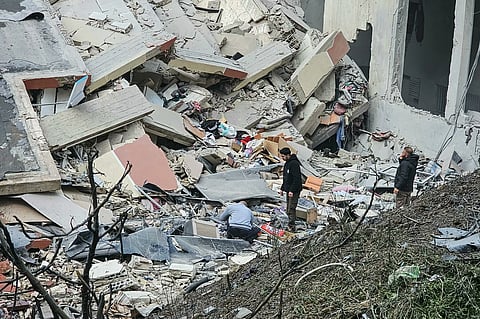
The Israeli military responded with air and naval strikes targeting Hezbollah positions in Beirut’s southern suburbs and southern Lebanon. According to Israeli officials, the strikes aimed at “Hezbollah command centers and weapons storage facilities in Beirut,” while additional attacks hit missile launch sites and other infrastructure linked to the group.
Lebanese authorities said the strikes killed at least 52 people and wounded more than 150. Explosions and fires were reported across Beirut. Roads near Beirut’s airport were filled with traffic as residents attempted to flee affected areas. Many families sought refuge in schools opened to accommodate displaced civilians.
A teacher from the suburb of Dahieh described the panic caused by the overnight bombardment. “The house was shaking around us,” she told the BBC. “I was with my daughter and I told her, ‘we are dying. There is no chance for survival.’”
The violence comes as the broader regional conflict intensifies following joint US-Israeli strikes on Iran on 28 February 2026. Tehran said the attack killed dozens of civilians and Ayatollah Khamenei, Iran’s Supreme Leader, prompting retaliatory missile and drone strikes by Iran and allied groups on US bases across the region. Countries struck by Iran include the UAE, Qatar and Kuwait among many others.
Lebanon’s government condemned both the Israeli strikes and Hezbollah’s rocket fire. Prime Minister Nawaf Salam called the group’s actions “irresponsible” and announced that authorities were banning Hezbollah’s military activities.
“The decision of war and peace rests exclusively with the state,” Salam said, adding that the government would require the group to hand over its weapons.
Hezbollah defended its actions, saying its missile barrage targeted Israeli military facilities rather than civilians. The group said it fired “a barrage of precision missiles and a swarm of drones” at a missile defence site near the Israeli city of Haifa.
Israel’s defence minister vowed a strong response. Israeli forces warned residents of more than 50 locations in southern Beirut and nearby areas to evacuate ahead of further operations targeting Hezbollah infrastructure.
The Israeli military also indicated the possibility of a wider campaign. Military spokesperson Brigadier General Effie Defrin said Israel was keeping “all options on the table,” including a potential ground invasion of Lebanon.
See Also:
The Israel–Hezbollah conflict has deep historical roots. Hezbollah emerged in the early 1980s during Israel’s occupation of southern Lebanon and grew into one of the most powerful non-state armed groups in the region. The group’s power has also been influenced by Lebanon’s political landscape and its alliance with Iran, which has provided financial, ideological and military support.
Despite periods of ceasefire, the Israel–Hezbollah rivalry has repeatedly flared into conflict. A major war in 2006 killed around 1,200 people in Lebanon and 159 in Israel.
More recently, Israel carried out an air campaign and ground invasion against Hezbollah in 2024 following cross-border attacks. The conflict ended with a US and French-brokered ceasefire in November 2024, under which Hezbollah agreed to withdraw armed fighters from areas south of the Litani River while Israel committed to withdrawing its forces. Both sides have since accused each other of violating the agreement.
Hezbollah’s latest missile strike and Israel’s response threaten to draw the wider Middle East into a deeper and potentially prolonged confrontation as regional powers become increasingly involved.
[DS]
Suggested Reading:
Subscribe to our channels on YouTube and WhatsApp
Download our app on Play Store
