
- HOME
- OPINION
- ON GROUND
- INTERVIEW
- Neta Profile
- Editor's Pick
- INDIA
- NewsGram USA
- WORLD
- न्यूजग्राम
- POLITICS
- ENTERTAINMENT
- CULTURE
- LIFESTYLE
- ECONOMY
- SPORTS
- Jobs / Internships
- Misc.
- NewsGram Exclusive
This article was originally published in Radio Free Europe/Radio Liberty (RFE/RL). Read the original article.
By Julia Parnis and RFE/RL's Ukrainian Service
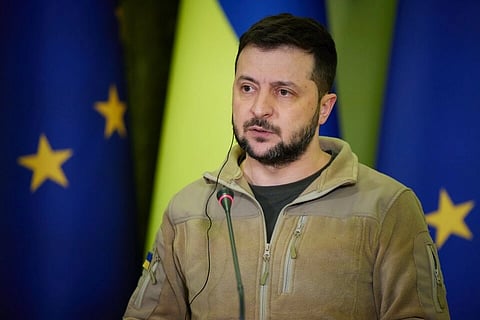
Ukrainian President Volodymyr Zelenskyy has arrived in Canada in an attempt to shore up support from Ukraine's allies amid destructive Russian drone and missile attacks on Kyiv and other major cities.
The Ukrainian leader arrived in the western city of Calgary late on September 9 after a visit to Norway for the funeral of King Harald V and talks on air defense support.
Zelenskyy’s plane was delayed on its way to Oslo after an alert in Moldova that a Russian drone had entered the nearby airspace.
“Canada remains one of our closest partners," Zelenskyy wrote on X after his arrival in Canada. "We value the support of the Canadian people and the decisions that help Ukraine to withstand the war and to protect our people.”
See Also: Russia Does Not Rule Out Resuming Trilateral Talks on Ukraine: Kremlin
Zelenskyy's visit comes as Russia continued launching intense air attacks on Ukraine, with fresh strikes reported on September 10 in Kyiv, Dnipro, Kramatorsk, Kryviy Rih, and Mykolayiv.
In Dnipro, a major city in east-central Ukraine, Russian forces struck a food-industry facility that had already been damaged in an attack earlier in the day, killing two people and injuring five, including a child, according to regional governor Oleksandr Hanzha.
Further east, in the Donetsk region, the number of people injured in strikes on the frontline city of Kramatorsk rose to 16, according to the head of the city's military administration. Regional authorities said Russian forces struck the city four times, with impacts recorded near educational facilities and a multistory residential building.
Russian air strikes also hit the southern port city of Mykolayiv and civilian and industrial infrastructure in the surrounding region, killing four people and injuring 19, acting regional governor Heorhiy Reshetilov said on Telegram.
Moscow has stepped up its air war in recent months, using ballistic missiles and jet-powered drones that have taken advantage of Ukraine’s dwindling air defenses.
The attacks have also targeted Ukraine’s power grid ahead of the upcoming winter in what appears to be part of a campaign to demoralize civilians after more than four years of war.
Ukraine, meanwhile, has continued its own long-range strikes inside Russia.
Overnighton September 9-10, Ukrainian drones struck the Russian Caspian Sea port of Makhachkala in Daghestan. One person died and two were injured in another drone attack in the Voronezh region. Russia's Defense Ministry claimed that 448 Ukrainian drones were shot down overnight.
The intensifying exchange of strikes has put air defense and the protection of Ukraine's energy infrastructure at the center of Zelenskyy's trip.
Zelenskyy and his wife, Olena Zelenska, are set to attend events in Calgary, Toronto, and North Bay, as well as a meeting with Canadian cabinet members in Banff, Alberta.
See Also: How Much Can Ukraine Disrupt Civilian Flights In Russia?
Canadian Prime Minister Mark Carney said in a statement on September 9 that that Zelenskyy's visit "will focus on shared priorities between Canada and Ukraine, including deepening defense, economic, and energy cooperation."
"It will also address the human cost of Russia's war of aggression against Ukraine and build on the strong people-to-people ties that connect our countries," the statement said, adding that Canada "remains steadfast in our commitment to support Ukraine's defense, recovery, and reconstruction."
On his way to Canada, Zelenskyy made a stopover in Iceland, where he met with the country’s foreign minister, Thorgerdur Katrin Gunnarsdottir. At the center of the conversation was protecting Ukraine’s energy infrastructure and strengthening its air defenses.
With fighting remaining intense, Zelenskyy's diplomatic push comes amid renewed efforts to find a path toward ending the war.
After months of stalled talks on ending the conflict, hopes have been raised by a flurry of diplomatic moves.
Russian President Vladimir Putin spoke by phone with US President Donald Trump on September 8, a conversation that the Kremlin described as "constructive and quite frank."
"We had a great conversation. He [Putin] is wanting to make a deal, and if Zelenskyy is wanting to make a deal, that'd be very nice," Trump told reporters on September 9, adding, "These are two people that are tired of fighting."
Putin has given no sign he is ready for a cease-fire unless Kyiv makes major concessions it has rejected, including ceding territory in the eastern Donbas region that Russian troops have been unable to take by force.
Kremlin aide Yury Ushakov suggested that Putin told Trump that an immediate cease-fire could be secured if the United States would end all support for Kyiv.
On September 9, the Financial Times reported that CIA director John Ratcliffe is preparing to take a bigger role in US negotiations with Russia and Ukraine, citing unnamed sources the paper said indicated the roles of US special envoy Steve Witkoff and Trump’s son-in-law Jared Kushner might be scaled back to make room for Ratcliffe.
In a post on X, White House spokeswoman Anna Kelly called the FT story "incorrect and ridiculous." CIA spokeswoman Liz Lyons, also on X, wrote: "This reporting is false."
Witkoff and Kushner have led the talks with Moscow and Kyiv for the last year and a half.
According to the FT, officials close to Ratcliffe have told their European peers that in addition to maintaining contact with intelligence agencies in both Russia and Ukraine, the CIA director would now play a more active role in shuttle diplomacy.
Copyright (c)2025 RFE/RL, Inc. Used with the permission of Radio Free Europe/Radio Liberty
[VS]
Suggested Reading:
Subscribe to our channels on YouTube and WhatsApp
Download our app on Play Store


