
- HOME
- OPINION
- ON GROUND
- INTERVIEW
- Neta Profile
- Editor's Pick
- INDIA
- NewsGram USA
- WORLD
- न्यूजग्राम
- POLITICS
- ENTERTAINMENT
- CULTURE
- LIFESTYLE
- ECONOMY
- SPORTS
- Jobs / Internships
- Misc.
- NewsGram Exclusive
This article was originally published in Radio Free Europe/Radio Liberty (RFE/RL). Read the original article.
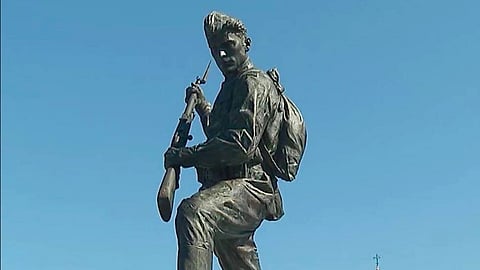
ONE DAY BEFORE the unveiling of a World War II memorial in the Siberian city of Khabarovsk on September 4, Japan's Consulate General urgently requested an amendment.
The 15-meter-high monument to the Soviet victory over Japan depicts a granite border post being shattered under the rifle butt of an advancing Soviet soldier. Across the broken marker is a cracked imperial crest of Japan.
The chrysanthemum flower emblem was used during World War II by Nazi-allied Japanese forces, but it remains a de facto emblem of Japan in lieu of a formal coat of arms. Today the 16-petalled flower symbol is used by the Japanese emperor and features on the country's passports.
Response to the Japanese appeal to remove the symbol ahead of the monument's unveiling was swift and unbending.
"In my view, this request is highly inappropriate," Nikolai Ovsienko, a senior figure of the Russian Military Historical Society, declared on the same day as the Japanese outreach. "The chrysanthemum is not only a symbol of Japan's imperial house but also a symbol of militarism responsible for horrific crimes," he said.
See Also: 80 years since the end of World War II, a dangerous legacy lingers in the Pacific
The historical society created the monument jointly with the Khabarovsk regional government.
After the monument was unveiled on September 4, Japan's Foreign Ministry issued an unusually blunt statement calling for the removal of the entire monument, which it called "extremely regrettable." Japanese Prime Minister Sanae Takaichi has vowed to "continue to strongly urge its removal."
Russian Foreign Ministry spokeswoman Maria Zakharova ridiculed Japanese calls to remove the monument.
"All that remains is to demand that the wind stop blowing and the sun stop shining," she said in response to the request. "Our land was defended by our ancestors; our history is based on facts; our memory is enshrined in this monument," she added.
In Japan, the unveiling of the monument has been viewed as a deliberate message to Tokyo, coming just weeks after Russian President Vladimir Putin visited the disputed Kuril Islands in August. The islands are known in Japan as the Northern Territories but were seized by the Soviet Union in the final days of World War II.
Putin's August visit to the islands was the Russian leader's first and sparked an angry response from Tokyo. Relations between the two countries deteriorated sharply after Russia's 2022 invasion of Ukraine.
Due to dispute over ownership of the Kuril Islands, Moscow and Tokyo never signed a formal peace treaty to end World War II hostilities.
The border post depicted in the Khabarovsk monument is based on granite markers that split Sakhalin Island, in today's Far Eastern Russia, between Japanese and Russian control. The island was divided between Moscow and Tokyo as part of a peace treaty following the 1904-1905 war between the two countries.
[GRT]
Suggested Reading:
Subscribe to our channels on YouTube and WhatsApp
Download our app on Play Store

