
- HOME
- OPINION
- ON GROUND
- INTERVIEW
- Neta Profile
- Editor's Pick
- INDIA
- NewsGram USA
- WORLD
- न्यूजग्राम
- POLITICS
- ENTERTAINMENT
- CULTURE
- LIFESTYLE
- ECONOMY
- SPORTS
- Jobs / Internships
- Misc.
- NewsGram Exclusive

The US Supreme Court struck down Donald Trump’s sweeping global tariffs, ruling that only Congress can impose taxes.
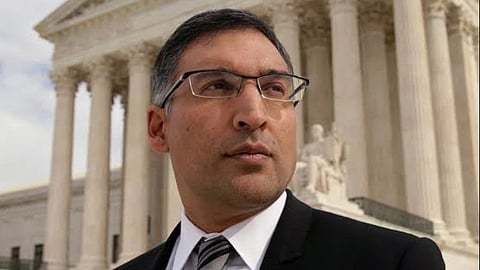
Indian-American lawyer Neal Katyal led the successful constitutional challenge against the tariffs.
The verdict limits a president’s ability to use emergency powers to impose broad import taxes.
The Supreme Court of the United States has ruled striking down the sweeping global tariffs imposed by President Donald Trump on 20 February 2026. It clarified that there is no authority for the President to impose broad import taxes without congressional approval, citing the Constitution. The one leading the argument in court against President Trump was Indian-American lawyer Neal Katyal. He pointed out how Trump justified his high tariff imposition, which he argued was an unconstitutional overreach of executive power under the International Emergency Economic Powers Act (IEEPA).
As the decision was announced, Katyal said outside the court, “Today, the United States Supreme Court stood up for the rule of law and Americans everywhere.” He clarified that the Court addressed power distribution in America through the verdict, saying, “Its message was simple: Presidents are powerful, but our Constitution is still more powerful. In America, only Congress can impose taxes on the American people.”
The Indian-American lawyer Neal Katyal, who led the argument against Trump in court, was born in Chicago to Indian immigrant parents. Katyal’s career is marked by high-stakes constitutional battles, with his father being a doctor and his mother an engineer. Neal Katyal rose through the ranks of the legal establishment step by step, starting out by serving as a clerk for Justice Stephen Breyer. He completed his studies at Dartmouth College and Yale Law School.
He was appointed as the Acting Solicitor General of the United States in 2010 by then-President Barack Obama, where his role was to represent the federal government before the Supreme Court and appellate courts nationwide. Katyal holds a record of arguing more than 50 cases before the Supreme Court, making it one of the highest totals for any minority advocate in US history.
Katyal specialises in constitutional and complex appellate litigation and is currently a partner at Milbank LLP and the Paul Saunders Professor at Georgetown University Law Center. He has fought cases related to environmental and national security disputes, including defending the constitutionality of the Voting Rights Act and challenging Trump’s 2017 travel ban.
He has also authored the book “Impeach: The Case Against Donald Trump.” He was one of the special prosecutors for the State of Minnesota in the murder case of George Floyd. The Indian-American lawyer has been honoured twice with the title of Litigator of the Year by The American Lawyer, along with receiving the Edmund Randolph Award, known as the highest civilian honour of the US Justice Department. Forbes has also listed him as one of the top 200 lawyers in the US in 2024 and 2025, adding to his achievements.
The tariff case was brought to the court by a group of small businesses with the support of the Liberty Justice Center. It challenged Trump’s rising tariffs, referring to Article I, which gives the constitutional authority to impose tariffs to Congress unless explicitly delegated. On the other hand, Trump defended his tariffs through the 1977 IEEPA as a necessity for national security and economic leverage, pointing towards the trade deficit and the fentanyl crisis. However, this resulted in wide-ranging tariffs on imports from almost every major trading partner.
The bench, led by Chief Justice John Roberts, along with Justices Neil Gorsuch, Amy Coney Barrett, Sonia Sotomayor, Elena Kagan, and Ketanji Brown Jackson, upheld that the tariff-setting authority rests with Congress, as written in the Constitution. On the opposite side were Justices Clarence Thomas, Samuel Alito, and Brett Kavanaugh, who supported the President’s emergency powers under IEEPA during the proceedings.
The ruling was then described as a “complete and total victory” for the challengers by lawyer Katyal. He added, “The US Supreme Court gave us everything we asked for in our legal case. Everything.”
Suggested Reading:
Subscribe to our channels on YouTube and WhatsApp
Download our app on Play Store
