
- HOME
- OPINION
- ON GROUND
- INTERVIEW
- Neta Profile
- Editor's Pick
- INDIA
- NewsGram USA
- WORLD
- न्यूजग्राम
- POLITICS
- ENTERTAINMENT
- CULTURE
- LIFESTYLE
- ECONOMY
- SPORTS
- Jobs / Internships
- Misc.
- NewsGram Exclusive
This story written by Kanav Narayan Sahgal and Aashna Mansata originally appeared on Global Voices on March 23, 2026.
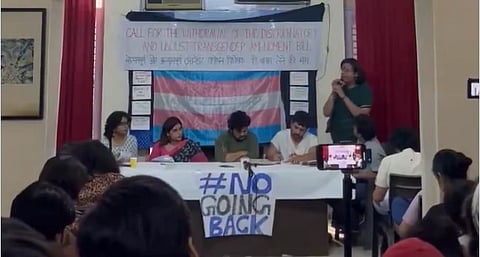
A Bill has been proposed in India’s lower house of Parliament that strikes at the core of transgender people’s right to bodily autonomy and privacy as guaranteed by the Supreme Court of India in a landmark 2014 judgment, National Legal Services Authority (NALSA) v. Union of India. Activists have therefore called the bill “unconstitutional” and “dangerous,” and as it is expected to soon become law, it has also heightened concerns and uncertainty about its impact.
The Transgender Persons (Protection of Rights) Amendment Bill, 2026 (“2026 Bill”) has been newly introduced in India’s ongoing Parliamentary Budget Session, proposing to amend the Transgender Persons (Protection of Rights) Act, 2019 (“2019 Act”), much to the chagrin of India’s transgender community.
According to activists, the proposed amendments to the 2019 Act threaten trans people’s safety and privacy in two ways. First, they narrow the definition of who counts as “transgender” by effectively excluding a wide range of identities, including, but not limited to, transgender men, non-binary and gender-fluid persons who do not fit into rigid gender categories, as well as many intersex and trans-feminine identities. Second, the amendments delete the provision of the law that explicitly guaranteed, within the text of the statute, the right to self-identification of one’s gender. Instead of self-identification, a person would now need to provide medical proof of gender change through surgery and submit a certificate issued by the Medical Superintendent or Chief Medical Officer to the District Magistrate, who, upon being satisfied with the correctness of the certificate, may issue a certificate indicating a change in gender.
The amendments also envision the creation of “medical boards” to certify gender identity. These boards are to be headed by a Chief Medical Officer or a Deputy Chief Medical Officer, and mandate that the District Magistrate issue certificates only after examining the recommendation of this board. The provision also allows the District Magistrate to seek the assistance of other medical experts if required.
Comics channel Sanitary Panels weighs in:

According to activists, the proposed amendments to the 2019 Act threaten trans people’s safety and privacy in two ways. First, they narrow the definition of who counts as “transgender” by effectively excluding a wide range of identities, including, but not limited to, transgender men, non-binary and gender-fluid persons who do not fit into rigid gender categories, as well as many intersex and trans-feminine identities. Second, the amendments delete the provision of the law that explicitly guaranteed, within the text of the statute, the right to self-identification of one’s gender. Instead of self-identification, a person would now need to provide medical proof of gender change through surgery and submit a certificate issued by the Medical Superintendent or Chief Medical Officer to the District Magistrate, who, upon being satisfied with the correctness of the certificate, may issue a certificate indicating a change in gender.
The amendments also envision the creation of “medical boards” to certify gender identity. These boards are to be headed by a Chief Medical Officer or a Deputy Chief Medical Officer, and mandate that the District Magistrate issue certificates only after examining the recommendation of this board. The provision also allows the District Magistrate to seek the assistance of other medical experts if required.
Another possible path is litigation through the courts after the Bill gets signed into law. However, petitions challenging several provisions of the Transgender Persons (Protection of Rights) Act, 2019, have already been pending before the Supreme Court since 2019, which means that relief through this route, if it comes at all, is unlikely to be immediate.
In the meantime, activists and members of the transgender community remain committed to ensuring that the Bill is withdrawn, allowing the law to return to the first principles outlined by the Supreme Court in NALSA.
[VP]
Suggested Reading:
Subscribe to our channels on YouTube and WhatsApp
Download our app on Play Store
