
- HOME
- OPINION
- ON GROUND
- INTERVIEW
- Neta Profile
- Editor's Pick
- INDIA
- NewsGram USA
- WORLD
- न्यूजग्राम
- POLITICS
- ENTERTAINMENT
- CULTURE
- LIFESTYLE
- ECONOMY
- SPORTS
- Jobs / Internships
- Misc.
- NewsGram Exclusive
This story by Mong Palatino originally appeared on Global Voices on September 07, 2026.
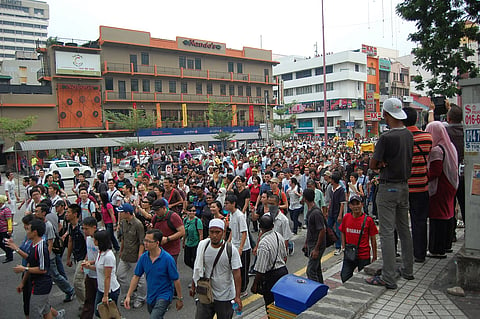
Human rights advocates are calling on the Malaysian government to amend the Peaceful Assembly Act, which contains several provisions that police and local authorities use to undermine, disrupt, and even criminalize protests and public assemblies. Despite months of promises to amend the controversial provision, the government has continually delayed reforms.
The law passed in 2012 and has been weaponized by successive governments to file harassment charges against protest organizers and leaders of civil society groups.
After years of condemning the law, civil society groups scored a crucial victory in 2025 when Malaysian Prime Minister Anwar Ibrahim pledged to amend the more extreme sections of the law, particularly Section 11, which requires a property owner’s consent before an assembly or protest is held in a particular place.
This was followed by a favorable Federal Court ruling in July 2025, which struck down Section 9(5) of the Peaceful Assembly Act as unconstitutional and invalid. Section 9(5) requires protest organizers to notify the police at least five days before a protest or rally. Failure to do this is considered an offense that authorities often invoke to threaten activists. The court ruling described the section as “a disproportionate intervention” that amounted to a prohibition rather than a restriction on guaranteed rights.
The government initially sought to review the ruling, but this was dropped after a Cabinet meeting in January 2026, which meant that the court’s decision remains in effect.
Despite the landmark court ruling and the government’s stated commitments, the bid to amend the law has stalled in Parliament over the past year.
Police violently broke up a protest in July 2025 near the Parliament building, as demonstrators demanded reform of the “draconian legislation.” Police also tried to prevent protesters from submitting a memorandum for lawmakers against the “oppressive law.”
Nalini Elumalai, senior Malaysia program officer at ARTICLE 19, a global human rights watchdog, condemned the police’s actions in a statement:
Authorities continued to invoke the law to threaten protest organizers, which led the Human Rights Commission of Malaysia (SUHAKAM) to issue a reminder in February 2026 addressed to law enforcement bodies.
In April 2026, Amnesty International Malaysia expressed dismay over the lack of any meaningful action to amend the law.
Amnesty International Malaysia’s spokesperson Divya Shesshsan Balakrishnan noted that anti-corruption activists and student protesters continue to be slapped with charges for organizing protests. He added that Malaysia’s global stance on human rights is often inconsistent with its local actions. For example, she argued that though the Malaysian government has been criticizing Israel’s attacks on the Palestinian people, it also ordered the arrest of some individuals who protested Israel’s interception of the Global Sumud Flotilla.
In August 2026, civil society groups urged Malaysia’s Parliament to present a clear timeline for reforming the Peaceful Assembly Act. In a press conference, Bersih advocacy officer Anas Nor’azim summed up the sentiments of human rights advocates. “The same promise continues to be repeated, but the long-awaited reform remains stuck in the study phase.”
[VP]
Suggested Reading:
Subscribe to our channels on YouTube and WhatsApp
Download our app on Play Store


