
- HOME
- OPINION
- ON GROUND
- INTERVIEW
- Neta Profile
- Editor's Pick
- INDIA
- NewsGram USA
- WORLD
- न्यूजग्राम
- POLITICS
- ENTERTAINMENT
- CULTURE
- LIFESTYLE
- ECONOMY
- SPORTS
- Jobs / Internships
- Misc.
- NewsGram Exclusive

Jamaat-e-Islami fields no women candidates and rejects women leadership on religious grounds.
Remarks spark nationwide criticism given Bangladesh’s history of female leaders.
The controversy adds a gender debate dimension to the 2026 election campaign.
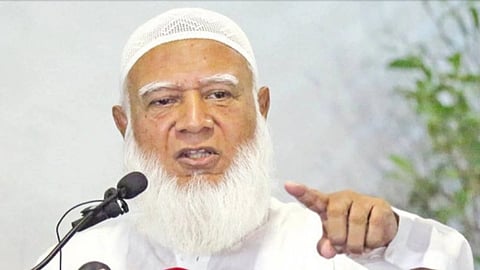
Bangladesh’s Jamaat-e-Islami, an Islamist movement is facing sharp scrutiny ahead of the 12 February 2026 elections after its chief Dr Shafiqur Rahman’s remarks on women in leadership positions. When asked about the absence of any female candidates in the upcoming election in a recent interview with Al Jazeera English, he said, “We are working on it.”
He further said that a woman could never be the head of Jamaat, reasoning that “what Allah made, we cannot change.” He then said:
He agreed that there is little representation of women in politics when considering other parties too and that they are “preparing” for greater participation of women candidates. He said that it is not a party policy but rather a societal norm, given that no party has nominated a “substantial number” of female candidates in the election.
The part of Rahman’s comments that received significant attention was when he criticised modern employment patterns for women, continuing that women exposed outside the home are prone to exploitation and moral decline. As the backlash grew across Bangladesh’s political spectrum, Jamaat claimed that Rahman’s account was hacked, leading to such social media posts. However, the interview itself was widely shared online.
The statement has drawn criticism across social media, with many denouncing it as regressive and inconsistent with Bangladesh’s political history. Bangladesh has been governed for long periods by two female Prime Ministers, Khaleda Zia and Sheikh Hasina, highlighting how women hold important positions in national politics. The controversy comes at a time of a highly competitive election environment, when the Jamaat-led alliance is seeking to expand its influence, complicating the situation.
The polls will be held on 12 February 2026, and Bangladesh is currently being governed by an interim administration led by Nobel laureate Muhammad Yunus following the ousting of the Awami League government in 2024. As a result, the Awami League has been barred from participating in the elections, reshaping political alignments and increasing the stakes for opposition parties, including Jamaat-e-Islami.
Jamaat has promised a “safe and dignified environment” for women in its manifesto; however, it has contradicted itself by not nominating even one female candidate. This has led to renewed discussion over gender representation in Bangladesh’s politics.
(SY)
Suggested Reading:
Subscribe to our channels on YouTube and WhatsApp
Download our app on Play Store
