
- HOME
- OPINION
- ON GROUND
- INTERVIEW
- Neta Profile
- Editor's Pick
- INDIA
- NewsGram USA
- WORLD
- न्यूजग्राम
- POLITICS
- ENTERTAINMENT
- CULTURE
- LIFESTYLE
- ECONOMY
- SPORTS
- Jobs / Internships
- Misc.
- NewsGram Exclusive

Key Points
Deepavali becomes India’s 16th cultural element on UNESCO’s Intangible Cultural Heritage list.
The announcement came during the 20th session of the Intergovernmental Committee for the Safeguarding of the Intangible Cultural Heritage - the first to be held in India.
The announcemeent was celebrated, with PM Modi saying the festival “is the soul of our civilisation.”
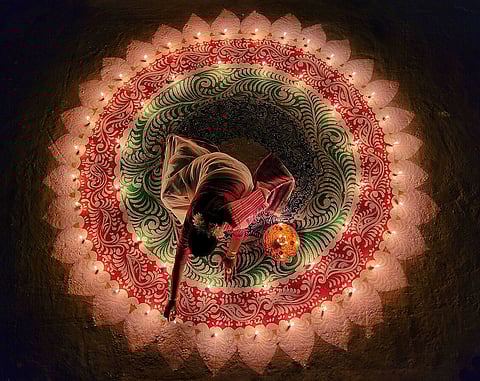
Deepavali, the Indian festival of lights, has officially been inscribed on UNESCO’s Representative List of the Intangible Cultural Heritage of Humanity. The announcement was made on Wednesday, 10 December 2025, during the 20th session of UNESCO’s Intergovernmental Committee for the Safeguarding of the Intangible Cultural Heritage, hosted for the first time in India at Delhi’s Red Fort.
The meeting was chaired by Vishal V. Sharma, India’s Ambassador and Permanent Delegate to UNESCO. Minister of Culture Gajendra Singh Shekhawat celebrated the recognitio saying, “This UNESCO tag is also a responsibility; we must ensure Deepavali remains a living heritage.”
The 2025 session will evaluate 67 nominations from nearly 80 countries. The session commenced on 8 December 2025 and is set to conclude on 13 December 2025.
Celebrations broke out at the Red Fort complex as UNESCO announced its decision. Chants of “Jai Hind”, “Vande Mataram” and “Bharat Mata ki Jai” echoed through the venue, accompanied by performances from artistes in traditional attire as visuals of Deepavali lit up giant screens.
“For every Indian, Deepavali is deeply emotional, it is felt, lived, absorbed across generations,” said Union Minister Shekhawat in his address. Later, on social media, he congratulated PM Modi for elevating Indian culture on global platforms. Modi himself welcomed the inscription, saying in a social media post that the festival “is the soul of our civilisation.”
Pakistan also congratulated India, with a diplomat from its High Commission acknowledging the significance of the inscription.
The United Nations Educational, Scientific and Cultural Organization (UNESCO) defines Intangible Cultural Heritage (ICH) as traditions, expressions, rituals, and knowledge inherited across generations. Unlike monuments or artifacts, these are living practices – performing arts, festivals, skills, crafts and social customs.
Traditional and Contemporary: evolving practices, rooted in community identity.
Inclusive: shared across regions and adapted by different groups.
Representative: valued not for exclusivity but for the knowledge it carries, passed down through communities.
Community-based: recognised and maintained by the people who practice it.
The Intangible Heritage List aims to safeguard these practices, promote cultural diversity and encourage global dialogue. UNESCO emphasises that the value lies not in the rituals themselves, but in the knowledge, skills and social meaning passed from one generation to the next.
With Deepavali’s addition in 2025, India now has 16 cultural elements on UNESCO’s Representative List:
Durga Puja of Kolkata (2021)
Kumbh Mela (2017)
Nowruz (2016)
Traditional brass and copper utensil-making of Punjab’s Thatheras (2014)
Sankirtana of Manipur (2013)
Buddhist chanting of Ladakh (2012)
Chhau dance, Kalbelia dance of Rajasthan, Mudiyettu of Kerala (2010)
Ramman festival of Garhwal (2009)
Kutiyattam Sanskrit theatre, Ramlila, Vedic chanting (2008)
The 2025 UNESCO Intangible Cultural Heritage list features a wide range of living traditions from around the world.
From West Asia, Jordan’s Al-Mihrass tree rituals and Iraq’s Al-Muhaibis social practices were inscribed, alongside the Hadrami Dan gathering of Yemen and Kuwait’s Diwaniya, a unifying cultural tradition.
Europe contributed elements such as amateur theatre acting in Czechia, bagpipe craftsmanship and performance in Bulgaria, Belgium’s rod marionette tradition, and Italy’s recognition for Italian cooking as a biocultural practice.
In addition to Deepavali, South Asia saw the inclusion of Tangail saree weaving from Bangladesh.
Africa and the Caribbean added diverse expressions, including Ghana’s Highlife music, Ethiopia’s Gifaataa New Year festival, Haiti’s Compas, and Chad–Cameroon’s Guruna pastoral retreats.
The Americas were represented by Argentina’s Cuarteto, Mexico’s Iztapalapa Passion play, Bolivia’s Virgen of Guadalupe festivity, and Peru’s Sarawja dance.
Several multinational entries, such as the Arab world’s Bisht-making tradition and the Zaffa wedding procession, highlighted shared cultural practices across regions.
Suggested Reading:
Subscribe to our channels on YouTube and WhatsApp
Download our app on Play Store

.jpg)