
- HOME
- OPINION
- ON GROUND
- INTERVIEW
- Neta Profile
- Editor's Pick
- INDIA
- NewsGram USA
- WORLD
- न्यूजग्राम
- POLITICS
- ENTERTAINMENT
- CULTURE
- LIFESTYLE
- ECONOMY
- SPORTS
- Jobs / Internships
- Misc.
- NewsGram Exclusive

Indian Navy Day on 4 December marks the success of Operation Trident and the Navy’s 2025 theme.
It highlights the Navy’s evolution from colonial roots to a modern maritime force.
The day celebrates India’s naval legacy and the Navy’s role in security and humanitarian operations.
The American strategist and historian Alfred Thayer Mahan described the importance of a country’s naval strength through his statement, “Sea power is essential to the life of a nation.” India, being a country with a long coastline and extensive maritime interests, honours its Navy each year on 4th December, marking it as Indian Navy Day. India is committed to self-reliant defence and maritime security, which reflects the theme of the year for Navy Day: “Combat Ready, Cohesive and Self-Reliant.”
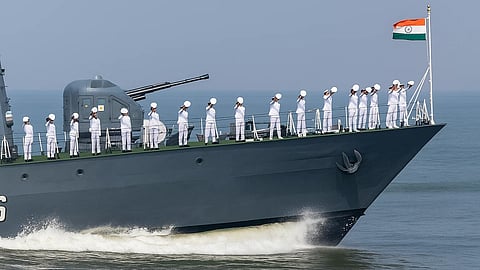
The Indian Navy takes the opportunity to display its operational capabilities before the public by demonstrating its ships, submarines, aircraft and special-force units. It also makes an effort to connect the force with citizens, especially the youth, through naval band performances, honouring veterans, laying wreaths for martyrs and shore-based outreach. The celebration was marked by an “Operational Demonstration” where warships, submarines, aircraft and elite marine commandos participated at Shanghumugham Beach in Thiruvananthapuram in 2025. However, Navy Day is not just about the show but also about remembering the origin and evolution of the Indian Navy, along with its achievements, sacrifices and continued mission to protect India’s maritime interests.
The celebration of Navy Day on 4th December emerged owing to Operation Trident, launched on the port city of Karachi, Pakistan by the Indian Navy. It was carried out on the night of 4th December during the Indo-Pakistan War of 1971, when the Indian Navy used anti-ship missiles for the first time in combat. The operation destroyed Pakistani naval and economic infrastructure, as Pakistan lost its destroyer PNS Khaibar along with the damage sustained in the fuel depots at Kemari. It was a moment of triumph for India, as the Navy succeeded in the operation with zero casualties. India used its vessels, which included missile boats like INS Nipat, INS Nirghat and INS Veer. The day was then commemorated as Navy Day to pay tribute to the valour, strategic foresight and naval capability demonstrated during the operation, highlighting the effectiveness and reach of the Navy.
Earlier, during the colonial era, Navy Day used to be celebrated on 21st October by the Indian Navy, which was then called the Royal Indian Navy. The date then shifted multiple times through the early decades after independence. Navy Day was observed on 15th December for a period after 1947. However, after the India-Pakistan War of 1971, Navy Day was settled to be observed on 4th December as a remembrance of the moment of operational triumph rather than the day being a colonial commemoration. Thus, the day serves as a rewriting of naval heritage, blending pre-independence lineage acknowledgement with the foregrounding of post-independence achievements.
The Indian Navy has a long history whose roots take us back to the marine services maintained by the East India Company in the 17th–18th centuries. This later gave rise to the Bombay Marine, which evolved into the Royal Indian Marine and later came to be known as the Royal Indian Navy under British rule. However, the assets and personnel of the Royal Indian Navy were divided between India and the newly created Pakistan in 1947 with the partition.
The Indian component was then formally called the “Indian Navy” after India became a republic on 26th January 1950. The Navy expanded in the following decades into a modern force with warships, submarines, aircraft, shore infrastructure, and naval aviation and marine commando capabilities. The Indian Navy matured from a scattered colonial fleet into a modern blue-water navy through technological and strategic advancements, as India continued to rise, proving its maritime importance and responsibilities in the Indian Ocean region.
The Indian Navy has proved itself multiple times through wartime operations, sea-lane security, humanitarian assistance, disaster relief and diplomacy, with Operation Trident standing out as one of the most symbolic milestones. It is not just in war that the Navy has excelled but also in securing sea-lanes, combating piracy and performing maritime surveillance. It has played its role in India’s commitment to global maritime security by protecting merchant vessels and ensuring safe shipping routes in places like the Gulf of Aden.
The Navy has also extended its capacity by contributing to humanitarian assistance and disaster relief (HADR). It has evacuated Indian nationals from conflict zones by coordinating rescue missions and delivering supplies using its ships, helicopters and medical and logistic teams. Thus, the modern navy is characterised by the blend of being combat-ready while also being humanitarian-minded, showcasing its dual capability.
Chhatrapati Shivaji Maharaj has been symbolically regarded as the Father of the Indian Navy by the public owing to his visionary strategies and maritime accomplishments that laid the foundation for naval traditions in India. He has been credited with the construction of fortified coastal bases, the establishment of a seagoing force and the commissioning of naval activity along the western coast. This marked the emergence of one of the earliest organised indigenous naval traditions in the subcontinent. However, the modern-day navy highlights a balanced approach between Shivaji’s indigenous legacy and colonial inheritance, leading to a post-independence transformation.
The day fosters awareness of maritime issues among the youth, inspiring future generations by reinforcing the fact that naval security aligns with national prosperity, peace and development. The Navy’s existence is a reaffirmation of courage, sacrifice and strategic responsibilities, combined with a commitment to self-reliance and readiness for any situation. The Indian Navy has stood strong in the face of piracy, natural disasters, humanitarian crises, energy security challenges and geopolitical rivalry. Indian Navy Day demands not only respect for the past but also a resolve for the future.
Suggested Reading:
Subscribe to our channels on YouTube and WhatsApp
Download our app on Play Store
