
- HOME
- OPINION
- ON GROUND
- INTERVIEW
- Neta Profile
- Editor's Pick
- INDIA
- NewsGram USA
- WORLD
- न्यूजग्राम
- POLITICS
- ENTERTAINMENT
- CULTURE
- LIFESTYLE
- ECONOMY
- SPORTS
- Jobs / Internships
- Misc.
- NewsGram Exclusive

Key Points
Colobus congoensis is only the fifth new African monkey species identified in 75 years, found in a remote stretch of the Congo Basin.
Junior Amboko named the species in honor of his homeland's biodiversity, marking the first primate ever named after the DRC.
Researchers warn the species faces threats from hunting for bushmeat and habitat loss, confining it to a small geographic range.
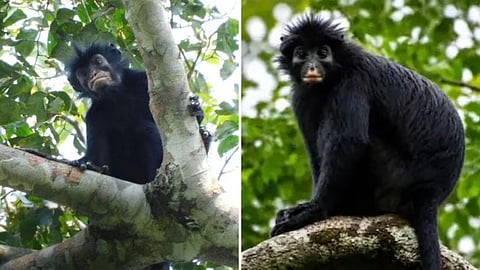
THE DIVERSITY OF FLORA AND FAUNA ON EARTH is unmatched. As of yet, over 8.7 million different species have been identified, though only about 2.2 million have been formally discovered and categorized to date. Yet, life continues to surprise, with scientists discovering new species every now and then. In one of the rarest discoveries in modern primatology, scientists have found a new monkey species hidden deep in the forests of the Democratic Republic of Congo: a black furred, “orange-lipped” monkey now scientifically known as “Colobus congoensis.” The primate was found in a remote region in the Congo Basin, and hitherto remained undocumented despite years of exploration in Central Africa.
The ‘discovery’ was made by a team of researchers and scientists from Florida Atlantic University, the Lukuru Wildlife Research Foundation, Yale University, the City University of New York, as well as Lomami National Park, Frankfurt Zoological Society. The international team of personnel conducted years of research to formally identify and document the new monkey species, and published their findings in the PLOS ONE journal.
The mysterious monkey was discovered in the remote intersection between the Lomami and Congo (Lualaba) rivers in east-central Democratic Republic of the Congo (DRC), one of Central Africa’s most biologically significant regions.
In the past 75 years, only four new African monkey species have been found, and now Likweli being the fifth. Researchers say that this new discovery is a reminder of the importance of conservation in a region that is under threat from hunting pressures and habitat loss.
The monkey, known among local communities as “Likweli,” has one distinct identifying aspect: muted orange patches around its mouth, hence the term “orange-lipped monkey” given by scientists. The Likweli has a shiny black coat of fur with a glossy finish that catches light, long tail, and “spiky hair” at the top of its head. Additionally, the monkey has a “roaring” call that can be heard over long distances.
See also: Dominican Republic: Is Protecting Your Environment a Way to Love Your Country?
Likweli is a primate of the Colobus genus, though it is different from other animals of its group as it has only four fingers and is smaller in size. Within the colobus genus, the Likweli are a much smaller species, sporting a white patch on their backside and orange patch around their mouth. Researchers say that it is not clear whether this new monkey species is a sub-species of an existing monkey, or a completely new species.
“This discovery is both exciting and deeply personal, highlighting the extraordinary biodiversity of my homeland and how much remains undocumented,” said Junior Amboko, co-author of the study, a Ph.D. student in the Department of Biological Sciences in FAU’s Charles E. Schmidt College of Science.
Amboko remarked that he named the species Colobus congoensis in recognition of the Congo basin’s “remarkable natural heritage.” He further remarked that this new species is the first primate named after the Democratic Republic of Congo itself, which is a matter of local pride and global importance.
The clever primate has been evading detection and identification for almost two decades. Back in 2008, observers first spotted the Likweli but only managed to capture a blurry photograph of it. Ten years later, the animal was again spotted in 2018 and a much clearer image was obtained, leading scientists to confirm that they've witnessed a completely new species.
Over four years, Junior Amboko along with his team observed the monkey in its natural habitat and recorded its vocalizations. They also questioned local communities, a large part of whom were unfamiliar with the Likweli. Out of 52 communities, only 8 stated that they've seen or heard of the species.
As the monkey species is hunted for its meat, researchers were also able to recover some dead specimens of the animal to study their bodies and extract genetic samples to compare with those from a nearby population of related monkeys. Genetic, acoustic, and anatomical analysis of the Likweli have confirmed that the monkey is part of a distinct evolutionary lineage that diverged from its closest known relative 4 to 5 million years ago.
Researchers warn that the Colobus congoensis is an endangered species. Habitat loss from hunting and or land cultivation has forced the species to occupy a small geographical zone, as well as the killing of the monkey for its meat make matters worse.
(Proofread by Anshika Verma)
Suggested reading:
Subscribe to our channels on YouTube and WhatsApp
Download our app on Play Store
