
- HOME
- OPINION
- ON GROUND
- INTERVIEW
- Neta Profile
- Editor's Pick
- INDIA
- NewsGram USA
- WORLD
- न्यूजग्राम
- POLITICS
- ENTERTAINMENT
- CULTURE
- LIFESTYLE
- ECONOMY
- SPORTS
- Jobs / Internships
- Misc.
- NewsGram Exclusive
This story by Daria Dergacheva originally appeared on Global Voices on February 13, 2026.
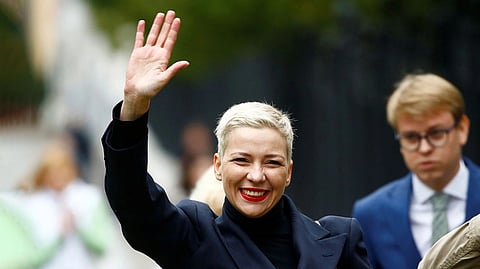
The latest US-negotiated release of political prisoners from Belarus in December 2025, included high level political figures from the 2020 Belarus protests, and among them, Maria Kalesnikava.
Kalesnikava had for a long time been the second after Sviatlana Tsikhanovskaya, a symbolic figure of Belarusian protests and opposition forces. She entered Belarusian politics shortly before the 2020 presidential election by joining the campaign team of banker and philanthropist Viktor Babariko, who was considered Lukashenka’s main rival in the upcoming vote. In June 2020, writes Meduza, a month and a half before the election, Viktor Babariko and his son Eduard were detained. After that, Kalesnikava became the face of Babariko’s campaign. She teamed up with Sviatlana Tsikhanouskaya, the only opposition candidate allowed to run,and together they traveled around the country holding rallies (permitted as part of the official campaign).
The presidential election 2020 in Belarus took place on August 9. Lukashenka was declared the winner; Tsikhanouskaya was forced to leave for Lithuania; large protests started and were suppressed by force in Belarus. In September 2020, security forces attempted to deport Kalesnikava to Ukraine, but she tore up her passport right at the border, Meduza reminds us. Kalesnikava was arrested and sentenced to 11 years in prison in a case over an alleged attempt to seize power.
Kalesnikava and Babariko both served their sentences under extremely harsh conditions, in isolation from the outside world, under pressure from prison authorities and without access to proper medical care. It was reported that the elder Babariko was beaten, hospitalized, and sent to a punishment cell. Kalesnikova was also hospitalized in prison.
The release of Kalesnikova and Babariko sparked enthusiasm:. But disputes quickly followed.
The thing is, Maria Kalesnikava made several statements that go against the ‘traditional’ policies of both the Belarusian opposition in exile as well as the EU politicians.
On January 19, 2026, in an interview with the Financial Times, she said: “The more Belarus is isolated from Europe, the more it is forced to move closer to Russia. This makes Belarus less safe and less predictable for Europe.” This is part of her argument that the EU should have a dialogue with Lukashenka. “Lukashenka is a pragmatic person. He understands the language of business. If he is ready to take humanitarian steps in response to sanctions relief, including the release of prisoners and allowing independent media and NGOs into Belarus, this should be discussed,” Kalesnikava said.
On February 3rd, at the meeting with the Lithuanian prime minister, Kalesnikova called for increasing the mobility of Belarusian citizens between Lithuania and Belarus, stressing the importance of more intensive movement with Europe and proposing the restoration of passenger rail service on the Minsk–Vilnius route, as well as bus routes. The response by Prime Minister Inga Ruginienė, was that she currently sees no opportunities for this. She said:
In an interview with a popular Russian journalist in exile, Yury Dud, Maria Kalesnikova explained why she thought it was necessary to talk to Lukashenka. “If dialogue liberates people, that's good. If dialogue ends repression and stops punishing people for expressing their opinions, that's very good,” she said.
However, the position of other Belarusian political figures in exile, including Tsikhanovskaya, has always been against any talk with Lukashenka. And, as the Financial Times notes, Kalesnikava’s approach runs counter to the EU’s current policy: maintaining contacts with Belarusian democratic forces in exile, minimizing interaction with the Lukashenka regime, and preserving economic sanctions, the ban on air travel, and stricter visa rules for Belarusian citizens.
Belsat media, currently working from Poland, had published some opinions of other Belarusians in exile.
Politician Pavel Latushko, who served as Belarus’s minister of culture before 2020, said that under the approach Kalesnikava proposes, Belarusian democratic forces would be excluded from the dialogue between Minsk and Brussels.
Politician Anatoly Lebedko highlighted that, during more than 30 years of Lukashenka’s rule, Europeans have repeatedly tried to establish contact with him, offering not only sanctions relief but also investments. This did not lead to systemic changes and ended roughly the same way each time: protests flared up again in Belarus, Lukashenka again responded with violence and imprisoned people, and then released them in exchange for the easing of restrictions by Western countries.
Several other commentators, as Meduza mentions, expressed their views in social media channels. Activist and former political prisoner Nikolai Dedok, representative of the opposition association of Belarusian security officials BelPol Vladimir Zhigar, and former head of the fund that helped victims of repression BySol Andrei Strizhak noted that Europe abandoned dialogue with official Minsk not only because of the repression after 2020, but also because of Belarus’s complicity in Russia’s full-scale invasion of Ukraine in February 2022.
In particular, Dedok said:
Radio Liberty political observer Valery Karbalevich told Belsat that disagreements over which approach toward Lukashenko is more effective, hardline (as in Europe) or flexible (as with the current US Trump administration), have existed for a long time, but have intensified. He said:
Meanwhile, the regime in Belarus does not go easy on its opponents. Belarusian human rights movement Viasna has described the horrible conditions that people detained for political dissent face in a state temporary detention center (called Akrescina) while awaiting trial. They report that the detention conditions at Akrescina amount to torture. Detainees are kept in inhumane conditions without access to basic hygiene products or clean clothes for the duration of their 28-month detention.
Human Rights Watch, while supporting the latest release of political prisoners in Belarus, notes that over 1,100 people are still imprisoned for peacefully exercising their rights in Belarus.
Among them are human rights orgnization Viasna's board member and human rights defender Valiantsin Stefanovic; Viasna activist and volunteers’ coordinator Marfa Rabkova; and Nasta (Anastasia) Lojka, a prominent human rights advocate. All are serving draconian prison sentences in Lukashenka's Belarus.
(SY)
Suggested Reading:
Subscribe to our channels on YouTube and WhatsApp
Download our app on Play Store

