
- HOME
- OPINION
- ON GROUND
- INTERVIEW
- IPL 2026
- INDIA
- NewsGram USA
- WORLD
- न्यूजग्राम
- POLITICS
- ENTERTAINMENT
- CULTURE
- LIFESTYLE
- ECONOMY
- SPORTS
- Jobs / Internships
- Misc.
- NewsGram Exclusive
By- Khushi Bisht
The Philippines is a large archipelago with about 7100 islands. It was named after the prince of Spain, Philip II, by a Spanish adventurer named Ruy López de Villalobos in 1544. The Philippines' pre-Spanish past was veiled in an enigma. Nobody ever questioned what the archipelago was termed even before the Spaniards gave it the name Philippines some four centuries ago. However, recent findings have helped to clear the haze surrounding the Philippines.
In ancient India, the Philippines was known as "Suvarnadvipa" which means the "Golden Island." The Philippines, like many other Southeast Asian nations, has been impacted by the ancient Indian civilization. It is said, from the 2nd to the late 14th centuries CE, the impact of Indian civilization on the Philippines grew stronger via the maritime route.
ALSO READ: Sanskrit: The Deva-Vani
Through many trade trips from India, historical regions in the Philippines were heavily impacted by Hindu-Buddhist faiths, speech, cultural values, literary works, and belief systems. Indo-Sanskrit impacts extended over the Philippines archipelago before the arrival of the Westerners. In various Philippine languages, Sanskrit and Tamil account for approximately 25 percent of the vocabulary.
Sanskrit was one of the earliest non-Austronesian languages to have a significant influence on Tagalog. Despite being from separate linguistic families, Sanskrit and Filipino share several terms in common. Researchers presume that the ancient Filipino alphabet emerged from India and that the Sanskrit language is responsible for nearly a quarter of the Tagalog language's words.

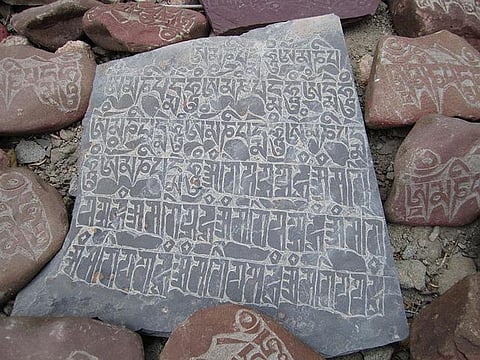
The word "Sanskrit" in Chinese and English.Wikimedia Commons
Sanskrit and Tamil have left a linguistic imprint on Tagalog as well as other Filipino languages that can still be seen today. Dozens of Sanskrit words are still spoken on the Philippines archipelago. In this article, we'll look at some of the similarities between the two languages, both of which are descended from Sanskrit.
Asa- In Tagalog, the word "Asa" means "hope." It comes from the Sanskrit word "Asha," which has the same meaning.
Bahala- In Filipino, the word "Bahala" denotes "concern," "responsibility," "burden." This word is thought to have evolved from the Sanskrit word "Bhara," which implies "weight, burden, pressure, or load."
Bathala- It's the Tagalog word for the highest deity and it's thought to have stemmed from the Sanskrit word "Batara Guru," which means "noble lord."
Dukha- "Dukha" is a Sanskrit word that means "pain and suffering" or "sadness," but it is used to describe "poor" or "needy" in Filipino.
Diwata- In Filipino, "Diwata" refers to a spirit or a subordinate god or goddess who is said to protect forests. The Sanskrit term "Devta," which means "divine being," is assumed to be the source of this name.
Guro- In both languages, this word is used to refer to a "teacher." In Sanskrit, however, the word is pronounced "Guru."
Kapas– The word "Kapas" implies cotton in both languages.
Katha- The word "Katha" in Filipino means "story" or "tale." Katha is also a Sanskrit word that means "tales of all kinds." In Sanskrit, the word "Gatha" also means tale.
Likha- In Filipino, this word signifies literature or the ability to create anything with intellect and expertise. It means "to write" in Sanskrit.
Mukha- In both Tagalog and Sanskrit, the word "Mukha" refers to "the face."
Naga- In Tagalog, it refers to a serpent, dragon, or mermaid. It is derived from the Sanskrit word "naga," which means "serpent" or "serpentine."
The Sanskrit language is responsible for nearly a quarter of the Tagalog language's words. Wikimedia Commons
These were merely a few Filipino words with similar meanings to the Sanskrit ones. However, Tagalog people employ a large number of Sanskrit words in their everyday conversations.
According to researchers, Hindu ideas and mythology came to the Philippines around the 9th to 10th centuries. The Philippines' folk literature bears a strong influence from ancient Indian civilization. The Mahabharata and the Ramayana, share similar traits, narratives, climaxes, and concepts from the folk writings as well as other major epics from the Philippines.
The Philippines has its own rendition of the Ramayana. In the Philippines archipelago, the Ramayana is known as 'Maharadia Lawana,' which translates as 'King Ravana.'
All of this demonstrates how influential Indian culture was in the Philippines.
Subscribe to our channels on YouTube and WhatsApp
Download our app on Play Store
