
- HOME
- OPINION
- ON GROUND
- INTERVIEW
- Neta Profile
- Editor's Pick
- INDIA
- NewsGram USA
- WORLD
- न्यूजग्राम
- POLITICS
- ENTERTAINMENT
- CULTURE
- LIFESTYLE
- ECONOMY
- SPORTS
- Jobs / Internships
- Misc.
- NewsGram Exclusive

Chandragupta Maurya relied on elite female bodyguards as his trusted protectors.
Women guards were strategically chosen to counter palace threats.
The Mauryan Empire empowered women in key security and intelligence roles.
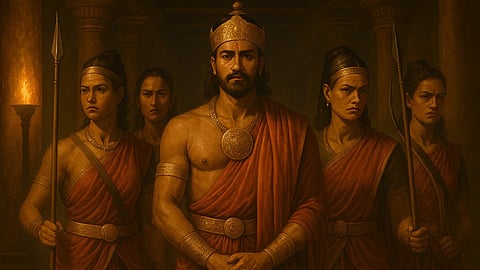
Ancient India was a world where women played revolutionary roles, shaping power long before it was recorded in history. We have seen women in the roles of poets, healers, philosophers, and even queens, but the Mauryan Empire was far ahead of its time, as women rose as bodyguards carrying weapons instead of ornaments in the late 4th century BCE. They were not attendants who stood behind royalty but protectors who stood around them. They protected the ruler Chandragupta Maurya, leaving travellers from around the world, including Greeks, astonished at the unusual sight. They even recorded the same.
The founder of the Mauryan Empire, Chandragupta Maurya, is known for an extraordinary administrative discipline, uniting much of the Indian subcontinent under a centralised state. The security of the ruler was treated as a matter of great importance amid this imperial machinery. The Greek ambassador to the Mauryan court, Megasthenes, stated that Chandragupta Maurya was surrounded by armed women, especially within the palace. The women also escorted him during his hunts and were trained fighters rather than ornamental escorts embellishing the royal entourage. They formed the inner operational circle of protection before anyone could approach the emperor, as per Megasthenes.
The female bodyguards are also mentioned by Chandragupta’s mentor and chief strategist Kautaliya in the foundational political treatise Arthashastra. These female bodyguards were called “Striganair dhanvibhihi,” which literally translates to “women armed with bows.” The text specifies that the king should be received first by these female guards early in the morning as part of a structured security arrangement, which was more than a ceremonial greeting. The Arthashastra focused on governance, espionage, and statecraft, so the mention of female bodyguards gave their existence institutional importance rather than making them appear incidental.
The royal palace of the Mauryan era can be described as both the seat of power and the breeding ground for intrigue. The Arthashastra bluntly says that a king’s “most untrustworthy people are his own queens and his own children,” showcasing a clear distrust of the king’s immediate family. It sounds ruthless, but some historical stories support this, such as those of Viduratha, Vairanya, and the King of Kashi, who were all believed to have been killed by close relatives. The instances of rulers being betrayed by their own family members are found throughout Indian history, from epic narratives to early dynastic chronicles. They shaped political thought, cautioning rulers in both history and mythology.
Thus, the female bodyguards were linked to a strategy born of necessity. A male bodyguard would be restricted by social taboos while confronting a female attacker or assassin, such as a concubine or queen. He would fear that his actions might violate boundaries within the harem, placing the king’s safety at risk. However, this was not the case for a female guard, as she faced no such constraints, making her an effective means of neutralizing threats without fear of impropriety. Kautaliya beautifully described the way gender was weaponised to protect the monarch, given that the royal premises were a gendered space.
The Mauryan worldview placed women in multiple active roles, and female bodyguards were one of them. They were spies, couriers, performers, and palace officials, making the court more systematic. There were even female agents who went forth on espionage missions, as their presence was less noticeable, especially in gathering intelligence in domestic environments. They highlighted utility over convention, reflecting the practical approach of the empire’s ethos. Women were recruited based on their efficiency in fulfilling state functions, as their gender automatically placed them in positions of strategic advantage.
The Indian subcontinent had gone through centuries of palace coups, dynastic instability, and the violent ambitions of royal families when power was bestowed upon Chandragupta Maurya. The empire thrived by promising order, discipline, and centralised authority, and the female bodyguards contributed to the palace’s larger security overhaul. The female warriors were recruited, trained, and monitored closely inside the palace, ensuring their loyalty through a controlled setup. Earlier kingdoms had turbulent courts, which contrasted with the relative stability of Chandragupta’s rule, strengthened by the presence of female guards.
India later saw women leading as Rajput warrior queens and women archers in tribal polities, but the structured female corps of the Mauryan era remains a distinct account from early Indian history, making it the foundation or breeding ground for such advances. This defines how ancient India had a strategically flexible political world, redefining societal gender roles.
The legacy stands as a tale of a pragmatic empire that rose above stereotypes to recognise skill, as women stood at the centre of political power with weapons to guard a rising civilisation. The stories converge evidence from Greek and Indian sources, bringing together two independent perspectives, one administrative and the other observational.
Suggested Reading:
Subscribe to our channels on YouTube and WhatsApp
Download our app on Play Store
