
- HOME
- OPINION
- ON GROUND
- INTERVIEW
- Neta Profile
- Editor's Pick
- INDIA
- NewsGram USA
- WORLD
- न्यूजग्राम
- POLITICS
- ENTERTAINMENT
- CULTURE
- LIFESTYLE
- ECONOMY
- SPORTS
- Jobs / Internships
- Misc.
- NewsGram Exclusive

Trans women marry gods one night and become widows the next in ancient Indian festivals.
Rooted in mythology, these rituals symbolise devotion, loss, and spiritual acceptance.
Practised for centuries, the traditions reflect India’s inclusive cultural imagination.
India has always been a country defined by its culture and traditions, narrating stories through rituals. These traditions continue from grand temple festivals to quiet village customs, preserving memory, belief, and belonging, not merely marking dates on a calendar. They included those who lived beyond the boundaries placed by society even before the existence of classrooms and courtrooms, where modern debates about identity and inclusion found space. One such powerful ritual, with stories of its own, is the festival where trans women marry a god one night and become widows the next day.
The festivities have different names in different parts of the country, but the core remains the same. States like Maharashtra, Karnataka, Tamil Nadu, and Gujarat celebrate trans women as they participate in sacred ceremonies that convey marriage, loss, devotion, and grief, all unfolding within 24 hours. The ritual has its roots in mythology, faith, and long-standing cultural acceptance, although it may seem unusual or shocking to many.
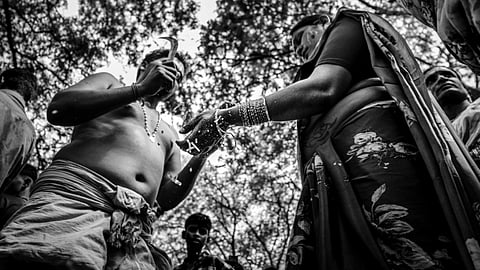
The festival of Chudi Pournima is observed in Maharashtra and Karnataka and is dedicated to Goddess Yellamma, a revered folk deity of southern India. Trans women dress as brides, adorned with jewellery and red and green saris, to symbolically marry the Goddess. The celebration then takes a dramatic turn, as the Goddess is believed to “die” at night during the fire ceremony, making the brides widows. This is followed by mourning rituals performed by widows through breaking bangles, wailing, and beating their chests, symbolising widowhood. The grief runs deep, signifying spirituality and lived reality for the participants, and not merely a performance.
Saundatti (Savadatti) in Karnataka witnesses the largest and most significant gathering during Chudi Pournima, as it is home to the largest temple dedicated to Goddess Yellamma. Maharashtra celebrates the festival on a comparatively smaller scale, as Karnataka is closely associated with the Goddess and serves as one of the most important pilgrimage sites. The gathering here runs into the thousands, making it one of the most visible and emotionally intense trans-centred rituals in India.
Tamil Nadu celebrates the Koovagam, or Aaravan festival, which is similar in essence but has its own distinct features. Trans women marry God Aaravan, a pivotal character from the Mahabharata, in the village of Koovagam. The festival traces its origins to the epic, where Aaravan, the son of Arjuna and the Naga princess Ulupi, was fated to die in the Kurukshetra war as a sacrificial offering for the Pandavas’ victory. Aware of his destiny, Aaravan expressed his final wish: to die as a married man. No woman was willing to marry him, knowing she would become a widow the very next day.
To fulfil Aaravan’s wish, Lord Krishna took the form of Mohini, a woman of divine beauty, and married him. Aaravan was killed in battle the following day, making Mohini a widow. She then grieved publicly, removing the symbols of marriage, a moment that is recreated every year in Koovagam. Trans women symbolically marry Aaravan by tying the sacred thaali and celebrating as brides, followed by mourning the next day, crying over their loss. The transformation is swift, symbolic, and deeply moving as they shift from brides to widows.
These festivals are not mere spectacles but represent a form of acceptance rooted deep in history for the transgenders. The rituals are acts of devotion, drenched in faith and mythology, offering sacred validation to trans women who have historically been excluded from mainstream social institutions like marriage. They symbolise spiritual belonging rather than conventional social legitimacy. Through these festivals, their womanhood is acknowledged, recognising their capacity to love and grieve as they take on the roles of bride and widow within the framework of religion itself.
These age-old festivals have continued for centuries, conveying experiences centered around identity, desire, loss, and belonging, long before the vocabulary of “transgender” existed. They stand as reminders that Indian society has inclusion embedded in its cultural and spiritual core, accommodating differences meaningfully, if not always perfectly. In these rituals, faith offers dignity to a section of society often failed by social structures. Quiet yet powerful, the tradition reiterates that there has always been space for everyone in India’s spiritual imagination, enacting a cycle of love and loss that seamlessly blends mythology with real life.
Suggested Reading:
Subscribe to our channels on YouTube and WhatsApp
Download our app on Play Store
