
- HOME
- OPINION
- ON GROUND
- INTERVIEW
- Neta Profile
- Editor's Pick
- INDIA
- NewsGram USA
- WORLD
- न्यूजग्राम
- POLITICS
- ENTERTAINMENT
- CULTURE
- LIFESTYLE
- ECONOMY
- SPORTS
- Jobs / Internships
- Misc.
- NewsGram Exclusive

The Black Orlov is believed to have once been a 195-carat diamond known as the “Eye of Brahma,” allegedly stolen from an Indian temple
The diamond became linked to a series of unverified suicides involving a diamond dealer and two Russian aristocrats, which cemented its reputation
After being cut into three pieces in the 1950s, the diamond resurfaced safely in auctions. Despite dramatic tales, historians dispute most claims.
Diamonds are beautiful crystals used in jewellery and are extremely precious. Their beauty is captivating, and so are the stories that surround them. The curses of the Hope Diamond, the Koh-i-Noor, the Shah Diamond, and, most notably for today’s story, the Black Orlov Diamond, have long fascinated people. The Black Orlov is believed to bring misfortune and even death to its holders. While such stories may sound like rumours or folklore, the incidents that built the diamond’s dark reputation are compelling. Coincidence or something more? Let us explore the story of the Eye of Brahma, also known as the Black Orlov Diamond.
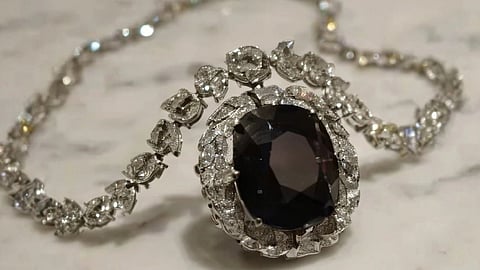
The Black Orlov Diamond, also called the Eye of Brahma, is one of the most mysterious gemstones in the world. It is a rare 67.49-carat cushion-cut black diamond with a dark, gunmetal hue. The diamond has fascinated people for decades because of its unusual colour, impressive size, and the ominous stories surrounding it. Over time, it has earned a reputation as one of history’s most “cursed” jewels—though much of this reputation stems from stories that blur the line between reality and myth.
According to popular legend, the Black Orlov was originally a much larger 195-carat black diamond. The story traces its origins to 19th-century India, where the diamond was allegedly embedded in the eye of a statue of the Hindu god Brahma in a temple near Pondicherry in southern India. Because of this sacred placement, it became known as the “Eye of Brahma.” The tale of the diamond’s curse begins with its theft. There are two versions of this story: one claims that a Hindu monk stole the diamond and later met a mysterious end, while the other suggests it was taken by a European missionary. This act of theft is said to have triggered a curse, bringing misfortune or death to anyone who possessed the stone.
Despite the popularity of this legend, historians and gem experts have raised serious doubts about the diamond’s origin story. There is no solid historical or archaeological evidence confirming that the diamond was ever part of a temple statue. Moreover, India is not known for producing natural black diamonds, which further weakens claims of its Indian origin. Nevertheless, the story persisted, largely because it added an aura of danger and intrigue to an already rare and striking gemstone.
The legend gained further momentum in the early 20th century when the diamond allegedly surfaced in Europe and the United States. One of the most widely circulated claims involves a diamond dealer named J.W. Paris, who is said to have brought the Black Orlov to the United States in 1932. According to the story, he later died by suicide after jumping from a skyscraper. However, despite the story’s popularity, no official records or contemporary reports confirm either his ownership of the diamond or the incident itself.
Another chapter in the curse narrative made the legend even darker. Two Russian aristocrats: Princess Leonila Galitsine-Bariatinsky and Princess Nadezhda Orlov, were said to have owned the diamond and later died by suicide in the 1940s. These claims also collapse under closer examination. One of the princesses had already died decades earlier, while the other would have been extremely elderly at the time of her alleged death. Still, these dramatic stories strengthened the diamond’s image as an omen of doom and eventually led to the name “Black Orlov.”
The story took a turn in the 1950s when the diamond came into the possession of jeweller Charles F. Wilson, who believed the curse stories were real. He purchased the diamond with the intention of breaking its curse. To neutralise the stone’s supposed negative energy, he ordered the original 195-carat diamond to be cut into three pieces. The reasoning behind this was simple: divide the stone and weaken or destroy the curse. The largest fragment, weighing 67.49 carats, became the Black Orlov as it exists today. The other two pieces vanished, adding yet another layer of mystery to the diamond’s history.
In modern times, the Black Orlov has been mounted as a brooch-style pendant which was surrounded by white diamonds and hung from a diamond necklace. It is considered one of the largest and most famous black diamonds in the world. In 2006, it was sold at Christie’s Magnificent Jewels auction in New York for approximately $352,000—far exceeding earlier estimates.
That same year, actress Felicity Huffman was rumoured to wear the Black Orlov necklace to the Academy Awards but ultimately chose not to. While some interpreted this as superstition, others dismissed it as coincidence. Importantly, no confirmed cases of violent death or misfortune have been linked to the diamond in recent decades.
Today, many people agree that the story of the Black Orlov’s curse is likely the result of exaggerated storytelling, historical gaps, and coincidence. Yet the legends from the Hindu temple origins to the mysterious deaths and the disappearance of the remaining diamond fragments, continue to captivate audiences worldwide. Whether myth or reality, the Black Orlov’s dark beauty and dramatic backstory ensure that it remains one of the most fascinating gemstones in history.
Suggested Reading:
Subscribe to our channels on YouTube and WhatsApp
Download our app on Play Store
