
- HOME
- OPINION
- ON GROUND
- INTERVIEW
- Neta Profile
- Editor's Pick
- INDIA
- NewsGram USA
- WORLD
- न्यूजग्राम
- POLITICS
- ENTERTAINMENT
- CULTURE
- LIFESTYLE
- ECONOMY
- SPORTS
- Jobs / Internships
- Misc.
- NewsGram Exclusive

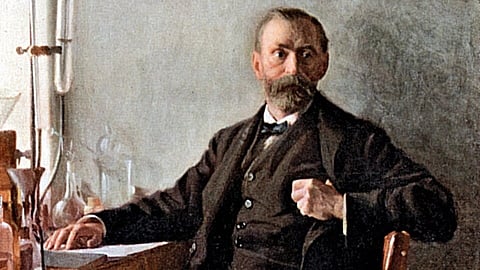
Alfred Nobel revolutionised explosives with the invention of dynamite which he thought will stop wars because of moral consequences
That didn’t happen and in a newspaper’s premature obituary in 1888 they branding him the “merchant of death” which shook Nobel
Nobel then used his fortune to establish the Nobel Prizes, ensuring his name would be associated not with destruction
When you hear about Alfred Nobel, the first thing that you think of is the Nobel Prize. The prize that is given for the greatest benefit to humankind, the one that promotes peace in the world. But what if the creator of such an award was once called the “merchant of death”? Yes, Alfred Nobel once accidentally “died” because of a mistake, and he saw what people would call him after his death. This moment led him to change his life and people’s views toward him.
Alfred Nobel was born on October 21, 1833, in Stockholm, Sweden. He grew up surrounded by engineering and experimentation because his father, Immanuel Nobel, was an inventor whose work involved explosives and machinery. Although often ill as a child, Alfred showed remarkable intellectual curiosity. He became fluent in several languages, including Swedish, Russian, English, French, and German, and developed a strong foundation in chemistry and engineering.
Most of his youth was spent in St. Petersburg, Russia, where his father’s business supplied military equipment to the Russian government during the Crimean War. Later, Alfred studied chemistry in Paris and worked in the United States. These experiences exposed him to both scientific innovation and the realities of industrial warfare.
Nobel’s life changed with his obsession with nitroglycerin, a highly powerful but dangerously unstable explosive discovered by Italian chemist Ascanio Sobrero. While others feared it, Nobel believed it could be controlled. Through relentless experimentation he invented practical detonators and, in 1865, the blasting cap, which made the controlled use of high explosives possible.
Tragedy struck in 1864 when an explosion at Nobel’s factory killed his younger brother Emil. Yet Nobel pressed on. In 1867, he made his most famous breakthrough: dynamite. By absorbing nitroglycerin into a porous substance called kieselguhr, he created an explosive that was far safer to transport and use. Dynamite revolutionised construction, enabling tunnels, railways, roads, and canals to be built on a scale the world had never seen.
Nobel’s inventions brought him immense wealth and global influence. He patented more than 350 inventions and built a vast industrial network across Europe and beyond. Yet his success came with a moral burden. While dynamite advanced infrastructure, it also intensified warfare, contrary to Nobel’s hope that more powerful weapons might make wars unthinkable.
He became a man whose inventions transformed explosives into tools of unprecedented power. Yet he is remembered today as the founder of the world’s most prestigious prizes for peace, science, and human progress. Let’s see how?
The turning point in his legacy came not in a laboratory, but in a newspaper. In 1888, when Nobel’s brother Ludvig died in Cannes after a long illness, a French paper mistakenly published Alfred’s obituary. The headline read: “Le marchand de la mort est mort” translated to “The merchant of death is dead.” Reading how the world might remember him shook Nobel deeply. He loathed war and was disturbed by the idea that his life’s work would be reduced to instruments of destruction.
This moment shaped his final decision. In 1895, Nobel signed his last will, leaving most of his fortune to establish prizes that would reward those who conferred “the greatest benefit to humankind.” He chose fields that reflected his own passions with physics, chemistry, medicine, literature, and most strikingly, peace. His friendship with Austrian pacifist Bertha von Suttner further strengthened his resolve to honour efforts toward ending war.
When Alfred Nobel died on December 10, 1896, he left behind not just explosives and factories, but a radical idea: that wealth built on destruction could be transformed into a force for human progress. Since 1901, the Nobel Prizes have honoured scientists, writers, reformers, and peacemakers, from Albert Einstein and Marie Curie to Martin Luther King Jr. and Nelson Mandela.
And that is how the man who helped perfect the tools of death ensured that his name would forever be linked not to destruction, but to peace.
Suggested Reading:
Subscribe to our channels on YouTube and WhatsApp
Download our app on Play Store

.jpg)

.jpeg)
