
- HOME
- OPINION
- ON GROUND
- INTERVIEW
- Neta Profile
- Editor's Pick
- INDIA
- NewsGram USA
- WORLD
- न्यूजग्राम
- POLITICS
- ENTERTAINMENT
- CULTURE
- LIFESTYLE
- ECONOMY
- SPORTS
- Jobs / Internships
- Misc.
- NewsGram Exclusive
Key Points
The stereotype of the “effeminate Bengali men” was constructed during British colonial rule as a political tool to weaken an emerging educated class.
The Martial Race Theory labelled Bengalis as weak while privileging other communities as “naturally martial.”
Bengalis actively resisted this narrative through physical culture movements, sports achievements, and revolutionary nationalism, reshaping their identity in the freedom struggle.
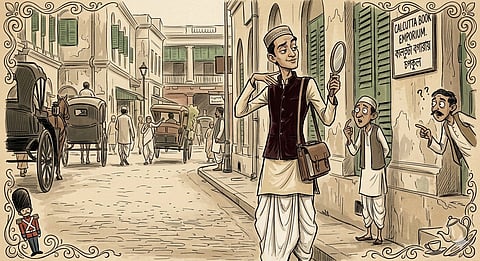
The ‘Effeminate Bengali Men’ trope is a long-withstanding one. We see it reflected in popular culture, in movies, and in casual banter passed back-and-forth. All these parrot and reiterate the same thing— that Bengali men possess feminine-like traits and are ‘joru ke gulaam’ (Wives’ servants). However did this stereotype emerge?
It isn't surprising that this trope traces its roots back to the British Colonial era in India.
The stereotype of the “Effeminate Bengali Men” is one of the most persistent and damaging images created during British colonial rule in India. It portrayed Bengali men as physically weak, delicate, overly intellectual, and lacking in courage and leadership qualities. This was never an innocent observation. It was a carefully crafted political tool designed to undermine the rising Bengali middle class. It served to justify exclusion from power, sow self-doubt among an emerging educated class, and reinforce the "divide-and-rule" strategy that kept Indians fragmented.
Yet, far from remaining unchallenged, the stereotype provoked a powerful counter-movement of physical regeneration and revolutionary nationalism that reshaped Bengal's role in India's freedom struggle.
Perhaps one of the most famous articulations of this trope, and one of the most scathing one too , came from Thomas Babington Macaulay, the architect of English education in India. In his writings, he described Bengalis in stark terms: "The physical organization of the Bengalis is feeble even to effeminacy... His pursuits are sedentary, his limbs delicate, his movements languid."
British journalist G.W. Steevens was even more vicious: "By his legs you shall know a Bengali... The Bengali's leg is either skin and bones... or else it is very fat or globular, also turning at the knees, with round thighs like a woman's. The Bengali's leg is the leg of a slave."
It is a truth universally acknowledged that the colonial-era British administration had little to no use of the then Indian citizens. The Britishers only saw the native people as a means to an end, educated them just enough to the extent to be useful in undertaking menial admin tasks.
By the middle of the 19th century, Bengalis had become the most Western-educated community in India. They were the first to master English and filled important clerical and administrative positions in the colonial government. They came to be known as the “Bengali babu.”
This closeness to the British system made the rulers uncomfortable. Educated Bengalis were beginning to question colonial rule and demand greater rights. To weaken this emerging threat, the British launched a campaign that attacked the masculinity of Bengali men.
See also: Silence: A Brief Literary History
They promoted the Martial Race Theory. According to this theory, certain communities such as the Sikhs, Marathas, Punjabis, and Pathans, were “martial” in nature and naturally brave. Bengalis, on the other hand, were labelled as physically weak and unfit for military service or political leadership. Colonial officials also blamed Bengal’s hot and humid climate and rice-based diet for producing “soft” bodies and passive minds.
As historian Mrinalini Sinha, a distinguished faculty at the University of Michigan, has pointed out, this was a calculated political move. By branding educated Bengalis as effeminate, the British aimed to create self-doubt and reduce the impact of their growing political awareness. The stereotype sought to turn serious intellectual criticism into mere ‘whining’ by oversensitive people.
From the 1860s onwards, Bengalis began a determined effort to counter this stereotype. Intellectuals and reformers launched a physical culture movement to rebuild both body and self-respect.
Rajnarayan Basu called for the revival of traditional gymnastic exercises. In 1867, the Tagore family supported the launch of the Hindu Mela, a festival that featured wrestling, stick-fighting (lathi), gymnastics, and other Indian sports. The aim was to challenge the so-called martial races directly and regain lost pride. Nabagopal Mitra established an akhara (gymnasium) in Calcutta. Physical training became a symbol of resistance and national regeneration.
Colleges also played an important role. Presidency College in Calcutta introduced gymnastics in 1879. Students formed clubs for football, cricket, and athletics. By 1897, gymnastics was made compulsory for first-year students. The college football team achieved notable success in inter-collegiate tournaments.
The greatest symbolic victory came in 1911 when Mohun Bagan became the first Indian team to win the IFA Shield, defeating a British regimental side. This triumph carried special meaning as it occurred in the same year the British shifted the capital of India from Calcutta to Delhi.
The emphasis on physical strength soon merged with the freedom struggle. Secret societies such as the Anusilan Samiti, founded in 1902, made physical training, including lathi and sword play, a core part of their programme. After the Partition of Bengal in 1905, these revolutionary groups gained momentum.
Leaders like Bagha Jatin and Surya Sen emerged from this tradition of disciplined physical and political training. Swami Vivekananda strongly supported the movement. A skilled sportsman himself, he famously declared: “You will be nearer to Heaven through football than through the study of the Gita.” He believed strong bodies were essential for building a strong nation.
Mahatma Gandhi offered another powerful response in to these stereotypes. He refused to accept the British definition of masculinity based on physical strength and violence. Instead, he gave dignity to qualities the British had dismissed as “feminine”— non-violence, simplicity, and patience. By turning the spinning wheel (charkha) into a national symbol, he challenged the entire colonial framework of manliness and effeminacy.
This instance tacks itself at the end of a long, long list of political and social maneuvers that the British undertook to implement their policy of ‘divide-and-rule,’ and to sow dissent between communities to weaken the nation from within.
More than a century later, the “effeminate Bengali men” stereotype still persists. It continues to portray Bengali men as soft, bookish, or overly influenced by their wives. However, understanding its origins is important. This was never a fair description of a community. It was a colonial weapon meant to weaken a group that was becoming too educated and politically conscious.
Bengalis responded with courage and creativity, through gymnasiums, football fields, revolutionary societies, and intellectual resistance. Their efforts helped lay the foundation for India’s broader nationalist movement.
The real story is not one of weakness, but of resilience and dignity in the face of deliberate humiliation.
(Edited by Dhruv Sharma)
Suggested reading:
Subscribe to our channels on YouTube and WhatsApp
Download our app on Play Store

