
- HOME
- OPINION
- ON GROUND
- INTERVIEW
- Neta Profile
- Editor's Pick
- INDIA
- NewsGram USA
- WORLD
- न्यूजग्राम
- POLITICS
- ENTERTAINMENT
- CULTURE
- LIFESTYLE
- ECONOMY
- SPORTS
- Jobs / Internships
- Misc.
- NewsGram Exclusive

AI generated summary, newsroom-reviewed
IN EARLY 2024, the Bharatiya Janata Party (BJP), after winning two consecutive general elections as part of the National Democratic Alliance (NDA), were aiming for a sweeping two-third majority in Lok Sabha as a single unit. Abki Baar 400 Paar (This time, 400-plus) was a popular slogan of the party at the time. Many questioned whether this will allow the ensuing BJP-govt to pass any bill unopposed, giving them special majority in the Parliament— enough to amend the constitution and change fundamental laws. Alas, it wasn’t to be, as BJP only managed to form the government as part of its alliance and we never got to see how India would have transformed.
Nonetheless, the question still remains: Can India be turned into a monarchy, dictatorship, or theocratic state, just with the two-third majority in the parliament, also known as special majority? The short answer is no; but the story behind achieving this definitive answer is one full of uncertainty in a period marred with conflict. One case that is often credited to have protected the constitution from this unlimited power is the Kesavananda Bharati v. State of Kerala. More than five decades ago, on April 24, 1973, after hearing arguments of the state and petitioners led by an Hindu monk, the largest-ever bench of the Supreme Court gave its monumental judgment that established the Basic Structure Doctrine of the constitution.
The petition filed by Swami Kesavananda Bharti in October 1972 was not a case in isolation. The case was deliberated for 68 days, with both sides presenting the arguments from October 31, 1972, to March 23, 1973. During the proceedings in the Supreme Court, both sides reportedly cited hundreds of other cases with the then Attorney-General presenting a comparative chart analyzing the constitutions of 71 different countries.
A similar case in 1967, Golaknath v. State of Punjab, was cited as a major precedent in the arguments of the 1973 case. Before the Golaknath case, article 368— giving Parliament the power to amend the constitution—was thought to be unlimited, as long as procedural safeguards are followed, i.e., the two-thirds majority in parliament, and in certain cases approval from more than half of state legislatures. However, in Golaknath v. State of Punjab (1967), the Supreme Court ruled that the Parliament can not amend the fundamental rights given to all citizens by the constitution of India because they are protected under Article 13.
In a response to the 1967 case, one of the most controversial constitutional amendments, officially known as The Constitution (Twenty-fourth Amendment) Act, 1971, was passed in the parliament by the Indira Gandhi-government. The act restored the total authority of the House to amend fundamental rights by seeking provisional changes in Article 368, overriding the Golaknath case judgement. It further made the President’s assent to the amendment obligatory. At the time, the critics called out the act for dismantling the judiciary’s authority and giving more power to Parliament and the Prime Minister’s office to make changes to the Constitution, including land and property rights.
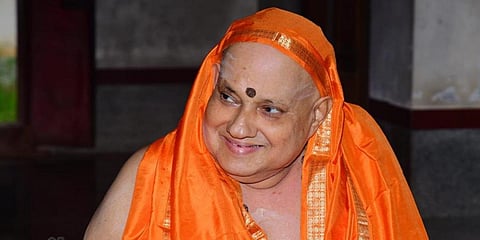
Swami Kesavananda Bharati, fighting for his property ownership rights in Kerala, filed a case against the state government in 1972. The Kerala government, under the amendments in the Kerala Land Reforms Act, imposed restrictions on the management of Edner Mutt— a Hindu monastery in the state. The government further attempted to take over a large portion of the land owned by the religious institution under the new land reforms. This claim of the state government was challenged by the senior Hindu monk of Edner Mutt, His Holiness Kesavananda Bharati.
The largest Constitution bench of 13 Judges, headed by the then Chief Justice of India Sarv Mittra Sikri, heard the case at the apex court and delivered the monumental judgement on April 24, 1973, after 68 days of proceedings. The divisiveness of the case was evident from the bench’s split, with the final decision getting a thin majority of 7-6.
The Supreme Court rejected the notion that the Parliament had unlimited and ultimate authority over constitutional amendments under article 368. However, it also overturned the Golaknath case. According to the apex court, the Parliament can amend any part of the Constitution, including fundamental rights, until the amendment does not destroy the “basic structure” of the constitution.
Although, the court did not provide an exhaustive list of what constitutes the “basic structure,” several judgments following the Kesavananda Bharati case have recognized elements such as supremacy of the constitution, secularism, independence of judiciary, federalism, unity and integrity of the nation, freedom and dignity of individuals, democracy, and equality as part of it.
The court also upheld the 24th Constitutional Amendment, which restored the Parliament’s power to amend Fundamental rights. However, it made it clear that these amending power is subject to the basic structure limitations. In simple words, the Parliament could change the Constitution, but it cannot use the laws to destroy the Constitution itself. This ruling established what came to be known as the Basic Structure Doctrine.
Raju Ramchandran, Senior Advocate, Supreme Court, in conversation with The Indian Express, claimed that if the basic structure doctrine was not established, India would have become a Hindu Rashtra (Nation) long ago. He said that clarifying the limitations to Article 368 was a monumental judgment during the Indira Gandhi-government.
Recalling that period, Ramchandran said, “There was a great ideological battle over property rights and other fundamental rights. At the time, Indira Gandhi was pushing for constitutional amendments that would have made the property rights subordinate for the larger good. In that time, this debate arose about what are the amending rights of the Parliament.”
He acknowledges how divisive the judgments were for the Golaknath and Kesavananda Bharati case, saying both kept checks on the Parliament’s unlimited and unchecked power by a “wafer-thin” majority. The Supreme Court advocate remembered the late Justice H.R. Khanna who gave the deciding vote in the 1973 judgment. Ramchandran said, “He (Justice Khanna) is often celebrated for other reasons because in the ADM Jabalpur case he took a pro-liberty stance and became a prominent voice for dissent. And he had the deciding vote [in Kesavanand Bharati case].”
The senior advocate gave an example, saying that India is a parliamentary democracy as established in the constitution; so can Parliament, if it has two-thirds majority, rule India to be a monarchy or theocratic state? “These are the real situations, which the unlimited amending power can lead to,” Ramchandran said. According to him, the property ownership fight by an Hindu monk from Kerala remains an “important check” on the governments. He remarked, “From 1973, this has been the law of the land that basic structure cannot be changed, or else India would have already been a Hindu Rashtra (nation).”
Suggested Reading:
Subscribe to our channels on YouTube and WhatsApp
Download our app on Play Store
