
- HOME
- OPINION
- ON GROUND
- INTERVIEW
- Neta Profile
- Editor's Pick
- INDIA
- NewsGram USA
- WORLD
- न्यूजग्राम
- POLITICS
- ENTERTAINMENT
- CULTURE
- LIFESTYLE
- ECONOMY
- SPORTS
- Jobs / Internships
- Misc.
- NewsGram Exclusive

THE 1857 REVOLT, which many consider as India’s first war of independence, gave rise to the legend of many heroes i.e. Jhansi Ki Rani Laxmi Bai, Tantia Tope, Mangal Pandey, Nana Saheb among others. These heroes later became an inspiration in the path of India’s later-generation revolutionaries like Veer Savarkar who used to idolize them and sought to fulfill their dream of taking breath in an independent India.
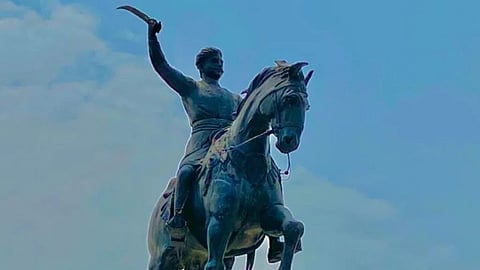
According to the Book ‘The Battle of Narnaul,” by Kulpreet Yadav and Madhur Rao, one such hero of the 1857 revolt was Rao Tula Ram, king of Rewari, born on December 9, 1825 in Haryana’s Rampura suburb. He belonged to a Ahir family and was the son of Puran Singh and Gyan Kaur. His father, Singh, passed away when Rao was young.
During the revolt, Rao emerged as a leading figure in the resistance against the oppression of British Raj. His real show of valour was seen in the field of Nasibpur village present on the borders of Narnaul Sub-division of Mahendragarh district of present day Haryana. This epic battle of Narnaul took place on November 16, 1857 in which King Rao Tula Ram’s cousin Rao Kirshan Singh led 5000 troops against the Britishers. In the battle, Britishers lost many officers including commander John Grant Gerrard and several others got injured.
However, Britishers retaliated with a strong force and Rao Tula Ram had to retreat and took shelter in Rajasthan. Here he joined forces with another icon Tantia Tope but his bad luck followed and he suffered another defeat in the Battle of Sikar in Rajasthan at the hands of British colonial rule.
In his book The Battle of Narnaul, writer Kulpreet Yadav and Madhur Rao further write that when the revolution was in its weakened state, Rao made a secret military alliance with kings of Jodhpur, Jaipur and Bikaner kingdom to fight against the Britishers. His plan was to seek support from the Russian empire to attack British India and overthrow British rule.
To achieve this he first left for Iran and met the Shah of Iran. After that he went to Alexander second of Russian Empire before finally moving to Afghanistan where he, in Kabul on September 23, 2026 died eventually without submitting himself to the British empire.
In 1877, restoring Rao Tula Ram’s title, his son Rao Yudhister Singh was made head of the Ahirwal region. On September 23, 2001, the Government of India issued a postal stamp on Rao Tula Ram to salute the courage of the brave freedom fighter.
[Rh/GS/RS]
Suggested Reading:
Subscribe to our channels on YouTube and WhatsApp
Download our app on Play Store