
- HOME
- OPINION
- ON GROUND
- INTERVIEW
- Neta Profile
- Editor's Pick
- INDIA
- NewsGram USA
- WORLD
- न्यूजग्राम
- POLITICS
- ENTERTAINMENT
- CULTURE
- LIFESTYLE
- ECONOMY
- SPORTS
- Jobs / Internships
- Misc.
- NewsGram Exclusive

Key Points:
Nidhi Razdan discussed on Frontline Magazine’s SpeakEasy how media pressure and restricted access existed during the UPA era.
She added that journalists were directed to avoid asking domestic questions and were told to submit questions in advance.
She highlighted growing threats to media freedom, including the weakening of news organisations, controlled media narratives, and pressure through investigative agencies.
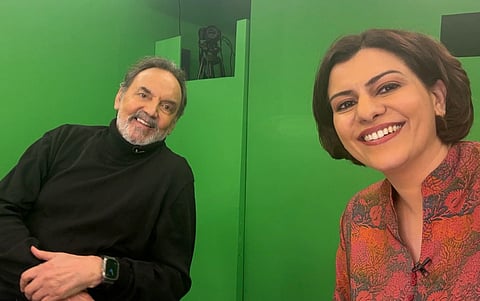
In a recent episode of Frontline Magazine’s SpeakEasy, host and journalist Amit Baruah and senior journalist and longtime news anchor Nidhi Razdan reflected on the contemporary status of the Indian media by drawing comparisons with the UPA era.
Razdan stated that media houses also faced pressure under the UPA (United Progressive Alliance) led by the Indian National Congress. She explained that during the later years of former Prime Minister Manmohan Singh’s leadership, the government began restricting media access. She said, “At one time, we could walk in with our PIB cards and talk to any official or secretary. They started closing off that access.”
Drawing comparisons between the Congress and BJP governments, Razdan outlined the status of Indian media during those periods. She recalled the early stage of her reporting career when Atal Bihari Vajpayee was the Prime Minister. She added that during the Vajpayee led NDA government, “everybody had access to the top leaders. You would get viewpoints and interviews,” with room for disagreement. Razdan told Baruah that attempts by ruling governments to control the narrative are inevitable.
“All governments try to control the narrative; that is their job. It is also the job of the media to push back,” said Razdan.
Taking a sly dig at the Modi government, she recalled that during visits by foreign dignitaries, journalists could earlier ask domestic political questions at joint press conferences. “First, there used to be press conferences,” added Razdan. However, things began to change over time, as journalists were directed to avoid asking domestic questions. Razdan stated, “We were also supposed to submit questions in advance. As a result, some very atrocious questions were asked to President Obama during his first visit.”
In contrast to the earlier BJP government, Razdan emphasized the lingering fear in the current atmosphere - the fear of being labelled anti-government and the fear of facing consequences.
During their conversation, they discussed the biggest threats facing the country. Baruah quoted Indian economist and Nobel laureate Abhijit Banerjee’s comment that media freedom and transparency are the two most critical issues in India. Razdan expressed partial disagreement with his view, arguing that the problem is broader, pointing to the rise in institutional decline seen in recent times.
Razdan spoke about the growing threat to media freedom, which she said is falling prey to several factors, including the “decimation of news organisations, controlling the narrative in the press, and coercion through the use of agencies, whether against newsrooms, corporates, or political rivals.” Speaking about controlled narratives, Baruah asked about billionaires shaping media narratives and the pressures faced by editors and reporters.
Razdan cited the example of the recent mass layoffs at The Washington Post, which is owned by billionaire businessman Jeff Bezos. According to Razdan, independent media can survive with the support of subscriptions, which remains a challenge in a country like India.
Nidhi Razdan is an award-winning journalist and author, widely known for her anchoring and reporting on a range of subjects such as current affairs, foreign affairs, etc. Razdan’s family has its roots in journalism, with her father, Maharaj Krishan Razdan, being the former editor-in-chief of Press Trust of India (PTI). Razdan, who belongs to the Kashmiri Pandit community, worked at NDTV as a journalist for nearly 21 years and anchored NDTV’s prime time show Left, Right & Centre. Razdan is currently working with Prannoy Roy led DeKoder.
Suggested Reading:
Subscribe to our channels on YouTube and WhatsApp
Download our app on Play Store
