
- HOME
- OPINION
- ON GROUND
- INTERVIEW
- Neta Profile
- Editor's Pick
- INDIA
- NewsGram USA
- WORLD
- न्यूजग्राम
- POLITICS
- ENTERTAINMENT
- CULTURE
- LIFESTYLE
- ECONOMY
- SPORTS
- Jobs / Internships
- Misc.
- NewsGram Exclusive
Key Points
The Supreme Court of India allowed a 15-year-old rape survivor to terminate a 30-week pregnancy, prioritising her dignity and autonomy.
The court urged reforms to the Medical Termination of Pregnancy Act, especially in rape cases.
It emphasised that reproductive rights in such cases rest with the survivor, not the state or rigid legal timelines.
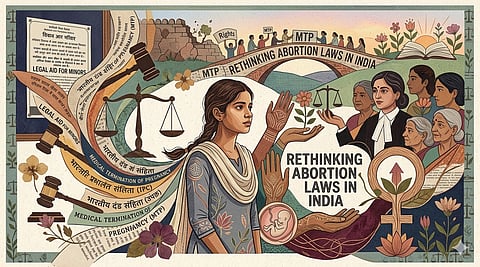
In a landmark judgment pertaining to abortion and reproductive rights in India, the Supreme Court had set a milestone precedent. On Thursday, 30th April 2026, the apex court defied its own previous ruling by allowing a 15-year-old rape survivor to medically terminate her 30-week pregnancy. Additionally, the SC has also directed the centre to amend its existing laws that allow allow rape survivors to terminate unwanted pregnancies even beyond 20 weeks.
The bench consisting Chief Justice of India Surya Kant and Justice Joymalya Bagchi refused to entertain a curative plea filed by the All India Institute of Medical Sciences (AIIMS) which sought the consideration of an earlier bench’s order (given on 24th April, 2026) that allowed a teen rape survivor to terminate her (then) 29-week pregnancy.
The bench said that this being a case of child rape, the child is question would be subjected to life-long scar and trauma if the termination of pregnany isn’t permitted.
Underlining a larger principle, the top court stressed that in cases involving rape of minors, reproductive rights cannot be goverend by the state and rests solely on her person and their family’s will. “We respect individual choices and so should you,” Justice Joymalya Bagchi observed. The court firmly held that choice of the pregnant individual must take precedence, even in later stages of pregnancy.
The bench observed that existing legal limits on termination of pregnancy may require reconsideration in cases involving rape. It emphasised that the law must evolve with changing realities and should not impose rigid timelines where fundamental rights are at stake.
See also: Punjab Opposition Accuses CM Bhagwant Mann of Being Drunk During Special Session on Labour Day
The Medical Termination of Pregnancy (MTP) Act, 1971 (amended 202), governs abortion and reproductive rights in India. As of yet, abortion is legal up to 20 weeks with the opinion of one registered medical practitioner (RMP) in case the mother’s life is at stake or any fetal abnormalities are present. In special instances, such as victims of rape/incest, minors, and disabed women, the abortion window stands at 24 weeks, with the opinion of two RMP’s under the MTP Act, 1971
Abortion beyond 24 weeks is only permitted only for substantial fetal abnormalities diagnosed by a medical board.
The case began on 9th April, 2026. A 15-year-old child, who is a rape survivor, was diagnosed with a 27-week live pregnancy. As the child was well beyond the permitted gestational period to qualify for pregnancy termination as per the MTP Act, she was denied the abortion procedure by medical practitioners.
On April 13, the victim's mothers filed a writ petition in the Bombay high court, seeking the right to terminate her minor daughter’s pregnancy that occured as a product of rape, citing the mental amd emotional trauma that the teenager would have to endure should she carry the pregnancy to term. The Court directed AIIMS to constitute a medical board to look into the matter. The board held that it is not ‘advisable’ for the abortion procedure to take place, citing risks of caesarean and instrumental delivery.
The medical institution recommended that the teen prolong her pregnancy to 34-weeks, “in the best interest of both mother and baby” and declaring the minor ‘physically fit’ for the same. On the psychological side, it recorded “no major psychiatric disorder”, noting only “signs of emotional distress and adjustment difficulties related to the pregnancy.
On April 21, Justice Purushaindra Kumar Kaurav dismissed the writ petition, the reasoning being wholly dependent on the board’s recommendation.
See also: SC takes suo motu cognisance of alleged denial of emergency treatment to stabbed woman advocate
However, three days later, on 24th April, 2026, a Supreme Court bench comprising Justices B V Nagarathna and Ujjal Bhuyan, reiterated that compelling a woman, especially a minor, to carry a pregnancy to term could cause adverse effects to the woman’s mental, emotional, and physical trauma.
The judges asserted that a woman's reproductive autonomy must be of the highest importance and that compelling her to continue the pregnancy violates her fundamental rights. The court noted her psychological distress and the fact she twice attempted to die by suicide, and said, "Forcing her to continue is a direct affront to her right to live with dignity." The bench permitted the teen to terminate her pregnancy.
The same day, AIIMS sought a review of this order, and filed a review petition in regard to this decision which was rejected by the Supreme Court. Once again, the medical institution filed a final curative plea seeking to overturn the bench’s decision via Additional Solicitor General (ASG) Aishwarya Bhati.
Bhati argued that at 30 weeks, the fetus is viable and that termination may not be medically advisable. She warned that if the termination procedure ends up in a live-birth, the child could suffer severe deformities and organ complications, while the minor herself might face long-term physical and psychological health consequences.
The ASG further submitted that continuing the pregnancy and opting for adoption thereafter would be in the best interest of the child. Bhati also cautioned the court that termination at this advanced stage carries significant medical risks.
CJI Kant firmly rebuked Bhati, citing that the ASG has no ‘locus’ to challenge the court’s termination order. “Nothing can compensate the agony she (the child) suffered after the rape,” the CJI stated.
Concluding the hearing on a firm note, the Chief Justice underscored that the case ultimately concerns the rights of the survivor. “If it has become a contest between the child and the foetus, then the child should be allowed to live with dignity,” he remarked.
The court also urged the government to change existing laws that put a clock in such cases. “When there is a pregnancy due to rape, there should not be time limit. Law needs to be organic and in sync with evolving time,” the court remarked.
This case stands as a watershed moment in the nation’s abortion and reproductive rights. Not only did the apex court underscored the women’s autonomy over her body, it also paved the way for amendment in abortion law that deal with special instances (such as rape) in abortion appeals more firmly and accurately.
(Edited by Dhruv Sharma)
Suggested reading:
Subscribe to our channels on YouTube and WhatsApp
Download our app on Play Store

