
- HOME
- OPINION
- ON GROUND
- INTERVIEW
- Neta Profile
- Editor's Pick
- INDIA
- NewsGram USA
- WORLD
- न्यूजग्राम
- POLITICS
- ENTERTAINMENT
- CULTURE
- LIFESTYLE
- ECONOMY
- SPORTS
- Jobs / Internships
- Misc.
- NewsGram Exclusive

Former Japanese minister Hideki Makihara accused India of causing delays in the Mumbai-Ahmedabad Bullet Train project, alleging that Indian negotiators repeatedly changed positions
The ₹1.08 lakh crore MAHSR project, largely funded through JICA loans, will use Japanese technology and is expected to begin phased operations between Surat and Bilimora on August 15, 2027.
As per sources the discussions with Japan are progressing smoothly and that both countries have agreed to initially operate the corridor using an Indian-built high-speed train before introducing Japan's E10 Shinkansen in the early 2030s.
ON JULY 15, 2026, former Japanese minister Hideki Makihara took to X and publicly blamed India for delays in the Shinkansen project. Shinkansen is Japan's high-speed rail technology that is being used for the Mumbai-Ahmedabad High-Speed Rail (MAHSR) project, popularly known as India's bullet train project.
Makihara, who is a member of Japan's ruling Liberal Democratic Party (LDP), said that they (India) frequently changed their positions during negotiations, did not stick to commitments they had made, and prioritised India's own interests until the final stages of discussions. He claimed that he had personally been involved in the project and accused Indian negotiators of repeatedly changing their positions during discussions and failing to honour commitments made during negotiations.
In a post on X, accompanied by a Japanese article, Makihara wrote "The Shinkansen project in India is something I was involved with myself, but what stood out in international meetings and negotiations was the sheer recklessness of the Indian side, repeated over and over. They just don't keep promises, no matter what. Even if they make a promise, they flip it right away. They keep pushing their own self-interest right up to the very end."
He also criticised the Indian minister involved in the negotiations, writing "The minister in charge was especially awful—if the top guy's like that, there's no way to have any decent dealings.” Makihara further claimed that India was entirely responsible for the delays, stating "For the honour of all the Japanese folks who poured their hearts into this, I have to say it: I feel 100% that the reason this hasn't moved forward is entirely on the Indian side."
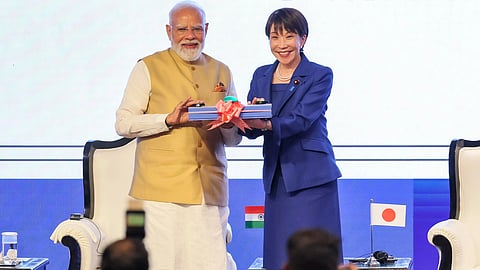
He also expressed disappointment that Japanese Prime Minister Sanae Takaichi's recent visit to India had failed to produce any significant progress regarding the project. "No results from Prime Minister Takaichi's visit either—'India Shinkansen' failure: Japan excluded from the signal system, the key to safety."
Makihara shared a Japanese article titled "India Shinkansen Failure: Japan Excluded from the Signal System, the Key to Safety." The article argued that the project had gradually moved away from the original Japanese Shinkansen model.
It claimed that the 508-kilometre Mumbai-Ahmedabad Bullet Train project was launched in 2017 with Japan's Shinkansen technology and financial support from JICA. However, discussions on purchasing the trains and finalising the signalling system later stalled, leading to delays in the project.
The Mumbai-Ahmedabad High-Speed Rail (MAHSR) corridor is India's first bullet train project and remains one of the flagship infrastructure collaborations between India and Japan. The 508-km high-speed rail line will connect Mumbai with Ahmedabad through 12 stations across Maharashtra, Gujarat, and Dadra and Nagar Haveli.
The project will use Japan's iconic Shinkansen technology. The trains are designed to operate at a speed of 320 kmph, reducing travel time between Mumbai and Ahmedabad from around six hours to nearly two hours.
The project is largely funded through long-term, low-interest loans from the Japan International Cooperation Agency (JICA), which finances approximately 81% of the total project cost. The remaining cost is shared by the Government of India and the state governments of Gujarat and Maharashtra. The estimated cost of the project is approximately ₹1.08 lakh crore (excluding taxes), and it is being executed with Official Development Assistance (ODA) loan assistance from JICA.
Although the project faced years of delays due to land acquisition issues and political changes, construction has accelerated significantly in recent years. Major progress has been made on stations, bridges, and tunnels. Railway Minister Ashwini Vaishnaw has announced that the first phase of the project, likely between Surat and Bilimora in Gujarat, is expected to begin phased passenger operations on August 15, 2027.
Despite Makihara's criticism, ANI reported that discussions between India and Japan regarding the project are progressing smoothly. According to the sources, both governments have jointly agreed to begin operations using an Indian-built high-speed train so that services can commence as early as 2027. Japan's next-generation E10 Shinkansen train, which is still under development, is expected to be introduced in the early 2030s.
(Edited by Harsh Pandey)
Suggested Reading:
Subscribe to our channels on YouTube and WhatsApp
Download our app on Play Store
