
- HOME
- OPINION
- ON GROUND
- INTERVIEW
- Neta Profile
- Editor's Pick
- INDIA
- NewsGram USA
- WORLD
- न्यूजग्राम
- POLITICS
- ENTERTAINMENT
- CULTURE
- LIFESTYLE
- ECONOMY
- SPORTS
- Jobs / Internships
- Misc.
- NewsGram Exclusive

Key Points
India used a Trump-linked lobbying firm to contact senior US officials on media coverage on the day of the Operation Sindoor ceasefire.
Pakistan sought extensive US intervention during the conflict, including mediation requests and offering incentives.
Most India-US coordination on trade, messaging and official meetings took place through lobbyists, highlighting the greater importance of networking under the Trump administration than traditional diplomatic channels.
India activated a US lobbying firm linked to President Donald Trump’s inner circle to reach senior American officials on 10 May 2025, the day of the Operation Sindoor ceasefire. According to filings under the US Foreign Agents Registration Act (FARA), the Indian Embassy in Washington sought engagement with top White House, trade and national security officials to discuss media coverage of the conflict and the status of bilateral trade talks.
According to the filings, the Indian Embassy reached out on the day India and Pakistan agreed to halt hostilities after four days of military escalation following the Pahalgam terror attack. Calls were made through SHW Partners LLC, a lobbying firm headed by Trump campaign veteran Jason Miller, to US Trade Representative Jamieson Greer, National Security Council official Ricky Gill, White House Chief of Staff Susie Wiles and White House communications director Steven Cheung. The stated purpose of these calls was to discuss media coverage of Operation Sindoor.
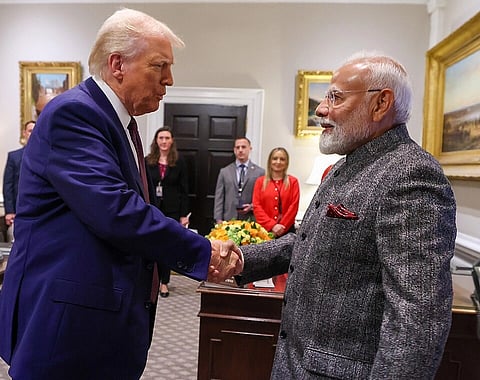
The outreach came amid repeated claims by Trump that the United States had mediated the ceasefire and pressured both India and Pakistan using trade leverage. The Indian government has consistently rejected these claims, with the Ministry of External Affairs maintaining that the cessation of hostilities followed Indian military action and bilateral communication, without third-party mediation. PM Narendra Modi later told Trump that India had not discussed trade or mediation with the US during the conflict.
See Also:
In parallel with India’s outreach, Pakistan mounted an even larger lobbying effort in Washington during Operation Sindoor. FARA documents show that Pakistani diplomats and defence officials sought more than 50 meetings, calls and media interactions with US officials and intermediaries during the conflict. These efforts were coordinated through multiple lobbying firms, including Squire Patton Boggs, Qorvis and the Ervin Graves Strategy Group.
The filings indicate that Pakistan repeatedly urged the United States to intervene with India and welcomed third-party mediation. Pakistani communications called for dialogue on counterterrorism, Kashmir and the Indus Water Treaty, and explicitly sought US facilitation. Islamabad also offered incentives to Washington, including increased imports from the US, access to critical minerals and deeper counterterrorism cooperation.
Pakistan’s lobbying intensified after the ceasefire, with new contracts signed to promote its rare earth mineral potential and broader strategic relevance to the US. As of January 2026, Pakistan had three active lobbyists in Washington, spending roughly $300,000 a month, comparable to India’s lobbying expenditure.
Despite Pakistan’s efforts, Indian officials have maintained that there was no US role in halting Operation Sindoor. The contrast between the two countries’ lobbying strategies, however, highlights the extent to which Washington became a focal point for messaging, perception management and diplomatic positioning during the crisis.
FARA filings also show that SHW Partners was involved in arranging meetings and calls for senior Indian officials with US counterparts over a broader period, covering trade negotiations, security issues and diplomatic engagements. SHW Partners is a small lobbying firm registered in Arlington, Texas, with the Indian Embassy listed as its only client. Jason Miller, who leads the firms, was the chief spokesperson for Trump’s 2016 presidential campaign.
Of the Indian Embassy’s 60 FARA entries, 30 were filed by SHW. The firm was contracted by the Indian Embassy in April 2025 under a one-year agreement worth $1.8 million. It became one of three lobbying firms engaged by India in Washington, alongside BGR Government Affairs and Mercury Public Affairs.
While India has traditionally hired lobbying firms in the US, diplomats cited in a report by The Hindu said it was unusual for a lobbyist to be tasked with arranging meetings and calls for serving ministers, senior officials and ambassadors. Requests were logged for meetings involving External Affairs Minister S. Jaishankar, Foreign Secretary Vikram Misri, Deputy National Security Adviser Pavan Kapoor and Ambassador Vinay Kwatra with figures including US Vice President J.D. Vance, Secretary of War Pete Hegseth and CIA Director John Ratcliffe.
Beyond Operation Sindoor, the filings show that trade dominated India’s engagement with the Trump administration during this period. Of the 60 recorded contacts by SHW Partners since April 2025, half were related to US-India trade talks. Calls increased after Washington announced reciprocal tariffs and penalty tariffs on Indian goods, and continued even as negotiations stalled. As of early January 2026, no trade agreement has been announced.
FARA records also reveal the degree of coordination between India and the US during and after the conflict. SHW Partners not only arranged meetings and trade calls but also flagged Prime Minister Modi’s social media posts to White House officials. These included posts responding to Trump’s statements on bilateral ties, trade negotiations and international peace initiatives. Calls were logged to senior White House aides to draw attention to Modi’s public messaging, particularly around US-India relations and Trump-led diplomatic initiatives in West Asia.
The filings suggest that India relied heavily on the lobbying firm to navigate what officials described as a changed operating environment in Washington, where access to the president’s inner circle had become critical. A government source cited in The Hindu’s report said the use of lobbyists reflected a belief that conventional diplomatic channels were less effective under the Trump administration.
Responding to questions, the Indian Embassy in Washington said hiring lobbyists was standard practice and consistent with long-standing norms under successive governments. It described the engagement as an effort to augment outreach in line with local requirements.
[DS]
Suggested Reading:
Subscribe to our channels on YouTube and WhatsApp
Download our app on Play Store

