
- HOME
- OPINION
- ON GROUND
- INTERVIEW
- Neta Profile
- Editor's Pick
- INDIA
- NewsGram USA
- WORLD
- न्यूजग्राम
- POLITICS
- ENTERTAINMENT
- CULTURE
- LIFESTYLE
- ECONOMY
- SPORTS
- Jobs / Internships
- Misc.
- NewsGram Exclusive

India and the EU sealed a historic Free Trade Agreement after 18 years of negotiations.
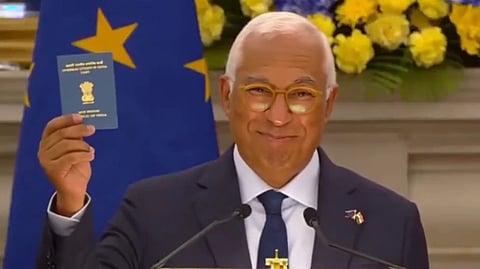
Antonio Costa highlighted his Goan roots by showcasing his OCI card at the signing.
The deal is set to deepen economic and strategic ties amid global uncertainty.
India sealed a landmark Free Trade Agreement with the European Union on Tuesday, 28 January 2026. It has been described as the “mother of all deals” by leaders, as it is the result of 18 years of negotiations. The deal was signed in New Delhi in the presence of Indian Prime Minister Narendra Modi, European Commission President Ursula von der Leyen, and European Council President Antonio Costa. However, the spotlight was stolen by the European Council President, who highlighted his own Indian roots, adding a personal touch to the historic moment.
Costa surprised everyone by showing off his Overseas Citizen of India (OCI) card during the joint press briefing at Hyderabad House. Costa said, “I am the President of the European Council, but I am also an Overseas Indian citizen.” He then added, “For me, this has a special meaning. I am very proud of my roots in Goa, where my father’s family came from, and the connection between Europe and India is something personal to me.”
The gesture followed the leaders’ announcement of the conclusion of a trade pact that would cover a combined market of nearly two billion people, creating one of the world’s largest free trade zones. At a time when the world is witnessing growing uncertainty in the global market, the deal is expected to significantly deepen economic ties between India and the EU.
For India, the deal will substantially reduce import duties on several European goods, including luxury cars, with tariffs cut from around 110 per cent to 40 per cent, and bring down duties on wine to 20 per cent from about 150 per cent. On the other hand, Indian industries such as textiles, gems and jewellery, and pharmaceuticals will gain expanded access to European markets. The pact is expected to ensure a win-win situation by doubling EU exports to India by 2032, while also allowing European companies to save nearly €4 billion annually in customs duties.
Prime Minister Narendra Modi called the agreement a “new blueprint for shared prosperity,” describing it as India’s biggest trade deal to date. The deal is being seen as a strategic and geopolitical stabilizer by EU leadership. Costa said that the two sides were taking their partnership “to the next level,” adding, “At a time when the global order is being fundamentally reshaped, the European Union and India stand together as strategic and reliable partners.”
While the trade deal itself drew significant attention, Costa’s remarks stood out as he spoke about his long-standing connection with India, particularly Goa. Although Costa was born in Lisbon in 1961, his family traces its roots to the former Portuguese colony, as his father, Orlando da Costa, was born and raised in Goa and later went on to become a noted poet and novelist in Portugal. Orlando emigrated to Lisbon at the age of 18 after the liberation of Goa in 1961. However, he remained deeply connected to his Indian roots, with his literary works reflecting Goan culture and identity, and some writings even influenced by Rabindranath Tagore.
Costa has often spoken candidly about his Indian roots, including his childhood nickname “Babush,” which in Konkani means “baby boy.” His family’s 200-year-old ancestral house still stands on Abade Faria Road in Margao, where his grandfather was born. Costa has spoken about visiting Goa for the first time as a teenager and later visiting the ancestral house and meeting his extended family during his 2017 visit to India.
In the same year, Prime Minister Narendra Modi presented Costa, then serving as the Prime Minister of Portugal, with his OCI card. He was also conferred with the highest honour bestowed upon a member of the Indian diaspora, the Pravasi Bharatiya Samman. Costa was described by PM Modi as a distinguished representative of the global Indian community.
(SY)
Suggested Reading:
Subscribe to our channels on YouTube and WhatsApp
Download our app on Play Store
