- HOME
- OPINION
- ON GROUND
- INTERVIEW
- Neta Profile
- Editor's Pick
- INDIA
- NewsGram USA
- WORLD
- न्यूजग्राम
- POLITICS
- ENTERTAINMENT
- CULTURE
- LIFESTYLE
- ECONOMY
- SPORTS
- Jobs / Internships
- Misc.
- NewsGram Exclusive

Key Points
The Karnataka Assembly has passed a first of its kind state law prescribing stringent punishment and preventive powers to curb hate speech and hate crimes.
The government says the bill is necessary to address rising communal tension and enforce Supreme Court directions on hate speech.
Civil society groups and opposition parties argue that the law is vague, grants excessive executive power, and threatens freedom of speech.
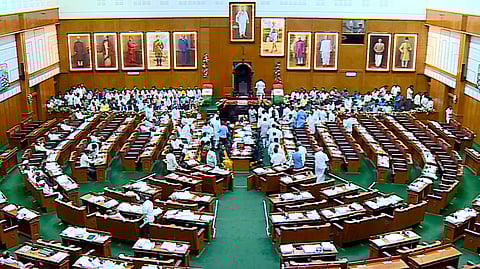
The Karnataka Legislative Assembly, on 18 December 2025, passed the Karnataka Hate Speech and Hate Crimes (Prevention) Bill, 2025, amid loud protests by BJP legislators in Belagavi. The stated purpose of the bill is to “curb and prevent dissemination, publication or promotion of hate speech and crimes, which cause disharmony, hatred in the society.”
Opposition MLAs accused the Congress government of attempting to curb free speech and warned that the law could be misused to target journalists and political opponents. Leader of Opposition R Ashok said the legislation would “turn the police into Hitler” and described it as a weapon for political vendetta.
Despite the uproar, the Bill was passed, with the government asserting that it was necessary to address the growing impact of hate speech on public order and social harmony.
The new law seeks to curb and prevent the dissemination, publication, or promotion of hate speech and hate crimes, provide punishment for such acts, and ensure compensation for victims. It defines “hate speech” broadly to include any public expression made through spoken words, writing, signs, visual representation, or electronic communication, intended to cause injury, disharmony, enmity, hatred, or ill will against a person or group.
The bill introduces the concept of “prejudicial interest”, which includes bias based on religion, race, caste or community, sex, gender, sexual orientation, place of birth, residence, language, disability, or tribe. Any expression targeting these grounds, if made with the intent specified under the law, can attract penal consequences.
“Hate crime” under the bill is defined as the communication, promotion, propagation, incitement, abetment, or attempted commission of hate speech. The law thus treats hate speech itself as a hate crime, rather than as a separate offence that may lead to other criminal acts.
The bill prescribes a minimum punishment of one year of imprisonment, which may extend to seven years, along with a fine of ₹50,000. For subsequent or repetitive offences, the minimum punishment rises to two years, which may extend to ten years, with a fine of up to ₹1 lakh. All offences under the Act are cognisable, non-bailable, and triable by a Judicial Magistrate First Class.
Courts are also empowered to award compensation to victims based on the gravity and impact of the hate crime. The law contains limited exemptions for publications or expressions that are justified in the public interest, including those related to science, literature, art, learning, heritage, or bona fide religious purposes.
One of the most significant aspects of the bill is the preventive authority it grants to the executive. An Executive Magistrate, Special Executive Magistrate, or police officer not below the rank of Deputy Superintendent of Police may take preventive action if there is reason to believe that a person or group is likely to commit an offence under the Act.
The bill also empowers the government to direct service providers, intermediaries, or any person or entity to block or remove hate crime material from their platforms, including electronic and digital media.
In addition, organisations and institutions can be held criminally liable. If an offence is committed by an organisation, every person in charge of and responsible for its functioning can be prosecuted, unless they prove lack of knowledge or due diligence.
The Campaign Against Hate Speech (CAHS) has emerged as one of the most vocal critics of the Bill. In a letter to the Chief Minister and senior ministers, CAHS flagged key concerns with the bill and called for wider public consultation.
It is worth noting that in 2020, CAHS had filed a petition at Karnataka High Court, pointing to inaction by the government against incidents of hate speech indulged in by political leaders and media organisations in the context of the Covid-19 pandemic.
CAHS argued that the bill falsely equates hate speech with hate crime, failing to distinguish between speech that incites violence and the actual commission of violent acts such as mob lynching. It said the law does not adequately recognise other forms of hate crimes, including social and economic boycotts or punitive demolitions.
The group also described the definition of hate speech as vague and emotion-based, warning that it lacks clear standards for determining criminality. According to CAHS, the wide range of punishment prescribed, from one to seven years, provides little guidance on proportionality.
Serious concern was raised about the preventive powers under the law, which CAHS said delegate excessive authority to the executive and create scope for arbitrary action. The provision allowing content to be blocked on the mere accusation of hate crime, without affording the accused an opportunity to explain intent, was described as a threat to free expression.
Critics have highlighted that the bill labels hate speech as a cognizable and non-bailable offence – this allows for arbitrary and disproportionate action on part of the state, with limited recourse for the accused.
Opposition parties, including the BJP and JD(S), echoed these concerns. JD(S) Youth Wing President Nikhil Kumaraswamy called the bill a “murder of democracy” and alleged that it would be used to suppress opposition voices and journalists. Others argued that the bill was essentially a tool to silence opposition parties.
Opposition members also argued in the Assembly that its vague language and sweeping powers risk undermining the fundamental right to freedom of speech under Article 19 of the Constitution.
India has seen a rising number of hate speech and hate crime events in recent years. A report by India Hate Lab showed a 74.4% increase in hate speech events in 2024, as compared to 2023. Similarly, in June 2025, the Association for Protection of Civil Rights published a detailed analysis of hate crimes in the first year of PM Modi’s third term. The publication noted an increase in overall incidents and a higher number of hate crimes occurring in BJP ruled states.
Karnataka, which was under the ‘double engine’ BJP leadership till 2023, has seen a string of hate crimes in recent years, along with institutional apathy to the problem.
The Congress government has defended the Hate Speech law by pointing to this rise in hate speech and communal tensions. Home Minister G Parameshwara cited Supreme Court observations that hate speech contributes to murders and clashes between communities, affecting the health of society.
In October 2022, the Supreme Court observed that a “climate of hate prevails in the country” and directed police authorities across states to take suo motu action against hate speech without waiting for formal complaints. This direction was extended to all States and Union Territories in April 2023. This was reiterated in a May 2025 observation by the court.
The Karnataka government has argued that existing laws under the Bharatiya Nyaya Sanhita are insufficient to prevent repeated provocative speeches, and that a specific, preventive law is needed to maintain public order.
As the legislation moves forward, it is expected to face legal scrutiny and continued political opposition, with questions persisting over whether a stricter law will curb hate speech effectively, or whether its application will deepen concerns about state overreach and civil liberties in Karnataka.
Suggested Reading:
Subscribe to our channels on YouTube and WhatsApp
Download our app on Play Store