
- HOME
- OPINION
- ON GROUND
- INTERVIEW
- Neta Profile
- Editor's Pick
- INDIA
- NewsGram USA
- WORLD
- न्यूजग्राम
- POLITICS
- ENTERTAINMENT
- CULTURE
- LIFESTYLE
- ECONOMY
- SPORTS
- Jobs / Internships
- Misc.
- NewsGram Exclusive

Key Points
Senior advocate Indira Jaising said she has represented numerous women judges who came to her with sexual harassment complaints against male colleagues.
Jaising said the judiciary's strict hierarchy allows senior judges to act without fear of consequences, citing customs like junior women judges being made to throw flowers at retiring male judges.
Jaising described one client's account of being asked to perform at a judge's anniversary party and losing her job after refusing, though the individuals involved remain unnamed.
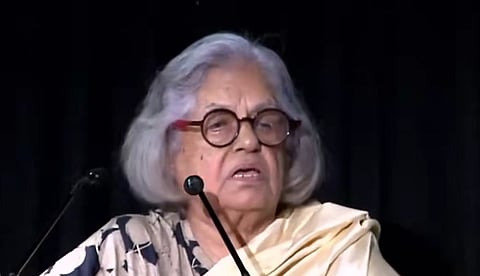
SENIOR ADVOCATE INDIRA JAISING has unveiled a culture of sexual harassment within the Indian judiciary, which she termed as its “dark secret.” Speaking at the 29th D.S. Borker Memorial Lecture on the topic ‘My Vision of India: 2047 A.D’ on August 24, 2026, Jaising stated that she had represented numerous female judges in sexual harassment cases against their male colleagues.
“In the course of my experience, I have had to deal with women judges. I have represented a lot of women judges. These women judges have come to me with complaints about sexual harassment by male judges, which is why I did write in my book that sexual harassment is the dirty secret of the judiciary of India. No one wants to talk about it,” the senior advocate stated.
Jaising remarked that the culture of sexual harassment is instilled into the Indian judiciary system, explaining that the problem comes from the strict hierarchy within the courts. Judges in the High Courts and Supreme Court are high-level authority figures wielding more power than judges in the district courts. This power imbalance, she said, allows senior judges to behave badly without any fear of facing consequences or retaliation.
During her speech, Jaising recalled an incident when she represented a woman judge. According to this judge, when a High Court judge retires, women judges from the district courts are told to line up. They are made to wear sarees of the same color and throw flowers on the male judges as they walk in for a farewell dinner. Jaising said this custom shows how much respect and obedience senior judges expect from junior women judges.
“This woman judge I was representing told me that when a High Court judge retires, women District Court judges are asked to line up, wear sarees of the same colour, and throw flowers at all the male judges who walk past entering into the dining room. This is the practice of the higher judiciary,” Jaising stated.
Jaising said the same woman judge later faced harassment directly. A male judge invited her to his 25th wedding anniversary party and asked her to perform an item dance number. When she refused, she lost her job, Jaising said.
Before Jaising spoke, another senior lawyer, Dr. S. Muralidhar, gave his own lecture. He commented upon many issues that have plagued the Indian legal system such as drawn-out court cases and student protests. The respected lawyer also leveled criticism towards archaic and unfair customs inside the judiciary. He said more women judges are now reporting insensitive comments with suggestive undertones and harassment from senior male judges.
Echoing Dr Muralidhar’s remarks, Jaising added one more concern of her own. She said that courts spend too much time on cases involving rich people and big corporations. Such a practice, Jaising remarks, leaves little time for the judiciary to deal with ordinary citizens needing justice.
Near the end of her speech, Jaising answered a question young people often ask her: why does she still feel hopeful about India's future? She said her hope comes from the Constitution of India. Reiterating her beliefs in the constitution and its directives, Jaising remarked that no government action can go completely unchecked as long as the Constitution stays strong and unchanged.
(Edited by Harsh Pandey)
Watch Full Report:
Suggested reading:
Subscribe to our channels on YouTube and WhatsApp
Download our app on Play Store
