
- HOME
- OPINION
- ON GROUND
- INTERVIEW
- Neta Profile
- Editor's Pick
- INDIA
- NewsGram USA
- WORLD
- न्यूजग्राम
- POLITICS
- ENTERTAINMENT
- CULTURE
- LIFESTYLE
- ECONOMY
- SPORTS
- Jobs / Internships
- Misc.
- NewsGram Exclusive
By Sayali Parate
Pandhurna, Madhya Pradesh: When Chhabi Sirsam (32) needed sal wood for a ceremony after her marriage, she assumed the difficulty was because she had shifted to Bhopal, Madhya Pradesh – an urban area.
“In my community, this wood has special importance. But finding it was very difficult for us in the city,” Sirsam, a member of the Gond tribal community, said.
In her village Pendhoni of Pandhurna district, sal was easy to find. “It was specifically important for weddings. These occasions can’t happen without sal,” she said.
Sirsam thought not being able to find sal trees was a problem limited to urban spaces. She was wrong.
In villages across Madhya Pradesh, sal trees are disappearing: hit by rising temperatures, changing moisture levels and insect infestations linked to climate stress.
In Jhallar village in Harda district of the state, there is only one tree left, Sundiya Bai Dhurve (60) told 101Reporters.
Dhurve was picking up cow dung in the courtyard when her daughter-in-law asked, “Amma, will there be a wedding without sal wood?”
Dhurve replied, “How will it happen?...The sal has to be there. Without it, the wedding does not happen.”
“In a Gond wedding, first people go near the sal tree, worship it and bring a branch home. It is placed in the middle of the wedding manda [canopy under which the wedding is held],” she explained.
Though she does not recall her exact age, Dhurve is a repository of Gond wedding rituals. “Earlier, there were so many sal trees that there was no counting them,” she told 101Reporters. “Now only one is left.”
She does not know why the trees disappeared. “Maybe because we took more of it?” she said.

According to reports, thousands of sal trees in Madhya Pradesh are drying up due to an outbreak of the sal heartwood borer in regions such as Dindori and Amarkantak. In some areas, 30-35% of sal trees are affected.
Scientific studies have linked the infestation to climatic factors such as temperature, relative humidity and rainfall. While higher temperatures increase the activity of the borer insect, lower soil moisture weakens the tree further, making it more vulnerable.
Harda district lies at the southern edge of the Satpura range and the Narmada valley. The region is better known for teak and sal has always been rarer here.
Sal forests are concentrated in eastern Madhya Pradesh—Rewa, Umaria, Anuppur, Balaghat, Mandla, Dindori and Jabalpur—covering just over four percent of the state’s forest area.
Dhurve told 101Reporters that she has seen sal in every wedding she attended since childhood. “It’s been part of our ancestors’ life and rituals,” she said. “Now only one tree is left.”
She visits the tree every day. “If we lose this last tree, we will have to travel deep into the forest to bring sal for weddings,” she said.
A Gond wedding manda usually requires a four- to five-foot-long sal pole. “Soon, we may have to manage with just a small branch,” Dhurve said.
Rambakas Irpache (40), a bhumka who conducts Gond weddings in Harda’s Guthania village, said, “When the manda is made, the most important wood is sal, placed exactly in the centre.”
Earlier, the entire mandas were built using sal. “Now it has become very difficult to get sal wood. Moini or mahua is used, but a small sal branch must still be brought…at least for support,” he said.
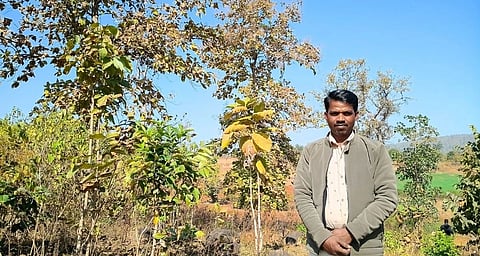
Vinod Kadam (30), the sarpanch of Jadkahu village, also pointed to a lone sal tree in his area about two kilometres from the settlement.
“This tree is important for weddings, but also for worship,” he said, explaining that the resin is burned like camphor during rituals, including aarti for chickenpox.
“After 2000, these trees became very few,” he said. “We try to plant sal, but seeds and saplings are not available.”
Storms have made survival harder. “Earlier, such windstorms did not come so often. In the last five years, they have increased a lot,” he said. “Sal is weak and flexible because of which it breaks easily.”
Studies show that soil moisture under sal trees is lower than in healthier forest patches, affecting regeneration. Heat stress disrupts flowering cycles and reduces seed quality, while long dry spells scorch saplings before they establish roots.
Shirish Kumar Chouriya, founder of Wild Routes Foundation, said abrupt temperature changes directly affect trees and seeds. “Species adapted to moderate climates cannot tolerate extreme heat or cold,” he said.
This is the reason that these species thrived in Central India, where the climate was relatively balanced.
Sudden spikes in temperature alter flowering cycles and reduce seed quality, affecting germination. After rainfall, prolonged dry spells combined with extreme heat often scorch young plants; even mature trees show damage, with new leaves burning in unusually hot summers.
At the other extreme, very low rainfall creates drought-like conditions, while excessive rainfall leads to flooding and increased moisture, raising the risk of fungal infections and disease.
The disappearance of the sal tree is more than an ecological loss for Gond and Korku communities. It threatens rituals tied to marriage practices through which families share happiness and carry forward tradition.
Shobha Salame (64) explained that a sal sapling is planted in the house after someone gets married. “Only when the tree takes root is the wedding considered complete,” she said.
In Gond weddings, the woman first pays obeisance to the sal tree. A branch is brought home and placed at the centre of the manda. In folk tales, the sal is a symbol of divinity and the beginning of celebration.
Rambakas Irpache, who conducts weddings in Harda district, said the sal wood is placed in the middle of the manda on the day it is set up. “In this same manda, the bride and groom sit and perform the wedding rounds,” he said. Half the rounds take place at the groom’s home and half at the bride’s. After the rituals are complete, the same tree is planted in the courtyard.
Ramnaryan Kajle (40), from the Korku community in Guthania village, said the rituals followed by Gond and Korku families are the same. “When a wedding takes place, the sal tree is first worshipped by two people from outside the household,” he said. “Only after that is the tree cut. When it is brought home, it is worshipped again before being placed in the centre of the manda.”
In the days leading up to the wedding, women dance and sing around the sal tree, applying turmeric to it, marking a symbolic beginning rooted in nature.
It is believed that the faster and healthier the tree grows, the faster the family grows and remains happy. The tree stays in the courtyard until the family is considered complete and until children are born and life settles into stability.
As sal trees disappear from forests and villages, elders say weddings may still take place. But the rituals that once grew alongside the tree, slowly, deliberately, are becoming harder to sustain.
This project is supported by the Internews Earth Journalism Network with funding from the Swedish International Development Cooperation Agency (Sida)
This article was originally published in 101 Reporters under Creative Common license. Read the original article.
[DS]
Suggested Reading:
Subscribe to our channels on YouTube and WhatsApp
Download our app on Play Store
