
- HOME
- OPINION
- ON GROUND
- INTERVIEW
- Neta Profile
- Editor's Pick
- INDIA
- NewsGram USA
- WORLD
- न्यूजग्राम
- POLITICS
- ENTERTAINMENT
- CULTURE
- LIFESTYLE
- ECONOMY
- SPORTS
- Jobs / Internships
- Misc.
- NewsGram Exclusive
This article was originally published in Radio Free Europe/Radio Liberty (RFE/RL). Read the original article.
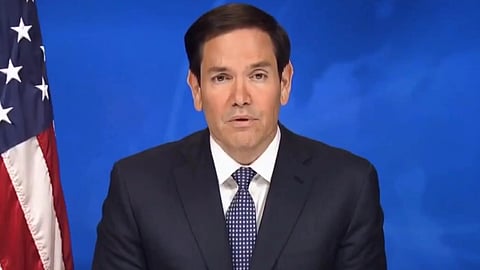
WASHINGTON -- US Secretary of State Marco Rubio has confirmed that Washington and Kyiv are negotiating a license that could allow Ukraine to produce missiles for the US-made Patriot air-defense system, reviving an idea that President Donald Trump appeared to downplay only weeks ago.
Rubio’s comments offer Ukraine a potential long-term path toward greater self-reliance in air defense. But he was clear that even if a license is granted, it would not address Kyiv’s immediate shortage of interceptors.
“That’s being negotiated as we speak,” Rubio said on September 2 when asked on The Brian Kilmeade Show whether he was opposed to giving Ukraine licenses to make its own Patriot missiles.
“But that is not an immediate solution,” he added, saying that “ramping up production” and building factories for such sophisticated weapons would take multiple years.
The remarks came as Ukraine seeks more air-defense interceptors ahead of another winter of Russian missile and drone attacks. Rubio said demand for interceptors has become “the number-one defense need on the planet,” with countries in the Middle East also seeking them.
He stressed, however, that the US has its own defense requirements and must maintain adequate stockpiles before supplying other countries.
For Kyiv, that leaves a difficult gap: the interceptors are needed now, while the industrial capability being discussed could take years to establish.
Rubio’s confirmation does not guarantee that an agreement will be reached, and it does not offer a quick answer to Ukraine’s immediate air-defense needs.
Retired Rear Admiral Mark Montgomery, a senior director at the Foundation for Defense of Democracies, told RFE/RL that Ukrainian Patriot production would be worthwhile but would not materially affect the war in the near term.
“The idea that the US is going to work with Ukraine for Ukraine to eventually license and build Patriots is admirable, but that's years away,” Montgomery said.
He estimated that licensing and establishing production could take at least 18 months and potentially two or three years.
“That will not produce Patriots for Ukraine anytime in 2026 or 2027, and maybe not even 2028,” he said. “So while that's interesting, that's not going to change the status quo of the conflict with Russia.”
Montgomery said he does not believe the US is currently offering Ukraine sufficient numbers of Patriots, which he said could make the coming winter difficult.
Instead, he pointed to ways Washington could help Ukraine strike Russian missile launchers before they fire.
He suggested providing targeting data that could help Ukrainian medium-range drones hit Russian Iskander ballistic-missile launchers, as well as software upgrades for Ukrainian F-16s to allow them to dynamically target those launchers.
The licensing talks nevertheless carry political and strategic significance.
Yevhenii Malik, a Ukrainian Marine veteran and Mariupol defender who heads national-security and defense programs at the Kyiv School of Economics, agreed that building a Ukrainian Patriot capability would be a long-term undertaking.
But he said the significance also lies in the signal that Washington is continuing to work with Kyiv on advanced defense capabilities.
“It’s more about the sign,” Malik told RFE/RL.
For ordinary Ukrainians and Americans, he said, the technical details of ballistic-missile interceptors may be difficult to understand. What is easier to see is the cooperation between the United States and Ukraine and the broader message of allied support.
Russia is also watching that relationship, Malik said.
The Patriot discussions come alongside US-Ukrainian talks on drone technology. Asked whether Washington had been reluctant to accept Ukraine’s offer of drone technology, Rubio said the United States was pursuing potential deals that made sense for it.
“If it’s a deal that makes sense for the US, I think we’re pursuing those,” Rubio said, describing the discussions as “a work in progress.”
He again stressed that such projects would be long-term efforts rather than capabilities that could come online immediately.
The discussions therefore point to a broader form of defense cooperation in which Ukraine could eventually become not only a recipient of Western weapons but also a source of battlefield-tested military technology.
See Also: Rubio Heads To Rome, Vatican As Iran War Strains US Ties With Europe
Even if Ukraine receives a license, the scale of the ballistic-missile threat presents a formidable challenge.
Malik said Russia could produce roughly 1,000 or more ballistic missiles a year, while US production of PAC-3 Patriot interceptors is slightly above 600 annually.
The imbalance becomes more pronounced because intercepting a ballistic missile does not necessarily require a single interceptor.
Malik cited Ukrainian estimates suggesting that two PAC-3 missiles could be needed to intercept one ballistic missile under optimistic assumptions, with other estimates putting the figure at three or even 3.5.
That underscores why a Ukrainian production capability would have to reach substantial scale to significantly affect the balance.
Malik also pointed to Russia’s military cooperation with North Korea and Iran, including the use of North Korean ballistic missiles against Ukraine. His broader argument is that Kyiv’s future air-defense needs must be measured against a wider and potentially growing ballistic-missile threat.
Kateryna Bondar, a senior fellow at the Center for Strategic and International Studies and a former adviser to the Ukrainian government, is similarly skeptical about any near-term impact.
Bondar recently returned from Ukraine, where she spoke with Ukrainian missile specialists about the prospects for domestic Patriot production.
She told RFE/RL that the experts she consulted believed it could take several years simply to begin manufacturing.
Bondar said the Ukrainian specialists she spoke with estimated that it could take “up to five, six years just to start producing” because of the system’s complexity.
Even established manufacturers face significant scaling constraints.
Bondar said Lockheed Martin experts had told her that, despite existing technology, supply chains, production partners, and other infrastructure, increasing output from roughly 600 PAC-3 interceptors to at least 2,000 could take about three years.
For Ukraine, which would have to establish much of the industrial base, the challenge would be greater. “So it won't change calculus in any short-term perspective for sure, and even mid-term,” Bondar said.
Yet she sees a potentially important long-term purpose.
Some Ukrainians increasingly view access to advanced interceptors as part of a future security guarantee, she said. A credible ability to defend against Russian ballistic missiles could help deter Moscow from restarting a large-scale war after a cease-fire or peace agreement.
“Having interceptors, having [the] ability to intercept Russian ballistic missiles is something that can stop Russia from advancing,” Bondar said.
Bondar said some Ukrainian experts fear Moscow could accelerate ballistic-missile production and develop countermeasures before Ukraine acquires the technology and infrastructure needed to manufacture PAC-3 interceptors.
“Russians are definitely getting the message,” Bondar said. “They’re not only getting the message. They already start thinking of countermeasures.”
That could turn the licensing effort into part of a longer technological competition. While Kyiv and Washington seek to establish a durable air-defense capability, Moscow could seek to increase missile production or develop ways to overwhelm it.
[GRT]
Suggested Reading:
Subscribe to our channels on YouTube and WhatsApp
Download our app on Play Store

