
- HOME
- OPINION
- ON GROUND
- INTERVIEW
- Neta Profile
- Editor's Pick
- INDIA
- NewsGram USA
- WORLD
- न्यूजग्राम
- POLITICS
- ENTERTAINMENT
- CULTURE
- LIFESTYLE
- ECONOMY
- SPORTS
- Jobs / Internships
- Misc.
- NewsGram Exclusive

Yulia Navalnaya accused Putin of murdering Navalny, claiming a joint investigation by five European countries found the deadly neurotoxin epibatidine in his body.
Russia rejected the allegations, calling them a Western disinformation campaign.
The case has reignited international dispute, as investigators cite possible state involvement while the exact method of poisoning remains unknown.
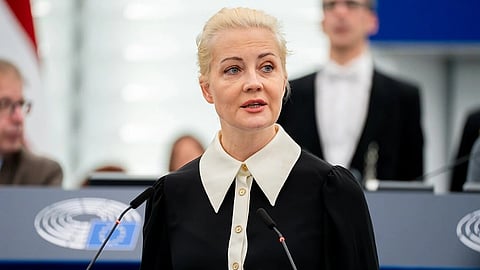
Wife of the late Russian opposition leader Alexei Navalny, Yulia Navalnaya has accused Vladimir Putin of murdering her husband. She took to her X handle to talk about the same on Saturday, 14 February 2026. She said that researchers have detected samples of a highly lethal toxin, epibatidine, found in South American dart frogs, in Navalny’s body.
She wrote in her post, “Scientists from five European countries have established: my husband, Alexei Navalny, was poisoned with epibatidine.” The claim came as a result of the joint assessment conducted by the authorities of the five countries, which included the United Kingdom, France, Germany, Sweden and the Netherlands. She further said that she had believed from the very start that “Putin killed Alexei with a chemical weapon.” She explained that the laboratory analysis “conclusively confirmed” the presence of the rare neurotoxin.
She further called Vladimir Putin a “murderer” and wants him to be held responsible for the same. Now, the case will be referred to the Organization for the Prohibition of Chemical Weapons for a possible violation of the Chemical Weapons Convention, with Russia as the “likely culprit.”
Meanwhile, the accusation has been denied by Russia, which clearly denied its involvement, citing the whole scenario as politically motivated. A spokesperson for the Russian Foreign Ministry, Maria Zakharova, denounced it as a Western “disinformation campaign” used to distract from domestic problems abroad. They stand by their earlier conclusion that Navalny’s death was due to natural causes, as there were no verified formulas or detailed analyses presented regarding the same. The Russian embassy in London said that the death was being exploited by the Western governments for political purposes and failed to seek justice.
The European authorities’ statement described epibatidine as around 200 times more potent than morphine, which is not naturally found in Russia. Investigators have pointed towards the state administering the poison and having “means, motive and opportunity” to do so as Navalny died in state custody. However, the European officials further clarified that the means through which the substance was delivered is still in the dark.
Alexei Navalny was a prominent anti-corruption campaigner and Putin’s most visible domestic opponent. He was serving multiple sentences which added up to over 30 years in a high-security Arctic penal colony. His death was declared in February 2024, and Russian authorities named the cause as medical, linking it to pre-existing conditions. However, his allies reported vomiting and convulsions shortly before his death, citing a possible poisoning. He was earlier poisoned in 2020 with a nerve agent and blamed the Russian security services for being involved in the poisoning.
Yulia Navalnaya has spoken at international forums following Navalny’s death, where she vowed to make authorities “pay” for what they did to her husband and her family. The narrative still remains the same after two years as Western governments and Moscow have two completely different takes on the death.
Suggested Reading:
Subscribe to our channels on YouTube and WhatsApp
Download our app on Play Store

