
- HOME
- OPINION
- ON GROUND
- INTERVIEW
- Neta Profile
- Editor's Pick
- INDIA
- NewsGram USA
- WORLD
- न्यूजग्राम
- POLITICS
- ENTERTAINMENT
- CULTURE
- LIFESTYLE
- ECONOMY
- SPORTS
- Jobs / Internships
- Misc.
- NewsGram Exclusive

He solved Einstein’s radiating star problem through the Vaidya Metric, shaping modern astrophysics.
He built India’s relativity and mathematics education ecosystem while mentoring generations of scientists.
Despite global recognition, he lived a simple Gandhian life devoted to teaching over fame.
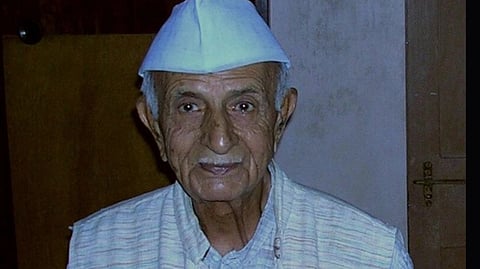
When we talk about modern physics, names like Einstein, Hawking and Chandrasekhar come as our first thought, dominating our imagination. However, a soft-spoken Indian mathematician often gets overshadowed, whose work solved a fundamental puzzle of the cosmos — what happens to gravity when a star shines. A mathematician, theoretical astrophysicist and educationist who followed Gandhian principles answered the question in 1943 through his solution, the “Vaidya Metric”, highlighting his intellectual lineage.
The Vaidya Metric was later found to have applications in the study of quasars, supermassive objects and black holes, becoming a turning point in relativistic astrophysics. He was a world-class scientist with hundreds of research publications and influenced generations of physicists, yet he never became a household name. His life was a symbol of simplicity; he chose teaching and service over fame, prestige and ambition. His works shaped modern physics yet went unrecognized.
Einstein proposed the theory of general relativity in 1915, which described gravity through ten field equations valid across the universe but required simplifying assumptions for exact solutions. The first solution came from Karl Schwarzschild, who described the gravitational field around a non-radiating spherical body. However, real stars were different as they emitted radiation while continuously losing energy.
The exact relativistic description of a radiating star’s gravitational field was derived in 1943 by P.C. Vaidya. He wrote it in his paper “The External Field of a Radiating Star in General Relativity”, published in Current Science, which later came to be known as the Vaidya Metric. Decades later, the importance of his work was established with the discovery of intensely energetic objects at galactic centers — quasars. Vaidya’s research connected the broader development of high-energy astrophysics, which linked theoretical relativity to observations of black holes and supermassive cosmic structures.
Prahlad Chunilal Vaidya was born to a modest family — his father worked as a postal official — in 1918 in Shahpur village in the princely state of Junagadh. His parents died early, leaving him in the care of relatives in Bhavnagar, where he studied at Alfred High School until 1933. Later, he continued his education at Ismail Yusuf College in Jogeshwari, Bombay, where his elder brother had found employment as a teacher. He then graduated with distinction and topped the University of Bombay as a postgraduate student, completing his BSc and MSc in Mathematics from the Royal Institute of Science.
However, his interest spiked in 1937 when he attended lectures on general relativity at Bombay University by V.V. Narlikar. The lecture elaborated that the gravitational field of a radiating star remained unsolved, which stayed with Vaidya and later defined his scientific life. He did not immediately go on to research, as he chose public service over academic ambition. He returned to Bombay in 1941 after teaching for a while in Rajkot.
Back in Mumbai, he was involved with the Gandhi-inspired voluntary organisation Ahimsak Vyayam Sangh, which was established to train satyagrahis during the turbulent Quit India movement period. But the organisation did not last long due to ideological disagreements, leaving Vaidya without direction. He then wrote to Narlikar in Banaras asking for permission to work informally under his guidance.
He travelled to Banaras along with his family to continue his research without any formal doctoral enrolment or institutional funding. He published several papers between 1942 and 1943, which he later wrote about in his memoir “Chalk and Duster”, describing it as a “Kashi Yatra” that shaped his present life rather than the afterlife.
Vaidya started teaching in Surat for income and later completed his PhD in 1948 from the newly established Tata Institute of Fundamental Research in Bombay. He even got the opportunity to work in the orbit of Homi Bhabha during the formative years of India’s scientific institutions but left the city due to housing issues.
He then moved to Vallabh Vidyanagar in Gujarat and started teaching at Vitthalbhai Patel College as a professor. As time passed, he served as chairman of the Gujarat Public Services Commission, a member of the Union Public Services Commission and eventually vice-chancellor of Gujarat University. He mentored several research students, generating curiosity among the young generation for mathematics.
He even became the highest-paid professor of mathematics in Gujarat, and his rising international reputation brought him invitations from universities in Europe and America. However, he lived a simple life, owning just a pack of chalk, a kurta and a bicycle, as he donated his wealth to establishing mathematics institutions. He believed that for a mathematician the greatest possession is his mind.
The great mind continued his scientific work at the intersection of general relativity and astrophysics by publishing papers in journals like Nature, Physical Review Letters, Astrophysical Journal and Current Science. He received international recognition after his paper was published in Physical Review in the 1950s following Robert Oppenheimer’s referral.
He went on to author 102 publications: 90 journal articles, 5 conference papers, 4 book chapters, 2 review articles and 1 report throughout his active career. His work was bibliometrically analysed to examine publication types, journals, publishers, countries, collaboration patterns, year-wise growth and top-cited papers. He was also a founder member of the Indian Association for General Relativity, building a community of Indian relativists including C.V. Vishveshwara, Naresh Dadhich and Jayant Narlikar. He was termed a guiding figure for the next generation of researchers along with the Calcutta mathematician Amal Kumar Raychaudhuri.
Vaidya chose a silent teaching life, preferring peace over fame. He spent his career in Gujarat away from metropolitan research centres, in keeping with his Gandhian values. He even wrote to the Bulletin of the Astronomical Society of India that he considered himself a mathematics teacher who loved teaching and was surprised to be called an astronomer of repute in the late 1990s.
Today, the Vaidya metric is extensively used to connect Einstein’s relativity to modern observations, including gravitational waves, and to understand radiating stars, gravitational collapse, black hole physics and cosmology. He stands as a rare example of intellectual humility who solved a cosmic puzzle, built institutions, educated generations and lived simply, proving that scientific greatness need not be accompanied by spectacle. His work is still used by the universe to model a shining star, highlighting his enduring legacy.
(Edited by Dhruv Sharma)
Suggested Reading:
Subscribe to our channels on YouTube and WhatsApp
Download our app on Play Store
