
- HOME
- OPINION
- ON GROUND
- INTERVIEW
- Neta Profile
- Editor's Pick
- INDIA
- NewsGram USA
- WORLD
- न्यूजग्राम
- POLITICS
- ENTERTAINMENT
- CULTURE
- LIFESTYLE
- ECONOMY
- SPORTS
- Jobs / Internships
- Misc.
- NewsGram Exclusive
For most of the past two years, the story of AI image tools has been told in the wrong register. The headlines celebrated novelty: a photo of the Pope in a puffer jacket, a face swapped onto a celebrity, a portrait conjured from a sentence. The implied question was always "can a machine make something that looks real?" That question is settled. It can, and it stopped being interesting a while ago.
The more interesting question turns out to be quieter, and it has less to do with quality than with control. Not "can the AI make an image," but "can it change only the one thing I asked it to, and leave everything else alone?" That distinction sounds small. In practice it is the line between a toy and a tool, and it explains why a wave of new platforms is reorganizing around a single idea: one place to describe what you want, and a growing menu of models underneath to carry it out.
Anyone who has actually tried to edit with early generative tools knows the frustration. You have a photo you like. You want the jacket to be red instead of blue. You type the request, and the model returns a new image where the jacket is red, the face is subtly wrong, the background has rearranged itself, and the lighting no longer matches. You got what you asked for and lost everything you didn't.
This is the problem that prompt-based local editing is meant to solve. Prompt-based local editing is a technique where you point at one region of an image, describe the change in plain words, and the system alters only that region while preserving the composition, texture, and identity of everything else in the frame. Newer platforms market this as their core capability. Imagvio AI, which recently rebranded and built its editing experience around a model it calls Nano Banana, pitches exactly this: local edits that target only the described region, plus consistency of a character across different outfits, poses, and scenes.
It is worth being precise here. Character consistency and "change only what you describe" are the platform's own claims, not independently benchmarked facts, and results still drift on hard cases like sharp profile angles. But the ambition is the right one. It is the feature that decides whether a non-designer is willing to touch the tool at all. If every small edit risks corrupting the whole image, ordinary users back away. If edits stay local and predictable, they lean in.

The second shift is structural. Until recently, image generation and video generation lived in separate products with separate logins and separate mental models. That separation is dissolving.
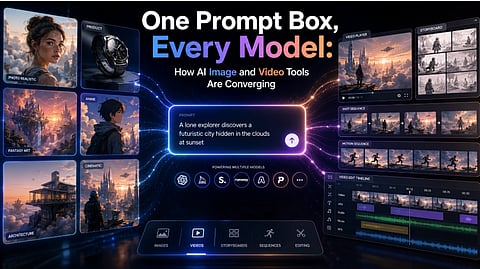
The reason is partly technical and partly commercial. Technically, the same prompt-understanding layer that interprets "make the jacket red" can, with a different model behind it, interpret "animate this scene for three seconds." Commercially, no user wants to learn five interfaces. So platforms are converging on a pattern that looks a lot like a single prompt box sitting on top of a rotating cast of specialized models.
Imagvio AI is a useful example of the pattern rather than an exception to it. Alongside image editing, it offers video generation and exposes a lineup of named models — its own Nano Banana 2, plus third-party systems it lists such as Flux, Seedream, Veo, Sora, and Wan — chosen per task rather than per app. The specific names matter less than the shape: the model becomes an interchangeable engine, and the interface becomes the product.
For a reader trying to make sense of the market, that reframing is the key. You are no longer choosing between "an image app" and "a video app." You are choosing an interface and trusting it to route your request to whatever model does the job best that week. That is a very different consumer decision, and it is why the category is consolidating.
There is a social dimension here that rarely makes the technology coverage. Generative AI is not a niche experiment. Bloomberg Intelligence has projected the generative-AI market could reach roughly $1.3 trillion by 2032. Numbers that large tend to reshape who gets to participate in an activity, not just how it gets done.
Visual creation used to be gated by skill and software. You needed to know a professional editor, or hire someone who did. Prompt-based tools lower that gate, and the pricing models lower it further. Most of these platforms, Imagvio included, run on a free-credit-plus-subscription structure: you get some credits to start, earn more through daily check-ins or referrals, and pay for volume, with each generation costing a few credits. That is honest to state plainly, because it also sets the limit. The free tier is enough to evaluate the tool, not to run a business on it. Anyone who tells you otherwise is selling something.
Still, "enough to evaluate" is a meaningful change from "you can't try this without a design budget." When a student in Pune or a small shop owner in Nairobi can restyle a product photo or draft a short promotional clip on a phone, the set of people who can produce professional-looking visuals expands well beyond the people who trained for it. That is the shift worth watching, and it will outlast any single viral image.
None of this means the tools have arrived fully formed. Two cautions are worth keeping in mind.
First, provenance. As synthetic images and video get easier to make and harder to spot, watermarking matters. Imagvio says it applies Google's SynthID invisible watermark to its outputs, which is a responsible default and the kind of thing worth checking for in any tool you adopt. Whether such marks survive screenshots and re-compression at scale is an open question the whole industry is still working through.
Second, hype discipline. Marketing language runs ahead of measured performance in this category more than almost any other. "Character consistency" is a claim to test on your own images, not a guarantee. The sensible posture for a reader is neither the breathless "AI changes everything" nor the dismissive "it's all fake." It is the practitioner's posture: try it on a real task, note where it holds and where it breaks, and keep the receipts.
The convergence, though, looks real and durable. The interface is becoming the product, image and video are becoming one workflow, and the price of entry is falling toward zero for anyone willing to learn a prompt box. The novelty phase of AI imagery is ending. The real question now is not whether these tools can make something impressive, but what happens to a culture when the ability to produce a polished image or a short video stops being a specialist skill and becomes as ordinary as typing. We are about to find out.
Suggested Reading
Subscribe to our channels on YouTube and WhatsApp
Download our app on Play Store
