
- HOME
- OPINION
- ON GROUND
- INTERVIEW
- Neta Profile
- Editor's Pick
- INDIA
- NewsGram USA
- WORLD
- न्यूजग्राम
- POLITICS
- ENTERTAINMENT
- CULTURE
- LIFESTYLE
- ECONOMY
- SPORTS
- Jobs / Internships
- Misc.
- NewsGram Exclusive

Key Points:
A SpaceX rocket part crashed into the Moon on August 5, 2026, marking only the second accidental Moon crash on record.
This tracked crash gives scientists a rare chance to study crater size, dust spread, and how debris behaves on the Moon.
With over 100 new missions planned and no international disposal rules, experts warn debris risks will only grow.
By Gopal Ram Tripathi
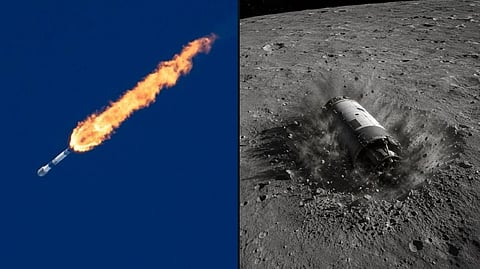
EARLY ON WEDNESDAY, August 5, 2026, a leftover part of a SpaceX rocket crashed into the Moon. The object hit near the Einstein Crater on the far side of the Moon. It was traveling at more than 5,000 miles per hour. Nobody could see the crash from Earth, but scientists tracked it closely before it happened. This rocket part had been launched back in January 2025 to help send a lunar lander into space. After its job was done, it stayed in space instead of burning up or falling into Earth. Now, it has become the second known rocket part to crash into the Moon by accident. The first accidental crash like this happened in 2022, when a Chinese rocket part hit the far side of the Moon too.
This event may sound small, but scientists say it is a warning. As more countries and companies send missions to the Moon, more trash is being left behind. Experts now want the world to pay closer attention to this growing problem before it becomes dangerous.
See Also: NASA returns moon mission rocket, spacecraft back to launch pad
The Moon does not have an atmosphere like Earth. This means there is nothing to protect it from crashing objects. Any object that hits the Moon leaves a mark that can stay there for a very long time. Because there is no wind or rain on the Moon, craters and debris don't disappear like they might on Earth.
Scientists say this crash gives them a rare chance to learn. It is very hard to track objects flying through deep space, so most impacts happen without warning. But because experts followed this rocket part closely, they will be able to study exactly what happens when something hits the Moon's surface. They want to know how big the crater becomes, how far dust and rock spread out, and how long the dust cloud lingers in space.
One scientist explained that the material thrown up by the crash, called ejecta, can move at very high speeds. This matters because future astronauts and Moon bases could be at risk from flying debris if a crash happens close by. A satellite from South Korea and NASA's Lunar Reconnaissance Orbiter will both try to photograph the impact area in the coming days.
This is not just about one piece of space junk. Experts say there are now about 3,000 human-made objects sitting on the Moon. Together, they weigh around 209 tons. This includes old rocket parts, broken spacecraft, and equipment left behind since 1959, when the Soviet Union's Luna 2 mission became the first human object to ever land on the Moon. Pieces from NASA's Apollo missions are still there too.
The real concern is what happens next. More than 100 new Moon missions are planned over the next ten years by different countries and private companies. As more spacecraft head to the Moon, more debris will likely be left behind or crash into the surface. Right now, there is no clear international rule about how countries should clean up or safely dispose of old spacecraft. Scientists warn that without better tracking systems and shared rules, future missions could face more crashes, damage to important lunar landing sites, and higher risks for the astronauts and equipment that will one day live there.
Some experts compare this to a similar problem in Earth's orbit, sometimes called the Kessler syndrome. This is the idea that one crash could create many small pieces of debris, which then crash into other objects, creating even more debris. If this keeps happening, in space it could make it dangerous to send anything into orbit at all.
This week's crash on the Moon was not dangerous on its own. But scientists agree it is a clear sign of a bigger issue. As nations race to explore and even live on the Moon, the trash we leave behind could become a serious problem. Experts hope this event pushes governments and space companies to build better tracking systems and set new rules, before the Moon becomes as crowded with junk as the space around Earth already is.
Suggested Reading:
Subscribe to our channels on YouTube and WhatsApp
Download our app on Play Store
