
- HOME
- OPINION
- ON GROUND
- INTERVIEW
- Neta Profile
- Editor's Pick
- INDIA
- NewsGram USA
- WORLD
- न्यूजग्राम
- POLITICS
- ENTERTAINMENT
- CULTURE
- LIFESTYLE
- ECONOMY
- SPORTS
- Jobs / Internships
- Misc.
- NewsGram Exclusive

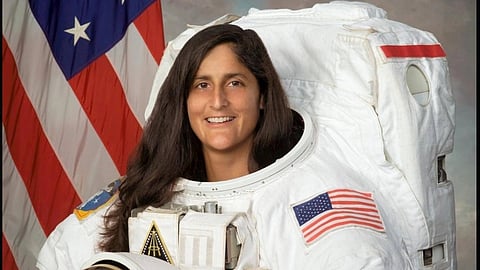
Sunita Williams retired from NASA after 27 years of service, ending a landmark career in human spaceflight.
She logged 608 days in space, completed nine spacewalks, and commanded the International Space Station.
Sunita Williams shared a close personal bond with fellow Indian-American astronaut Kalpana Chawla, supporting her family after the 2003 Columbia tragedy.
NASA announced the retirement of the Indian-origin American astronaut Sunita Williams on Tuesday, 20 January 2026. She retired on 27 December 2025 after a remarkable career spanning over 27 years of service devoted to human spaceflight, science, and exploration. Her career lasted around three decades, with her most recent incident involving being stranded for nine months aboard the International Space Station (ISS) and later being rescued.
As NASA announced her retirement, Administrator Jared Isaacman penned a post describing her as a defining figure in modern space exploration. He wrote, “Suni Williams has been a trailblazer in human spaceflight, shaping the future of exploration through her leadership aboard the space station and paving the way for commercial missions to low Earth orbit.” He further added that her achievements would pave the way for future generations by continuously inspiring them, noting how her work advancing science and technology “has laid the foundation for Artemis missions to the Moon and advancing toward Mars.”
Williams also shared a close personal bond with fellow Indian-American astronaut Kalpana Chawla, who lost her life in the 2003 Space Shuttle Columbia disaster. Chawla’s mother, Sanyogita Chawla, praised Williams, saying, “Sunita Williams stayed with us for three months after my daughter’s death.” Over the years, Williams has shown deep respect and admiration for Chawla, acknowledging her as a source of inspiration.
Williams holds the second-highest record of cumulative time spent in space by a NASA astronaut, amounting to a total of 608 days in orbit, after Russian astronaut Oleg Kononenko, who has logged over 1,000 days in space. She completed three missions to the ISS over the course of her career. She was also part of the sixth-longest single spaceflight, spending 286 days in orbit during NASA’s Boeing Starliner and SpaceX Crew-9 missions alongside astronaut Butch Wilmore.
The astronaut carried out a total of nine spacewalks, amounting to 62 hours and 6 minutes, making her the woman with the most spacewalk time and placing her fourth on the all-time cumulative spacewalk duration list. She also completed the Boston Marathon distance on a treadmill aboard the ISS as the station orbited Earth, making her the first person to run a marathon in space.
She went on her first space mission on 9 December 2006, joining the Expedition 14 crew aboard Space Shuttle Discovery (STS-116). She conducted her first extra-vehicular activity on the eighth day of the mission. Williams also set a record by completing four spacewalks during a single mission while serving as a flight engineer during Expeditions 14 and 15.
Her most recent mission took place in June 2024, when she was launched aboard Boeing’s Starliner for NASA’s Crew Flight Test, along with Butch Wilmore. Williams assumed command of the ISS during Expedition 72 as the crew joined Expeditions 71 and 72, completing two spacewalks during the mission. The astronauts remained in orbit longer than planned owing to delays and returned safely to Earth in March 2025 as part of NASA’s SpaceX Crew-9 mission.
Beyond her spaceflight records, Williams was involved in numerous key leadership and training roles at NASA. In 2002, she spent nine days living and working in an underwater habitat as part of NASA Extreme Environments Mission Operations (NEEMO), designed to simulate space mission conditions. After her first spaceflight, she served as deputy chief of NASA’s Astronaut Office and later became director of Operations in Star City, Russia, following her second mission.
Later in her career, Williams played a role in establishing a helicopter training platform designed to prepare astronauts for future lunar landings under NASA’s Artemis programme. The initiative aimed to contribute to the return of humans to the Moon and eventually support missions to Mars.
Sunita Williams was born on 19 September 1965 to Deepak Pandya, an Indian-American neuroanatomist, and Ursuline Bonnie Pandya, who is of Slovenian American descent. A native of Needham, Massachusetts, she served in the US Navy before joining NASA’s astronaut training programme in 1998. A retired US Navy captain, she is an accomplished helicopter and fixed-wing pilot, having logged over 4,000 flight hours across more than 40 aircraft.
Although Williams was born and raised in the United States, she shares a deep emotional bond with her Indian roots and her ancestral village in Mehsana district, Gujarat. She has often carried elements of Indian culture such as a Ganesh idol, a copy of the Bhagavad Gita, and Indian snacks with her on missions to the ISS. She was referred to as “India’s daughter” in a personal letter written by Prime Minister Narendra Modi, delivered by astronaut Mike Massimino, in which the Prime Minister wrote, “Even though you are thousands of miles away, you remain close to our hearts.”
Her legacy continues to symbolize courage, scientific excellence, and aspiration for millions of people in India and around the world.
Suggested Reading:
Subscribe to our channels on YouTube and WhatsApp
Download our app on Play Store
