
- HOME
- OPINION
- ON GROUND
- INTERVIEW
- Neta Profile
- Editor's Pick
- INDIA
- NewsGram USA
- WORLD
- न्यूजग्राम
- POLITICS
- ENTERTAINMENT
- CULTURE
- LIFESTYLE
- ECONOMY
- SPORTS
- Jobs / Internships
- Misc.
- NewsGram Exclusive
This article was originally published in Radio Free Europe/Radio Liberty (RFE/RL). Read the original article.
WASHINGTON -- Iran's Islamic Revolutionary Guard Corps (IRGC) said it had targeted US military sites in Bahrain and Kuwait in response to the latest US military strikes against Iran.
Air raid sirens sounded in both countries as Kuwait said its air defenses were responding to hostile missile and drone threats. Bahrain's Interior Ministry urged residents to seek shelter after warning sirens were activated.
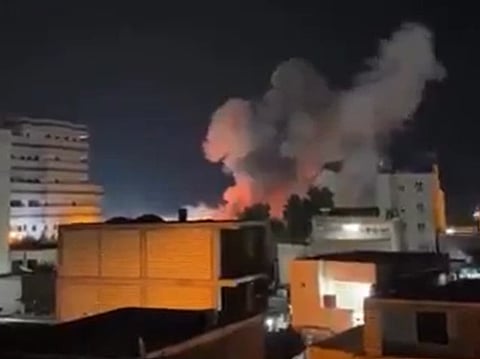
The United States launched a new round of military strikes against Iran and revoked a key sanctions waiver covering Iranian oil sales after accusing Tehran of attacking commercial shipping in the Strait of Hormuz, putting a fragile cease-fire into peril.
The twin moves mark the most serious crisis since the United States and Iran signed a 60-day memorandum of understanding (MOU) last month aimed at ending hostilities and reopening one of the world's most important maritime chokepoints.
“The attacks were designed to impose heavy costs for targeting and attacking commercial shipping crewed by innocent civilians in an international waterway," US Central Command (CENTCOM) said in a statement, calling Iran's actions "unwarranted, dangerous, and a clear violation of the ceasefire.”
Iranian media reported multiple explosions in southern Iran, including on Qeshm Island, in the city of Sirik, and near the strategic port of Bandar Abbas. US officials did not immediately specify which targets had been struck.
See also: In ‘Most Serious Test Yet’ of Ceasefire Deal, Trump Bombs Iran After Strike on Cargo Ship in Strait
Alongside the military strikes, the US Treasury revoked its authorization for Iranian oil sales, restoring sanctions relief that had been suspended under last month's memorandum of understanding.
A US official told RFE/RL the decision reflected the administration's long-standing position that any economic relief depended on Iranian compliance.
"As President Trump and the administration have repeatedly affirmed, the MOU in effect with Iran is entirely performance-based. Iran will only reap benefits if they exhibit good behavior," the official said.
“Iran's actions in the Strait were wholly unacceptable to the United States and will be met with consequences. Our negotiators continue to work in good faith towards a final deal.”
The waiver, originally scheduled to remain in force until August 21, had permitted limited Iranian crude exports and certain financial transactions as part of efforts to stabilize shipping through Hormuz.
Washington says Tehran violated its commitment by attacking vessels that used a US-protected shipping corridor near Oman rather than a northern route that Iran has insisted ships should use.
According to maritime security officials, three commercial vessels came under attack during the latest incidents, including the Qatari LNG carrier Al Rekayyat, whose crew reportedly issued a distress call after a drone struck near its engine room.
The Joint Maritime Information Center subsequently raised the threat level for commercial shipping in Hormuz to "severe."
Regional governments swiftly condemned the attacks.
Qatar called the strike on one of its vessels a "serious and explicit violation" of international law and said Iran would bear full legal responsibility. Saudi Arabia similarly accused Tehran of threatening international navigation and global energy supplies.
Tehran rejected Washington's justification, accusing the United States of repeatedly violating the ceasefire framework.
Iran's Foreign Ministry said revoking the suspension of sanctions on Iranian oil sales breached Paragraph 10 of what it called the "Islamabad Understanding," signed on June 18.
In a strongly worded statement, the ministry said the United States had committed "both minor and major violations" of the agreement over the past three weeks.
It warned that Iran would "take whatever measures it deems necessary to safeguard its national interests and security" and held Washington responsible for "the consequences of this breach of commitment."
Iran also continues to argue that the memorandum gave Tehran, in consultation with Oman, primary responsibility for reopening and managing shipping through the Strait of Hormuz.
Iranian officials have defended proposals to charge vessels for maritime security services, arguing that protecting navigation carries significant costs.
Western governments and shipping interests, however, have rejected any compulsory transit fees, warning they could resemble coercive payments rather than legitimate maritime services.
See also: The Flaws at the Heart of Donald Trump’s Iran Ceasefire Deal
Analysts say revoking the sanctions waiver increases pressure on Tehran but also risks undermining the fragile diplomatic framework before negotiations have concluded.
Brett Erickson, a sanctions expert at Obsidian Risk Advisors, questioned whether cancelling the waiver delivers meaningful economic leverage.
"The evidence simply didn't support the fear. During the life of General License X, Iran moved tens of millions of barrels of oil, but we never saw a wave of new buyers outside of China," Erickson told RFE/RL.
“The economic concession turned out to be relatively modest. Revoking it now risks collapsing the entire Memorandum of Understanding over a benefit that never proved particularly significant.”
Zineb Riboua, a research fellow at the Hudson Institute's Center for Peace and Security in the Middle East, told RFE/RL the administration may be using the waiver as additional negotiating leverage rather than abandoning diplomacy altogether.
She said disputes over frozen Iranian assets have remained unresolved throughout negotiations and suggested the latest move could be intended to strengthen Washington's bargaining position before the 60-day negotiating period expires.
Riboua cautioned, however, that the strategy carries significant risks, particularly for global energy markets.
While additional pressure could influence negotiations, she warned that continued instability in the Strait of Hormuz would keep insurance costs elevated and could reignite inflationary pressures in Europe and elsewhere through higher energy prices.
[KS]
Copyright (c)2025 RFE/RL, Inc. Used with the permission of Radio Free Europe/Radio Liberty
Suggested reading:
Subscribe to our channels on YouTube and WhatsApp
Download our app on Play Store

