
- HOME
- OPINION
- ON GROUND
- INTERVIEW
- Neta Profile
- Editor's Pick
- INDIA
- NewsGram USA
- WORLD
- न्यूजग्राम
- POLITICS
- ENTERTAINMENT
- CULTURE
- LIFESTYLE
- ECONOMY
- SPORTS
- Jobs / Internships
- Misc.
- NewsGram Exclusive

A 7.5-magnitude earthquake struck Japan late Monday, injuring around 30 people.
The quake forced mass evacuations amid aftershock warnings.
Japan’s response highlighted its strong disaster preparedness in the face of natural disaster.
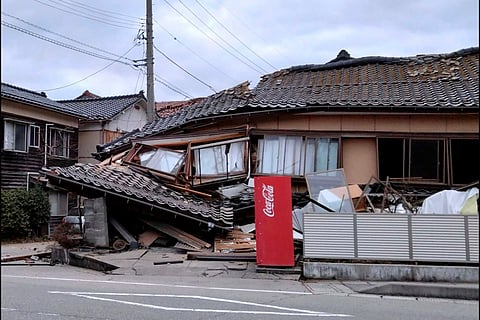
Japan was struck by a powerful 7.5-magnitude earthquake late at night on Monday, 8 December 2025. The tremor was felt at around 11:15 pm local time and was centred roughly 80 km off the coast of Aomori Prefecture at a depth of about 50 km. The shock left roads damaged, coastal communities shaken, and power cut to thousands of homes, leaving residents in freezing temperatures. It also triggered a tsunami, with the highest tide measured at around 70 centimetres. Reports suggest that around 30 people were injured, resulting in large-scale evacuations in the area as warnings of further strong tremors continue.
A wide area of northern Japan was affected, with parts of Aomori and nearby regions recording strong shaking. On Japan’s seismic intensity scale of 1 to 7, the quake registered an upper-6 in the city of Hachinohe. Such a level of shaking makes standing difficult and causes unsecured furniture and objects to topple. Social media videos showed the impact of the earthquake, with buildings shaking violently and papers and objects flying across rooms. The aftermath included roads developing cracks or partially collapsing, with some vehicles sustaining damage.
Japan’s Meteorological Agency soon issued a tsunami warning, initially cautioning that waves could rise up to three metres along parts of the north-eastern coastline. An estimated 90,000 people were ordered to evacuate the area to avoid risk. In the following hours, tsunami waves ranging up to 70 centimetres were observed at several ports. The warnings were later lifted by authorities.
The earthquake disrupted daily life across the region. Reports indicated that thousands of households were left without power in sub-zero night-time temperatures. Emergency crews worked through the night assessing infrastructure damage and clearing debris, leading to the suspension of rail services and road links over safety concerns. No serious irregularities have been reported so far following inspections of dams, industrial facilities and nuclear power plants in northern Japan.
Japan demonstrated its preparedness and well-established disaster management system as emergency response teams were deployed quickly. Local governments set up evacuation centres for displaced residents, while engineers and safety officials assessed damaged buildings before allowing people to return. Residents have been advised to remain cautious around weakened structures and landslide-prone areas amid warnings of aftershocks.
Japan’s geography makes it vulnerable to such disasters, as the country lies along the Pacific “Ring of Fire,” making it one of the most seismically active regions in the world. It has witnessed some of the most destructive earthquakes and tsunamis in history, including the 1707 Hoei earthquake, which devastated western Japan and generated a powerful tsunami. The Sanriku earthquake of 1896 triggered tsunami waves of nearly 38 metres, killing more than 22,000 people along the north-eastern coast. The Great Kanto Earthquake of 1923, with a magnitude of around 8, killed more than 100,000 people, devastating Tokyo and Yokohama.
The most recent disaster that defined modern Japan’s earthquake history occurred in 2011. The 9.1-magnitude earthquake triggered a massive tsunami, killing nearly 20,000 people. It also caused a nuclear crisis at the Fukushima Daiichi power plant and flattened entire towns. The scale of destruction forced Japan to reassess its disaster preparedness, coastal defences and emergency response mechanisms.
Seismic disasters have become a part of life in Japan, as the country continues to rise, rebuild and adapt after each crisis. Authorities have focused on enforcing strict building codes, developing advanced early-warning systems, and conducting regular disaster drills. Regulations and technologies have been improved to reduce casualties and damage in the future, even though earthquakes cannot be prevented. These efforts have played a critical role in limiting the impact of recent tremors compared to earlier catastrophes.
(Edited by Dhruv Sharma)
Suggested Reading:
Subscribe to our channels on YouTube and WhatsApp
Download our app on Play Store
